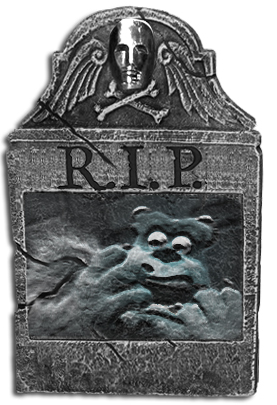
HERE LIES... the Best Animated Feature nomination for Monsters, Inc. (2001) sent to an early grave by a big green ogre. Hi, Deborah from Basket of Kisses here. The Great Oscar Animation War of 2001/2002 was fought between innocence and jadedness, between sincerity and irony, between modernism and post-modernism, or, to put it plainly, between Monsters, Inc. and Shrek. (To be fair, Jimmy Neutron: Boy Genius, was also in the race, but I don't know anyone who considered it a contender.) The winner, Shrek, announced a tragedy of 21st century humor, in which reference and winking has won out over wit and warmth. What? Do I sound bitter?
The film's Oscar-winning theme song would have you believe that the film is about friendship -- and Sully (John Goodman), Mike (Billy Crystal), and Boo—are lovely -- but at heart, Monsters, Inc. is about a childhood so unspoiled that there are still monsters in the bedroom closet. Fundamentally, Monsters, Inc. is about innocence. Children are becoming more cynical, Mr. Waternoose (James Coburn) tells us, and thus harder to make scream.
They're probably watching Shrek...
I'm mad at Shrek for substituting reference for wit, for making post-modernism palatable for the under-twelve set, and for spending most of its runtime winking at the audience. Monsters, Inc. certainly has its share of clever references—from the opening Stanley Donen-style credits, to Harryhausen's, to that Right Stuff entrance--but most of its humor is derived from exploring the cleverness of its central conceit: That there's a real Monster World behind the closet doors of children. The Pixar team explores and fleshes the brilliant concept out. Monsters, Inc. does real world-building that would do a lot of serious fantasy adventures proud.

The opening is masterful. First, we see a boy who imagines clothing on his chair is a monster. We all remember that experience, and we are instantly engrossed in his point of view. Then there's the comedic failure of a monster, who we learn is a trainee in a simulation. This provides quick access to our premise and some rapid-fire exposition that establishes the entire world and conflict (scream shortage, children are toxic) in record time. Finally, we learn that doors are magical in a very specific way, the last key to our appreciation of the world this film has built for us.
Like The Incredibles, this movie has an appreciation for the style and sensibility of early-to-mid 1960s films. You can see it in the opening credits, hear it in the soundtrack, and appreciate a tone that is modern but not post-modern, from back when modern was cool.
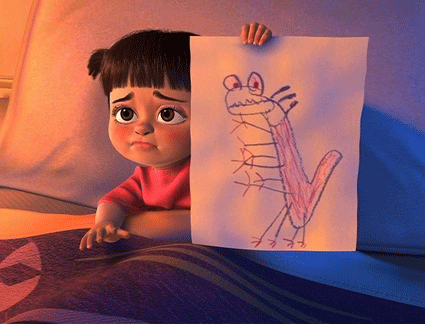 The characters are great and real lovely individual care is taken with each monster; Celia's snake-hair, Randall's chameleon changes, Abominable's fluffy fur. Each is unique and has internal consistency. Naturally, I love Boo, who is sweet, and playful, and very human indeed. Sully is voiced by and modeled on John Goodman, one of my favorite actors, so he's my favorite. And, yes, I do have little Sully and Boo mini-figures on my desk: Why do you ask?
The kind heart of this film carries through to the absolutely perfect closing shot. Too many movies want to finish those scenes; want to show you everything. I am reminded of the end of Shawshank Redemption, which cannot resist showing you a reunion that the original novella left hanging in the air. The moment before the reunion is so much more beautiful, and Monsters, Inc. has the courage to stay there, and let us see Sully's face, and have that be enough.
We scare because we care.