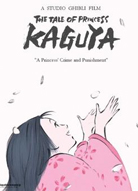
 Tim here. The Tale of Princess Kaguya , which could well compete for the animated Oscar this year, opens next week. But at that point I will be deep down in the pits of film festival madness (the Chicago International Film Festival starts today). So I want to talk about this now, lest I forget.
And that is the last thing I’d ever want to do, since Kaguya’s director, Isao Takahata, is (was?), along with Hayao Miyazaki, one of the twin gods of Studio Ghibli, though a director whose work was never as widely-known in the English-speaking world as his colleague’s. They're smaller in scale and less fantastic; one of his absolute best Ghibli-era works has never been released in the States, because the rights lie with Disney and one scene involves a discussion of menstruation, and we can’t have filthiness like that in our animation here, now can we!
He is, regardless of the difficulty in seeing his films, an unequivocal genius who deserves more attention for the wide range of styles he's explored in his films, and the graceful humanity of the stories he's told within those styles. Thus I have put together this little primer to celebrate the 78-year-old's newest film, and the career that led up to it.
[His three best films after the jump]
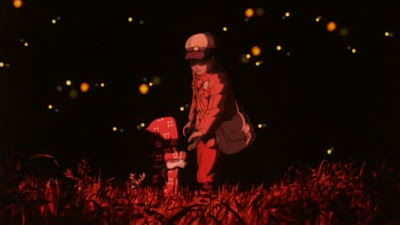
Grave of the Fireflies (1988)
The big one; the film that, more than any other, taught the West that Japanese animation (and animation generally) could address itself to any subject. In a strict, realistic style, with hard-edged colors and cluttered background, Takahata studied, in detail, the experience of two children in the aftermath of the firebombing of their home during World War II. It's one of the most anguished, unpleasant films ever made on any subject other than the Holocaust, and there's nothing I can do to describe what it's like to watch it that might make it sound otherwise ("When it was over, my legs almost gave out and I cried so hard I thought I'd vomit!" isn't much of a pullquote). But for proof that animation - that cinema, generally - can depict human beings with almost unbearable sympathy and emotional honesty, can speak lacerating truths without holding anything back, look no further.

Only Yesterday (1991)
That scandalous menstruation film. Which means that if you're living in North America as you read this, you're not in a position to see this film without a good deal of effort, and for that I'm sorry. But not nearly as sorry as I am that such a sophisticated look at memory and maturity has spent more than two decades in the doghouse because of corporate squeamishness. Depicting a very simple tale of a woman returning to her childhood community, and finding herself overcome with memories of her youth, Only Yesterday demonstrates vividly that even the most "normal" scenario can be splendidly translated into animation: while Taeko's present is depicted in rich, full colors and heavily realistic drawings, her childhood is a matter of soft, cartoon lines, muted colors, and backgrounds that fade off into white. The bleeding of one style into the other beautifully expresses the film's insightful, unsentimental character study in thoroughly visual terms.

My Neighbors the Yamadas (1999)
A comic strip adaptation that takes its source material very, very seriously: the characters are all drawn with playful, round strokes, moving line drawings that communicate their broad personalities in short, easy-to-read caricatures. Meanwhile, the spare and frequently unfinished backgrounds never try to imply the existence of a world beyond the edges of the frame, creating a whole film worth of images that express one emotion, one gag, one narrative beat, and move one to the next - just like comic strip panels. And with all of this self-imposed limitation and sitcom-style comedy, Takahata still manages to paint a lovely and memorable study of a family where annoyance and love mix and mingle comfortably.
Honorable Mentions
Pom-Poko (1994) - a lovely environmentalist fable with stellar character animation in new fewer than three different styles of kids' cartoon, prestige animation, and nature-sketch realism. But I just brought it up a little while ago, and I wanted to spread the love.
Panda! Go Panda! (1972) - Another title that's virtually impossible to find in the States, legally, and it's not nearly as worthy of the effort as Only Yesterday. On the other hand, it's title character is this adorable bastard:

So scratch that, it's totally worth hunting it down.