Glenn has been attending the 25th Stockholm Film Festival as a member of the FIPRESCI jury. Here he shares thoughts on three French films starring big names Catherine Deneuve, Jean Dujardin, and Gemma Arterton.
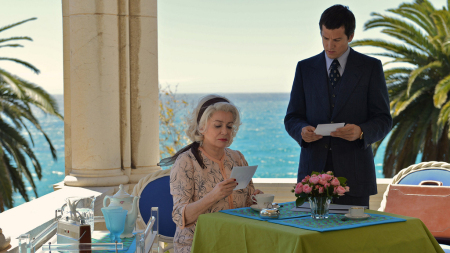
In the Name of My Daughter
As is common during a film festival, I had taken a seat in a cinema and completely forgotten what I was set to see. When the title card came up announcing ‘French Riviera’, I thought they were playing the wrong film as we had no such film on our schedule. Me in my festival state, stupidly didn't realise this was merely a location card. It wasn't until I checked the guide that I actually realised its name was In the Name of My Daughter. That title, far more verbose and clunky than is befitting André Téchiné’s movie, rather uncomfortably links the film to Jim Sheridan’s famous 1993 IRA drama despite not sharing anything in common. And, in further contemplation, actually comes off as rather offensive when comparing this trifle’s rich, white characters of privilege with those played by Daniel Day-Lewis and Pete Posthlethwaite.
Catherine Deneuve and Adéle Haenel star as Renée and Agnés Le Roux, mother and daughter. Renée manages the floor of a casino on the southern coast of France and Agnés has just divorced and returns to the French Riviera to open a book and ethnic trinket and knick-knack shop on her mother’s dime. With the assistance of her mother’s smooth operator assistant, Maurice, a ridiculously handsome and suited-up Guillaume Canet, she seeks to separate herself from the downward spiral of her mother’s business that could see her inheritance reduced to a pittance.
And therein lies the biggest problem with Téchiné’s film. Unlike before in films like Wild Reeds or The Witnesses (and perhaps the six other collaborations between Deneuve and Téchiné, none of which I have seen) his characters are horrifically hard to care about. Haenel and Deneuve, puffing on cigarettes at every turn, aren’t given enough material to make their characters identifiable as human beings worth empathizing over; their bourgeois, petty squabbles over money increasingly difficult to care about. A third-act turn into mystery territory at least gives audiences something to latch on to, that of a mother’s devotion to discovering the truth about her missing daughter, but it’s far too little too late and the lack of genuine development in their characters makes the stakes significently dim. A brief moment featuring the predominantly non-white employees of the mother’s casino being told they no longer have jobs threatens the prospect of Téchiné navigating something interesting in looking at the population for whom the French Riviera doesn’t mean easy-living, but it’s short-lived and cannot save this bland affair. C-

The Connection
The Connection is also set in the southern French region of Nice and also begins with a confusing title-card, named on screen as ‘Le Frenche’. If you had no idea about the story of Cédric Jimenez’s film then this peculiar translation is the first clue as to what it’s about as it quickly details the real life story known as the “French Connection”. While William Friedkin turned this true crime story into an Oscar-winning classic in 1971, this slick thriller starring Jean Dujardin looks at it from the French point-of-view. Despite the Friedkin film, it’s Martin Scorsese that is the obvious directorial influence on The Connection. At least during its early passages wherein details and exposition are given throughout pop-soundtrack montage and scenes of drug use and violence that recall the likes of Casino.
The mid-‘70s setting (the action takes place several years after the famous Gene Hackman-starrer) is wonderfully evoked through tightly-fitted and wide-collared button-down shirts, deliciously fuzzy sideburns, and other era-defining characteristics. Sadly, Jimenez hasn’t the skill of Friedkin and The Connection ultimately winds up becoming a much more conventional film. While it would be silly to recreate anything like the famous car chase sequence, there’s little in the French film to distinguish it from more superfluous genre flicks like another recent Dujardin crime caper, Möbius. There are several exciting sequences and it certainly looks great, but there are very few tricks up The Connection’s sleeve to make it stand out. C+
Gemma Bovery
On the opposite coast of France in Normandy is Gemma Bovary, a film that had me proclaiming after the screening “I hated almost every second of it.” Ouch. French director Anne Fontaine frequently has a problem with tone in her films, what with Nathalie… (remade as Chloe with Julianne Moore) and Adore proving far too serious takes of material that easily descended into camp. With this adaptation of Posy Simmonds’ 1999 graphic novel, it’s the opposite. Far too quick to go for quick gags, it's too inconsequential of a film to worth getting truly fussed about, yet it nonetheless left me wishing it would end at any given moment.

From the exhausting and exacerbating whimsical Frenchiness of this winking modern day take on Madame Bovery involving tired slapstick and cheesy humor, to the camera gaze that thinks star Gemma Arterton’s most valuable asset both physically and dramatically is her – as an erotic text may describe them – heaving bosom. Impressive with the meatier (in all definitions of the word) in Neil Jordan’s Byzantium, Arterton is back to her Tamara Drewe mode. That film was also adapted from a Posy Simmonds graphic novel, so something is awfully suspect about it. The British actress is not this French film’s biggest problem, but it’s a symbolic one. Gemma Bovery is a film of surfaces – and bad ones at that. Early on when Arterton’s titular character all but has an orgasm at the scent of freshly baked bread, we know this is going to be a film about the titillation of men and little more. That it was directed by a woman just makes it all the more confounding. D-
None of these films were France's selection for the Academy Awards, but the Deneuve film has been acquired by Cohen Media Group, Drafthouse purchased The Connection at Cannes, and Gemma Bovery has been picked up by Music Box.