In this new-ish series members of Team Experience share movies they've watched way too often and why...
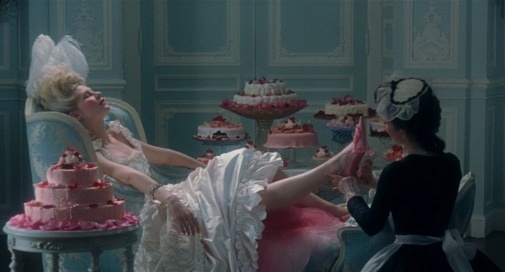
By Cláudio Alves
I don’t think I was a very ‘normal’ 12-year-old. Whatever that word might mean, I doubt it encompasses nerdy pre-teens obsessed with The French Revolution. Looking back, I’m not even sure why I was so enthralled. Maybe it was the tragedy of it all, how its horrors were as undeniable as the social changes they brought upon were necessary. Maybe it was the moral ambivalence, the complexity of its historical narrative. Maybe it was just the prettiness of the fashions.
One thing’s for sure, I was very excited by the prospect of watching Sofia Coppola’s Marie Antoinette...
 When I finally did watch it, I was nothing short of disappointed. Where was the History? Sure, the visuals were beautiful, the montages enticing and the actors good, but where was the Revolution? Why wasn’t it what I wanted it to be? At the time, I even grumbled about the musical choices and those dastardly anachronistic shoes. Despite that, even while wrapped in the petulant entitlement of a wannabe historian, I found myself unable to ignore it.
For the first time, I followed the movie awards season, always looking for any mention of the Coppola flick. My internet searches brought me here, to The Film Experience, and I have been a regular reader ever since. Truth be told, I doubt I would be the cinephile I am today if not for this film, this beautiful thing that enchanted me and frustrated me in equal measure. In college, I studied costume design in part because of the seed of passion Milena Canonero’s pastel confections had planted in my head.
Still, for many years, that was it. Sofia Coppola’s Marie Antoinette was a confusing irritation whose only point of undeniable value was its wardrobe. I couldn’t stop rewatching it or thinking about it, though. Moments of the film resonated through my days like the echoes of memories that aren’t mine. Its soundtrack always in my ear, scoring a life so very unlike that of the doomed queen.

When I walked home from my prom after-party, the dawn painting the sky and a couple of friends by my side, I remember thinking of Marie Antoinette. I thought of the scene where the queen celebrates her birthday and watches the sunrise while the rest of the world sleeps around her. I remembered its beauty and its feeling, its euphoria and the bitterness that tainted it. It was perfect, but it was fleeting. Soon, the happiness of that prom night would be over too, only living in hazy reveries to be edited by my mind.
Memory is the cinema of the self, where the fragments of a life are shaped into narrative, made to be revisited over and over again until death. I often find myself, during moments of particular happiness, mulling over how I will remember them. It’s bittersweet to live ten steps ahead, an actor in a film that will only be watched by me. Maybe I’m ridiculous or weird, not normal, peculiar, but that’s how I often feel and, to my surprise, no film has ever captured that as well as Marie Antoinette.
 “You’ll understand when you’re older” That’s what I’d say to my 12-year-old self. It’s a cliché and it would have infuriated me, but it would also be true. Marie Antoinette feels like memories, like the moments of happiness that are beautiful because they are fleeting and untethered. Moments tainted by their necessary finality. The guillotine doesn’t need to appear, because it’s always there.
Sure, Bow Wow Wow and Converse wouldn’t have featured in any 18th century shopping spree, but maybe it would have felt like that. There was more politics involved in the crossing of borders, but maybe a young princess would only remember the pain of leaving her dog behind and the touch of fingers unlacing her clothes. Such scenes don’t feel like History, they feel like a life lived and remembered.
My relationship with Marie Antoinette was slow to evolve, but evolve it did. I shed the preconceptions that made me dislike it and accepted the visceral attraction I always have felt for it. I learned why I loved it and why its beauty makes me melancholic and why that melancholy feels like a warm blanket. As I grow, the film grows with me and my love for it becomes stronger, more secure.
In a way, it’s one of the great love affairs of my young life, one that I have felt obligated to share with my other loves, my friends, my family, my boyfriend. So much so that I often feel that to see Marie Antoinette is to see me. It’s a bit ridiculous, I know, but as with clichés, being ridiculous doesn’t mean it isn’t true.

Previously in Over & Overs...
- Moonstruck (1987) by Deborah
- Indiana Jones and the Last Crusade (1989) by Lynn
- The Hudsucker Proxy (1994) by Mark
- Sugar & Spice (2001) by Spencer
- Julie & Julia (2009) by Ginny
- Moonrise Kingdom (2012) by Ginny