by Jason Adams
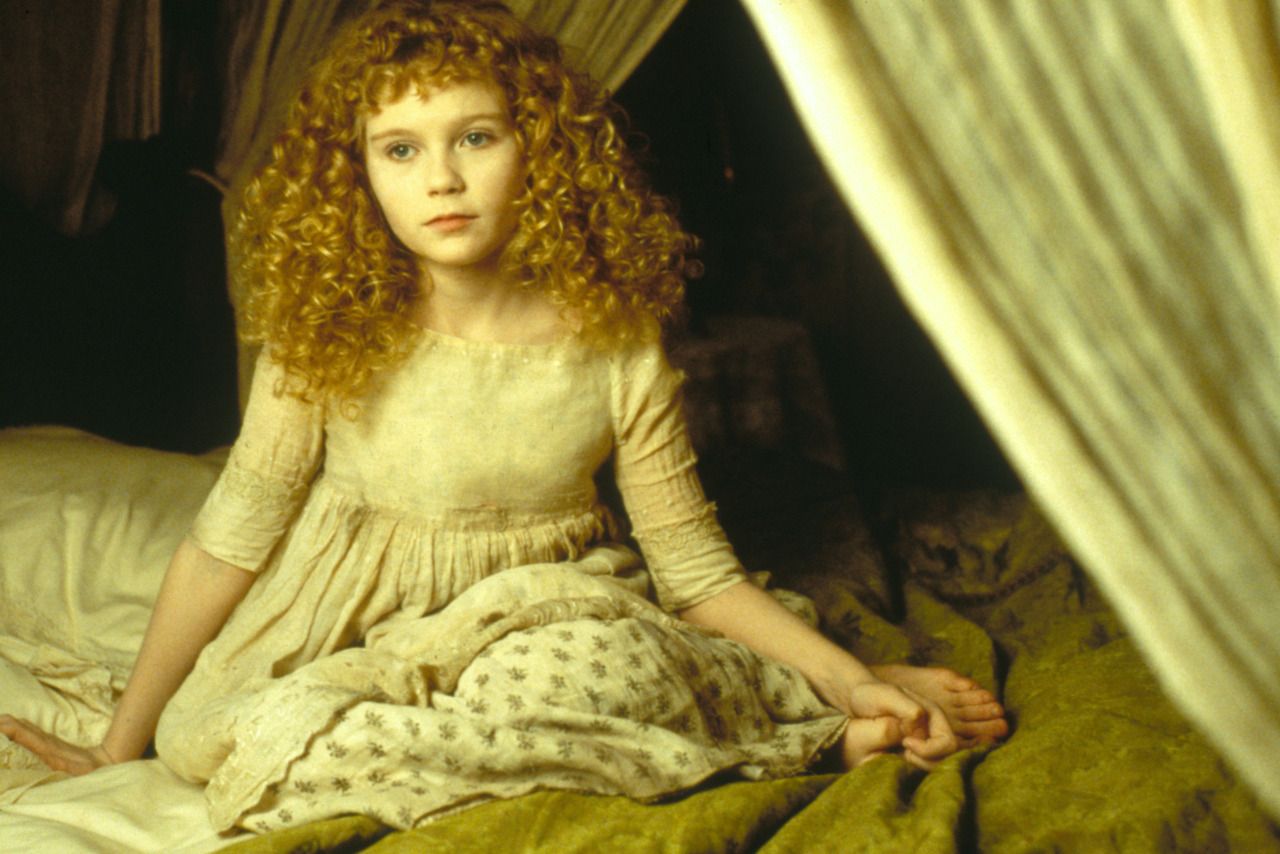
All of the best moments in Interview With the Vampire belong to the eleven-year-old. Re-watching the film now here on its 25th anniversary there's a lot to like (Tom Cruise allows himself to be camp in ways that he usually is but this time purposefully, and Neil Jordan floods everything with opulent blood-red atmosphere) and there's a lot to hate (it's a slog and Brad Pitt is awful) but there's really only one thing to love, and that thing is Kirsten Dunst every single second she's on-screen as the immortal vampire trapped in a little girl's perpetual curls.
The story goes that Dunst was the first girl that they auditioned for the role of "Claudia" but that she auditioned twice -- her agent supposedly told her she was terrible the first time through and forced her back into the room to do it all over again. "How avant-garde," indeed. Still that gambit worked, and one of our greatest actresses got her start by slashing up multiple nannies and kissing Brad Pitt on the mouth -- an experience Dunst maintains was "gross," speaking for exactly zero other people aged eleven to one hundred and eleven...

It's nigh impossible to cherry-pick a single favorite moment out of this preternaturally creepy and comedic performance, which balances the thirteen colliding tones that Jordan's aiming for with a deftness that makes you wonder if there really wasn't an immortal lurking behind those cherubic eyes. The hair-cutting scene is rightfully remembered, having finally given a voice to those of us who come back from the barber thinking we've done something spectacular that really just amounted to a number two on the clippers instead of a number three.
I think Dunst's finest moments in the film are two somewhat quieter scenes though -- there's the one where she lures Lestat into a deadly trap with a pair of laudanum-laced twins, and the scene later on where she begs Louis to give her a new companion, a mother to replace him as he entertains the thought of being Antonio Banderas' fuckboi (hey we've all been there). Both moments require her to foreward-face her innocence, first for deception and second for love and anguish, and to watch an eleven-year-old nail every complication and heart-breaking gray of these two poisonous monologues, making of sweetness an existential shriek, remains a real something.