Elisa Giudici reporting from Locarno
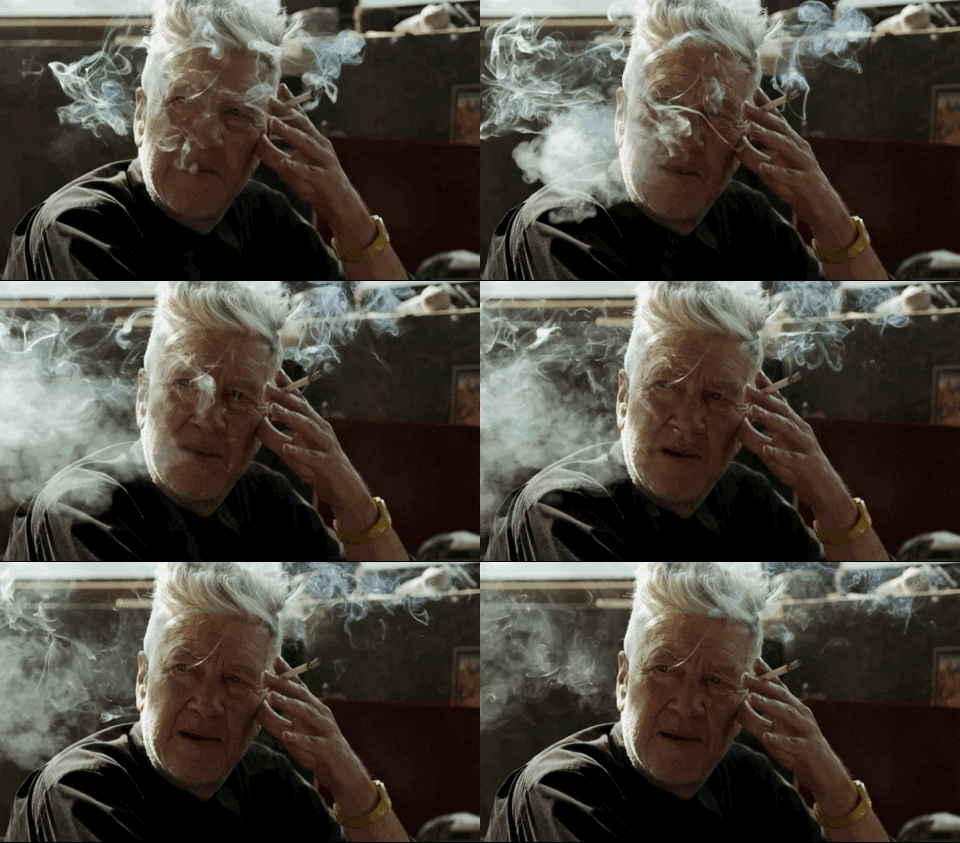
David Lynch has consolidated his status as one of cinema's greatest auteurs and geniuses to such an extent that it is easy to forget just how much fighting against compromise every step of his career required, even after winning the Palme d’Or for Wild at Heart or revolutionizing TV history with Twin Peaks.
At the Locarno Film Festival, his Icelandic producer and lifelong friend Sigurjón "Joni" Sighvatsson was presented with the Raimondo Rezzonico Award for his decades-long career as an outsider working within Hollywood. The Festival recognized how, as an outsider, he found ways around the major studio system's rules, helping lots of the soon-to-be great directors of the Eighties and Nineties gain some experience as music video makers...
Even if his life story is that of a young Icelandic kid cursed with always being surrounded by more talented people (the genius musician brother, the university colleagues soon to be writers, Terrence Malick as a cinema student), Lynch inevitably became one of the central figures in the conversation about his career.
Sighvatsson (who produced Wild at Heart and was involved in getting Twin Peaks made) was generous enough with the Swiss audience to share plenty of anecdotes and stories about his friend, painting a clear picture of the tired stubbornness of someone constantly trying to remain faithful to his vision without completely messing with his producer's budget. He ended up portraying him as just as stubbornly independent a filmmaker, whose career was repeatedly shaped by one very practical question: how do you find the money to let David Lynch be David Lynch?
Here are some of the best stories he shared about his late friend and collaborator.
They met because Lynch needed money
Originally, I met David because he was running out of money. He even decided to be friend with Giorgio Armani and taking some of his money, even though he really didn’t want to wear Armani clothes. Armani asked him to do a television commercial, and he had no idea how to do a television commercial. David had heard about Propaganda, the studio I had co-founded in 1986, so he called us and said, “Can you help me make this commercial?” That’s how our relationship with David Lynch started.
We did the spot for Armani’s first perfume. It was supposed to be 30 seconds, but David said “I don’t do anything in 30 seconds.” So it ended up being three minutes long. Armani called to complain, and David said to him “I’m giving you something very special. You paid for 30 seconds, I gave you three minutes.” Giorgio was a great man, a gentleman. He said: “I realize it’s fantastic, and I’m going to screen it exactly the way you delivered it to me.”
So maybe that’s what fostered the relationship between me and him, while Armani didn’t want to be caught in David Lynch’s world.
Dune taught him never to surrender creative control again
David told me very often about Dune. He often said that that one was the most traumatic experience of his entire professional life.
After they had shot for two or three days, they screened the dailies, and he was very content with them. But Dino De Laurentiis was not so happy. David told me: “I could see his face and his jaw dropping further and further down as we went on with the dailies. I realized then, after two days, that I had two months left to shoot. Every day I’m going on the set because I’m going to finish the assignment that I’ve been given. And I know I’m making a film that the producers don’t want. So every day I have to go on the set knowing I’m making a film that nobody associated with it wants, except me.”
“That taught me that I will never work for a studio again, or never work again unless I have creative control. It was a very painful and long lesson, but I learned I have to do things my way. I’d rather be a courier for The Wall Street Journal and get money that way so I can make my next film, because I’m not going to be under the control of anyone else. That’s the American system, and I don’t want it. I want to be my own person.”
Creative control didn't mean Wild at Heart was easy
Monty Montgomery and me bought the book ourselves. We loved the book, so we said, “Let’s just buy the book’s rights” Monty was going to write the screenplay, while David was trying to do another film that he never made. A few months went by and nothing was happening. So I said to Monty, “Why is nothing happening with the book? Every draft of the script you make gets worse. Why don’t we send the book to David Lynch?”
We sent the book to David on a Friday, and he called me on Monday and said: “I love it. I started writing the script.” I said to him: “Just write it, and we’ll make it.”
Even if Sighvatsson was willing to give Lynch creative freedom when they made Wild at Heart, however that approach did not magically erase the harsh reality of financing and distribution.
“The first cut of Wild at Heart was four and a half hours long. It took a long time to get it down to the right running time: we had to do it, because we had a contractual obligation to deliver a film that was around two hours long. But you can’t just do that overnight. There are three movies: the movie you write, the movie you shoot and the movie you edit. And they’re rarely exactly the same.”
Twin Peaks needed money television couldn't provide
David had met Mark Frost, who was mainly known as a television writer, and they wrote this pilot called Twin Peaks. Due to the nature of the story itself, when they saw it at ABC they were confused by it.
There was also the one condition David posed: to shoot it with his film crew. It was the first time this happened in television, because back then there were television people and then there were film people. When I was going to film school, we never even thought about going into television, we didn’t even talk to them. It was a different part of the business: cinema and TV were so clearly divided.
David wanted to do the series, but not meeting TV standards: ‘I’m not going to do it like they do television. I’m not shooting it in six days. I’m shooting it like a movie. I’ll do it with my film actors and with my film crew. That’s the only way I’ll do it.’
ABC basically said to us: ‘If you find the extra money, you can do whatever you want.’ But then we needed to find the extra money.”
VHS helped pay for Twin Peaks
In those years in Iceland, we only had one television station, broadcasting only six days a week. There was just an off day. Dallas was very popular back then, but they couldn’t show Dynasty either due to some contracts.
So I said to my brother, who was running a supermarket back then, “Why don’t we just bring Dynasty to Iceland? Everybody wants to see it, but nobody can see it on television. They can come to the supermarket, rent it on Wednesday, on the day when there is no broadcasting because there’s nothing to see, watch it at home on the video player, and then come back the next Wednesday, return it and get the new episode.”
I was already familiar with how popular videotape was, but it was still the early days, so there was plenty of room for experimenting with new marketing models.
Later I said to the Spelling people, “We have this great thing with this famous director who made The Elephant Man. ABC wants to do it, but they don’t want to give us enough money. Will you maybe give us the money?”
They said they couldn’t sell it through television stations. So I asked, “What about selling it on video?”
They said, “Okay, we’ll do that.”
So they gave us the other million and a half we needed. It was the most expensive pilot ABC had done because David wanted film standards for it.