Oscar History
Film Bitch History
Welcome

The Film Experience™ was created by Nathaniel R. All material herein is written by our team. (This site is not for profit but for an expression of love for cinema & adjacent artforms.)

Follow TFE on Substackd

Powered by Squarespace
DON'T MISS THIS

Oscar Volleys - one week until the big night!  


COMMENTS


What'cha Looking For?
Subscribe

Entries in editing (126)

Saturday
Jul022011

Tech Noir "The Terminator" 

This article was originally published in summer 2009. [Thanks to Leave Me The White for some of the screencaps] I'm reposting with minor edits in celebration of the 20th anniversary of its sequel Terminator 2: Judgment Day on this 4th of July Weekend.  Plus, what's more American than spectacles of Hollywood violence that launced billion dollar franchises?
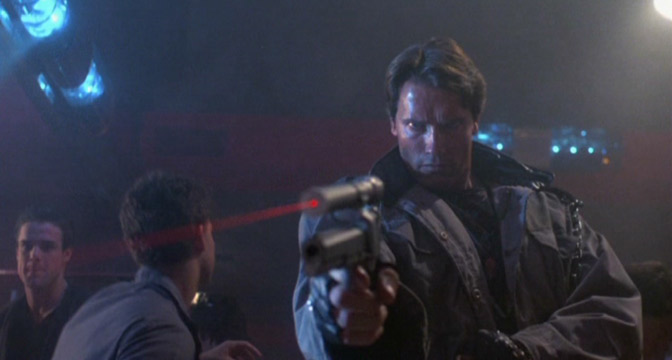
Arnold Schwarzenegger as "The Terminator"

"Tech Noir"
In March of 1984 when The Terminator began filming, the director James Cameron and the producer Gale Ann Hurd were no Hollywood heavyweights. Cameron was no one's idea of a visionary (except for perhaps his own) and had only one feature under his belt, Piranha 2: The Spawning -- auspicious beginnings! Hurd had learned the production ropes on B movies for Roger Corman. Cameron and Hurd intended for the dark, fast and cheaply made robot movie to be their calling card. Seven months later in October the movie premiered with only its deceptively simple premise (killer machine hunts woman) and Conan the Barbarian (Arnold Schwarzenegger) to sell it. The Terminator was an immediate hit, though not quite a blockbuster. It earned a Conan-like $38 million gross in its initial run (which I believe is something roughly in the ballpark of $100 million in today's ticket sales).

As a franchise it was a slow starter but as a stand alone movie The Terminator was anything but. The movie begins with a bone crushing (literally) view of "The Year of Darkness", in which massive machines hunt humans in desolate post-apocalyptic ruins. Very quickly we're thrown back to present day Los Angeles ...present day in in the 80s at least.

An electric storm begins and a naked crouching man rises from the clearing smoke. He proceeds to walk emotionless through LA and slaughters some punks for clothes. A second electrical storm follows dropping another naked man into downtown LA. The twin sequences are mostly wordless but already Cameron's story instincts are shining: The first man (we don't technically know he's a machine) is already embedded in the audiences mind as an cool collected deadly force to be reckoned with, the second Kyle Reese (Michael Biehn) is, in contrast, a scurrying, less capable and frankly desperate looking man.
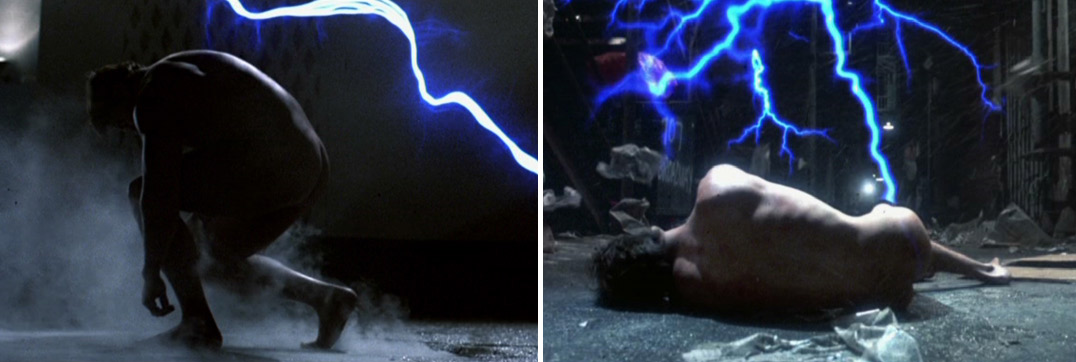
Contrasting Entrances

In short, he's mortal.

Click to read more ...

Wednesday
Jun222011

One Take Wonders

Though I don't recall when it began -- maybe with Rope as just discussed? --  I've been obsessed with one-take scenes for what seems like forever. You know the kind. It's that thrilling moment when the editor seems to go out for a smoke break and the director allows the film and/or performances to fully breathe. That free breathing is probably an illusion since the scenes must be rigidly corseted by the technical and performative choreography required to get it all without "coverage".


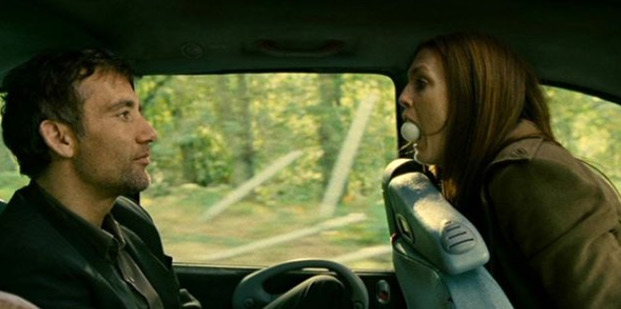
When you see a great one take scene or film, even if that "one" take is partly a matter of film trickery (examples: Atonement, Children of Men basically the entirety of Alfred Hitchcock's Rope and Aleksandr Sukorov's Russian Ark and a scene we just discussed from 25 years ago in Peggy Sue Got Married) it can be hard to return to the world of "regular" filmmaking with its generic one and a ½ second cuts composed of plentiful coverage. Over the shoulder. Close up. Over the shoulder. Repeat for billions of converszzzzzzzzzz  

I'm sorry I fell asleep.

So why do so few film directors trust in the highwire potency of long or single takes? Are they too difficult to pull off? Are film actors that unable to sustain themselves throughout emotional hairpin turns the way stage actors can 8 shows a week for hours at a time? Do people think the audience will get bored (a falsity since these scenes are usually THE talking points of their movies)?

If they're so hard to pull off why do music videos with significantly lower budgets than movies keep selling them so well?

The latest one I saw was the low budget but high entertainment "Party Girl" by XELLE 

Absolutely hot. Think of the rehearsal time required just to time things like that glitter blow? But it works, don't you think?

And I've already expressed my love for both Robyn's "Call Your Girlfriend" - just her dancing in a gym but with all the lighting tricks it's just totally a great watch --  and Cosmo's Jarvis "Gay Pirate" which is both sing-a-long fun and actually moving.

Although it's NOT a one take video, this REM "üBerlin" video starring rising actor Aaron Johnson (directed by his partner Sam Taylor-Wood) breathes enough to suggest that it wanted to be one and would have been a classic video instead of just a frisky uninhibited one, if it were. 

So I ask in full sincerity...

  Why are today's directors so afraid of letting a moment play out without zillions of edits? If music videos -- which were once blamed for shortening the average shot length in movies -- can ironically use them so often now, why can't today's full length pictures? 


Thursday
Jun022011

Unsung Heroes: The Editing of 'Glengarry Glen Ross'

Michael C. from Serious Film here this week with an appreciation of the craftsman that took what could have been an incredibly un-cinematic project and turned it into one hundred of the most riveting minutes of the nineties.

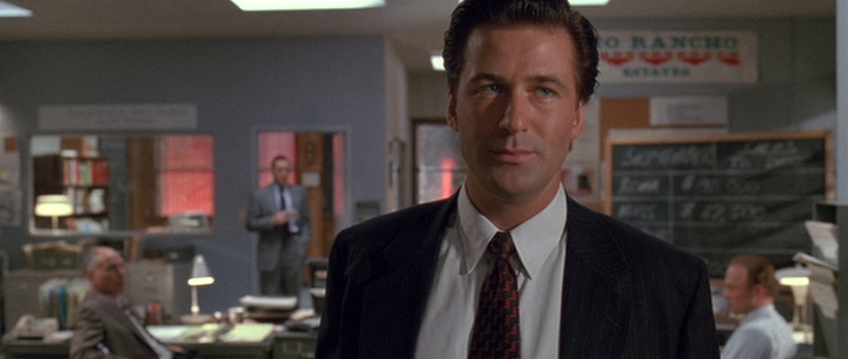
Alec Baldwin in Glengarry Glen Ross (1992)

Whenever a prominent stage play makes the trip to the big screen it is, without fail, greeted by throngs of film writers questioning how well the material has been “opened up” for the big screen. This always gets under my skin.  Never mind that many, if not the majority, of the most beloved stage adaptations were not “opened up” at all.  No, what gets me is the implied idea that there is something inherently uncinematic about dialogue. As if audiences say things like, “I guess it’s okay when Sidney Poitier tells Rod Steiger they call him Mr. Tibbs, I just wish they were doing something cinematic at the time, like dangling from a helicopter.”

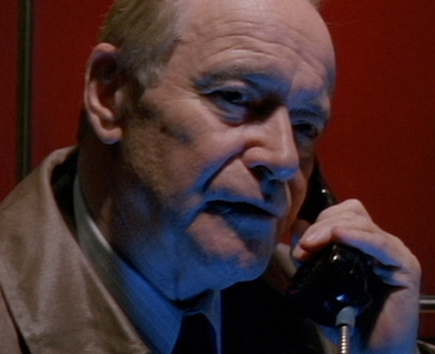
a desperate phone call with Jack LemmonThe truth, of course, is that any film that makes you identify with the events on screen is cinematic. It can take place entirely in a restaurant, a jury room, or the mind of one paralyzed man; if it makes you forget the darkened theater with the sticky floor it’s doing its job.

Director James Foley along with editor Howard E Smith knew this when he made the film of David Mamet’s Pulitzer Prize winning Glengarry Glen Ross (1992).  To paraphrase what he says in the DVD commentary, Ed Harris smoking a cigarette is as much a movie moment as Lawrence of Arabia coming over a hill leading a thousand men.  In the lesser Mamet films, the stylized writing can feel stilted and airless, but not this time. Throughout Glengarry we feel as if we are privy to the interior monologues of the characters.   

I could fill ten columns highlighting perfectly constructed moments but I’ll limit myself to three favorites:

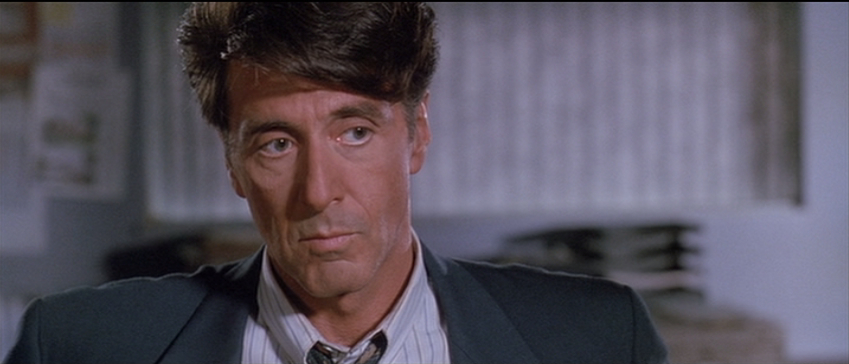
Al Pacino's nomination was the only Oscar attention for the film

  • Any discussion of Glengarry has to begin with Alec Baldwin’s legendary scene. It's an audacious move to begin the movie with one actor delivering an uninterrupted eight-minute monologue, but Foley and Smith get away with it largely by breaking the whole sequence down into a series of short scenes – Baldwin belittles Lemmon, Harris confronts Baldwin, Baldwin denies them the leads – that add up to one riveting whole. 
  • There is a perfectly held moment just after Spacey has opened his big mouth and blown Pacino’s big sale and just before Pacino lets loose with one of the most memorable torrents of profanity in film history. It just holds on Pacino’s face as he absorbs what has just transpired, giving the audience an all time great “Uh-oh…” moment watching the fury gather behind his eyes.
  • I love the way the filmmakers relax the film’s tension just long enough to let Lemmon’s Shelly “The Machine” Levine recount what he believes to be his great triumph to Pacino. It’s a small oasis of peace and contentment before the character’s final slide down to destruction. 

Throughout the film there is never a cut for it’s own sake, never a moment where Foley and Smith showoff just to prove that it’s a movie they’re making. Instead they rely on the basic language of cinema to give the bouts of verbal violence an impact that makes most movie violence feel like playing patty-cake.


Sunday
Feb202011

Editing. This Word. It Doesn't Mean What You Think It Means.

Though I've read a truly great book on the topic "The Conversations",  know a few editors, and have experimented with this completely fascinating craft in college, this morning when I woke up, I learned that I must have literally no idea what it means. The American Cinema Editor's Guild pulled the rug out by naming Tim Burton's Eyesore in Wonderland the best edited of all comedies in 2010. I realize that my hatred for the movie is self-feeding, ever-growing and thus deeply irrational but still... I watched it in full and all I saw was interminable rhythmless agonizing ugly incoherence.

The ACE Awards

Best Editing, Drama The Social Network's (INTERVIEW)
Best Editing, Comedy or Musical Alice in Wonderland
Best Editing, Animated Toy Story 3
Best Editing, Documentary Exit Through The Gift Shop ("UNSUNG HEROES")
Best Editing, TV Half Hour Modern Family "Family Portrait"
Best Editing, TV Hour The Walking Dead "Days Gone Bye"
Best Editing, TV (Non Commercial) Treme "Do You Know What It Means?"
Best Editing, TV Miniseries Temple Grandin
Best Editing, Reality If You Really Knew Me "Colusa High"

Perhaps the editors know something we don't? Perhaps Burton's footage from Alice was even more ghastly than what we saw in the final cut and Chris Lebenzon is being rewarded for true sorcery or merely for surviving it? Lebenzon has done fine work in the past -- even on other Burton films! -- so we don't begrudge him his kudos but this year??? When you stop to consider the other nominated efforts (The Kids Are All Right, Easy A, Made in Dagenham, Scott Pilgrim vs. the World) and how well those movies flowed and/or maximized their laughs with exceptional comic timing and/or carved out a magical performance or two, it's enough to make you straight up weep and reach for the booze.

The decision is even stranger when you look at the other winners and find that they are all relatively easy to comprehend as noteworthy work. (For instance, I'm not the world's biggest fan of The Walking Dead but that pilot episode was a master class in cumulative thrills, scary but not cheap-scary cutting, and overall pace.)  The same people voted for those achievements. Temporary insanity?

IN OTHER NEWS: Final Oscar Predictions in Craft Categories


Wednesday
Feb162011

The Interviews, Goddesses and Craftsmen Alike

A big "thank you" to readers who commented on the recent spate of interviews here at The Film Experience. We don't do too many of them but you've been quite complimentary about the ones you do get. If time allows and other variables improve this year we'll do more for 2011. But in case you missed any of the interviews covering the 2010 film year, here's the rundown:

AND THE OSCAR NOMINATION GOES TO...

Jenny Beavan, Costume Designer, (The King's Speech)
Roger Deakins
, Cinematographer (True Grit)
Angus Wall and Kirk Baxter, Editors (The Social Network)
Eve Stewart, Production Designer (The King's Speech)
Jacki Weaver, Actress (Animal Kingdom)

...FROM THE OLD BLOG: Four of Nathaniel's 100 favorite actresses in one calendar year? Too rich! And a couple of talented men for good measure.

Kirsten Dunst, Actress (All Good Things)
Alexander Desplat, Composer (The Ghost Writer, Harry Potter and the Deathly Hallows)
Javier Fuentes-Leon, Director (Contracorriente aka Undertow)
Juliette Lewis, Actress (Conviction)
Patricia Clarkson, Actress (Cairo Time)
Julianne Moore, Actress (The Kids Are All Right)

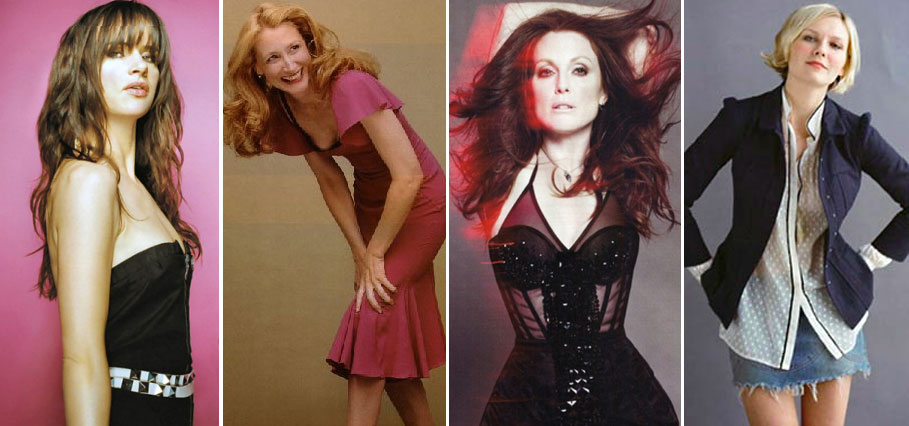
Beloveds: Juliette, Patty, God and Kiki


Who should we pursue relentlessly in 2011 until they're on the phone or grabbing a cup of joe?

Which Old Hollywood legend would you like to hear from?