Oscar History
Film Bitch History
Welcome

The Film Experience™ was created by Nathaniel R. All material herein is written by our team. (This site is not for profit but for an expression of love for cinema & adjacent artforms.)

Follow TFE on Substackd

Powered by Squarespace
What'cha Looking For?
Subscribe

Entries in Old Hollywood (180)

Thursday
Aug062015

Ingrid Bergman Centennial: The Film That Brought Her to Hollywood

August 29th marks the Centennial of Ingrid Bergman (1915-1982), one of the greatest of all movie stars with a career that stretched from the early 30s through the late 70s, encompassing multiple classics, multiple countries, and multiple Oscars. We'll be proceeding mostly in chronological order. Here's Abstew to kick things off with "Intermezzo" - Editor
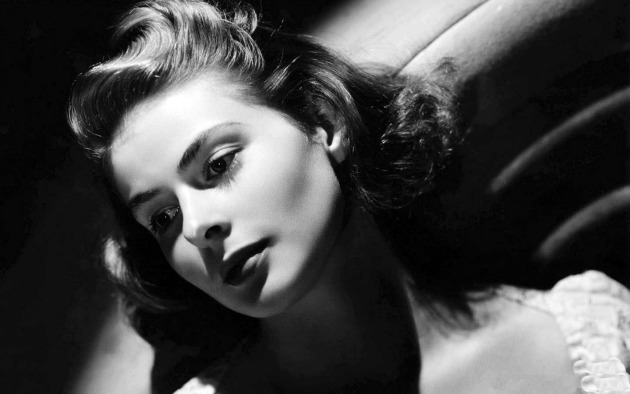
Had it not been for a Swedish elevator operator working in the building that housed the New York offices of Selznick International Pictures, the world might never have discovered the young actress that would become the Hollywood legend Ingrid Bergman. It was 1936, and the soon-to-be star had just appeared in a Swedish film named Intermezzo about a famous concert violinist (played by Sweden's first stage star Gösta Ekman) that leaves his wife and family and has an affair with his much younger accompanist. There was clearly something special about the actress playing the love interest. The elevator operator wasn't the only one to see it, but he happened to have the ear of Hollywood producer David O. Selznick's talent scout Kay Brown (since she rode in his elevator everyday), telling her to seek out the film and to pay special attention to the girl in the picture. And in the early part of 1939, Brown flew to Stockholm and persuaded the young actress from Intermezzo to come to America and star in the Hollywood remake. Thus launched the international career of Ingrid Bergman and, as they say in the pictures, a star was born.

But her path to stardom in Hollywood wasn't without its hurdles...

Click to read more ...

Monday
Jul272015

200 Oldest Living Screen Stars of Note 

The list is updated and now located here. 

Saturday
Jun202015

Sorry, Wrong Number (1948)

Please welcome Kyle Stevens to The Film Experience team. You've previously heard him on the podcast, you can pre-order his book on Mike Nichols, and you should follow him on twitter as he is delightful. - Editor

Adapted from the hit radio play by Lucille Fletcher (who also wrote the screenplay), Sorry, Wrong Number follows Leona Stevenson, a headstrong young heiress who aims to one day be the sharpest battleaxe in the armory. She is also an invalid, relegated to her bed. We discover Leona telephoning inquiries into her husband’s whereabouts when the line fatefully clicks. She overhears a conversation between two men plotting a murder that night. For me, the whole movie hangs on the image of her listening to this narrative catalyst. It hovers over the entire film. Its power lets us never forget that this is Leona’s story, even when we get elaborate flashbacks from others. We recall it later when we see Leona disheveled and shining from tears and anxious sweat. Its tightness contrasts with the way the camera later wanders in and around people, tracing the distances between them that the telephone extinguishes. 

The magic here is all down to Barbara Stanwyck, giving one her best performances (and receiving the last of her four Best Actress nominations). We see Leona’s selfishness ebb as she intelligently listens to the heavies on the line. That is, Stanwyck doesn’t play an inner monologue. Her bright brown eyes and horseshoe furrows do not propose “Oh no!” and “What should I do now?”, as though telling us what Leona wants to say. Rather, Leona, in this moment, and for a change, is not about herself at all. She just listens. This remains a thing of beauty, reminding us how much intelligence just listening can demand. I don’t know of a better demonstration of the cliché that listening is one of those feats accomplished by only the best actors.

Written by a woman and showcasing a female character who fights for what she wants, Sorry, Wrong Number would probably be received as a feminist statement were it released today. But in the moment in which Leona hears unheard, I am reminded that it is not just the film’s gender politics that remain relevant. Over the complex lines of a switchboard (where, according to Hollywood, women controlled the flow of information), the epigraph warns:

In the tangled networks of a great city, the telephone is the unseen link between a million lives… It is the servant of our common needs—the confidante of our inmost secrets…life and happiness wait upon its ring… and horror…and loneliness… and death.”

The technology behind our phones may have changed, but in an age where we’d rather text than talk, we seem to still fear verbal connections. We worry about who’s listening, and we know, deep down, that the voice can give too much away.

Previously
Vintage 1948 - Best of the Year 
Supporting Actress Smackdown - The Schedule 

Wednesday
Jun102015

Snack Break 

My brain is not working today. I looked at this photo of Jimmy Stewart and Norma Shearer on tumblr and assumed Jimmy was checking his phone and Norma was trying to sneak a peek at what bitchy thing Lucille Fay LeSueur had just texted him from the set of Ice Follies of 1939 and th--- oh, uh, 1939. Right. D'Oh!

Time to step away from the computer perhaps? Snack break. See you late late tonight for the AMADEUS (1984) roundup and two barking mad composers.

Sunday
May102015

Mother's Day Special: "Now, Voyager" and Bette Davis

Happy Mother's Day, readers! Here's new contributor Angelica Jade Bastién returning to talk Bette Davis, tell all bios, and a 1940s classic. - Editor

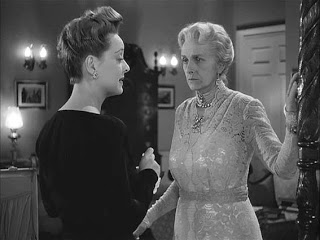
When I introduce friends to Bette Davis for the first time I tend to show them Now, Voyager. Yes, the film gives us one of Davis' best performances but my love for it is deeply personal. Whenever I watch Now, Voyager I see my emotional landscape on the screen. As a teenager struggling with mental illness and a caring yet controlling mother who didn’t quite know how to handle it the film was a revelation. It gave me hope that I could become the woman I always dreamed of. Ultimately, my obsession with the film centers upon the multiple ways it explores motherhood. 

Now, Voyager is essentially about the transformation of Charlotte Vale (Bette Davis) from spinster aunt figure to badass, emotionally realized womanhood. The film begins with Charlotte teetering at the edge of a nervous breakdown brought upon by the multitude of ways her mother, Mrs. Vale, controls her...

Click to read more ...