Oscar History
Film Bitch History
Welcome

The Film Experience™ was created by Nathaniel R. All material herein is written by our team. (This site is not for profit but for an expression of love for cinema & adjacent artforms.)

Follow TFE on Substackd

Powered by Squarespace
DON'T MISS THIS
COMMENTS
What'cha Looking For?
Subscribe

Entries in musicals (708)

Wednesday
May042016

Judy by the Numbers: "Caro Nome/When I Look At You"

Anne Marie is tracking Judy Garland's career through musical numbers...
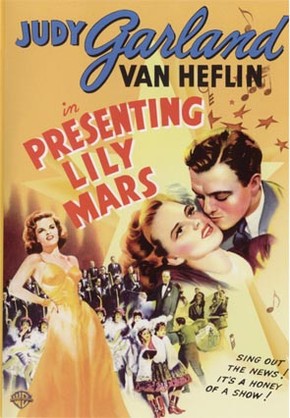
With Judy Garland now such an established hit, MGM worked overtime to make the most of its musical star. This meant that while Arthur Freed and the Freed Unit "made" her by crafting her star image (and arguably used her to her best advantage), Judy couldn't work with them exclusively. She was too valuable a commodity for that. So, MGM also put her under the watchful tutelage of another producer well-known for his musical mojo: Joe Pasternak. 

The Movie: Presenting Lily Mars (1942)
The Songwriters: Walter Jurmann (music) and Paul Francis Webster (lyrics)
The Players: Judy Garland, Van Heflin, Fay Bainter, Spring Byington, directed by Norman Taurog

The Story: Had Judy's fateful short with Deanna Durbin turned out differently only six years previous, she might have met Joe Pasternak earlier. For most of the 1930s, Pasternak was a top producer at Universal Studios, with major Marlene Dietrich titles such as Destry Rides Again to his credit. However, where Pasternak really made his name was in his big "get" for Universal; he was the man responsible for bringing Durbin to the studio after MGM rejected her. Under his production and guidance, Deanna Durbin became one of the biggest singing stars of the 1930s.

However, the fact remained that Universal was small potatoes next to MGM, so when Pasternak became a major musical producer it was only logical that MGM should hire him. Presenting Lily Mars was his second film for the studio. It was originally bought as a dramatic script for Lana Turner, but Pasternak convinced the studio to recycle some songs and turn it into a Judy Garland musical. Unsurprisingly, it was another hit, grossing over $3.5 million at the box office. What is surprising is that Pasternak and Garland only worked together one more time. After the near-miss six years before, it would take another six years for Judy to work with the high-spirited Hungarian again. And much would change for Judy in that six year period.
Monday
May022016

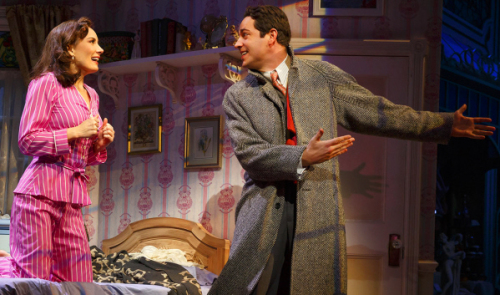
Stage Door: She Loves Me (and Tony Preview)

Overheard whilst exiting Broadway's She Loves Me this weekend:

[surprised] That was just like 'You've Got Mail'!

Bingo, tourist ladies, bingo. She Loves Me, the 1963 musical, currently in the middle of its second Broadway revival, is adapted from the 1937 Hungarian play Parfumerie by Miklós László. It's inspired so many riffs so often you'd think it was a Shakespeare comedy. The play has already resulted in three well-known movies in the form of the touching Jimmy Stewart clasic (The Shop Around the Corner, 1940), an undervalued Judy Garland romance (In the Good Old Summertime, 1949), and the Meg Ryan/Tom Hanks rom-com You've Got Mail (1998). The shop changes as does the mode by which the anonymous lovers correspond without realizing they know and hate each other in real life. Expect an internet catfishing riff on the story in 3...2...1... Anyway, in 1963 the play was adapted into She Loves Me for the musical stage...

Click to read more ...

Wednesday
Apr272016

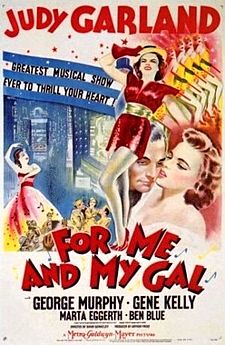
Judy by the Numbers: "For Me And My Gal"

Anne Marie is tracking Judy Garland's career through musical numbers...

 In 1942, Judy Garland met a man who would come to be one of her biggest onscreen costars and supporters at MGM. When he was cast in For Me and My Gal opposite Garland, Gene Kelly was as upstart Broadway star, hot off Pal Joey and trying to make the transition to Hollywood stardom. According to Kelly, Judy Garland eased that transition; she was gracious, she was giving, and she was a consummate professional. Gene Kelly, stage dancer, learned how to perform for the camera by watching Judy Garland.

The Movie: For Me And My Gal (1942)
The Songwriters: Edgar Leslie & E. Ray Goetz (lyrics) and George W. Meyer (music)
The Players: Judy Garland, Gene Kelly, George Murphy directed by Busby Berkeley

The Story: The title number of For Me And My Gal shows off the unique partnership Garland and Kelly shared. The two costars sing at the piano, a staging familiar to Garland fans who'd watched her share a similar scene with Mickey Rooney many times in the past. But Kelly is no Rooney. Where Mickey would mug, Gene floats. Where Mickey would riff, Gene croons. This isn't to say that Kelly can't be funny, but his relationship to Garland is different. Mickey and Judy were a couple of firecracker kids; he gave her zing and she gave him class. Judy and Gene are two contrasting talents; his dancing complements her songs. Each provides where the other is weak, creating a harmonious musical union. It's no wonder than Judy and Gene would go on to share another three movies together.

Wednesday
Apr202016

Judy by the Numbers: "Chin Up! Cheerio! Carry On!"

Anne Marie is tracking Judy Garland's career through musical numbers...

1941 was a year of beginnings and endings for Judy Garland. It was the year of Judy's last Andy Hardy film (Life Begins for Andy Hardy, wherein nobody sang). And she wasn't just growing up on film - 1941 was also the year of Judy's first marriage: to David Rose, the musical director of the Tony Martin Radio Show. At only 19, Judy Garland was transitioning from child sensation to full fledged star.


The Movie: Babes on Broadway (1941)
The Songwriters: E.Y. Harburg (lyrics) and Burton Lane (music)
The Players: Judy Garland, Mickey Rooney, Virginia Weidler, Fay Bainter, Margaret O'Sullivan, directed by Busby Berkeley.


The Story: As the country entered World War II, the Freed Unit was lining up a series of nostalgia-inflected new hits starring Judy Garland for MGM. While Babes on Broadway looks at first glance like the typical "let's put on a show" backyard musical of 30's Mickey and Judy, some palpable differences manifest. First, there's the emphasis on Americana and patriotism, from Judy urging young British youths on in "Chin Up Cheerio!" to the (racist blackface) closing number, "Robert E Lee." This was the influence of World War II. Though Pearl Harbor happened mere days before Babes on Broadway was released, national sentiment was already turning towards the patriotic messages that would define wartime Hollywood. However, the movie's bigger hit was a more conventional Judy Garland number "How About You?"

In many ways, Babes on Broadway looks and sounds like the old Judy and Mickey - the two doe-eyed lovebirds sing to each other at a piano or on a stage while Mickey pulls faces. However, there are two marked differences: First, Mickey is no longer the focus of the movie - the two actors share camera equally. Second, Garland has graduated from the giant lace sleeves and tulle-lined skirts of "in-between" childish Judy, instead dressed fashionably in the latest style. Ziegfeld Girl and Little Nellie Kelly had proven Judy's talent was mature. Now it was time for her star image to reflect that transition, too.

Sunday
Apr172016

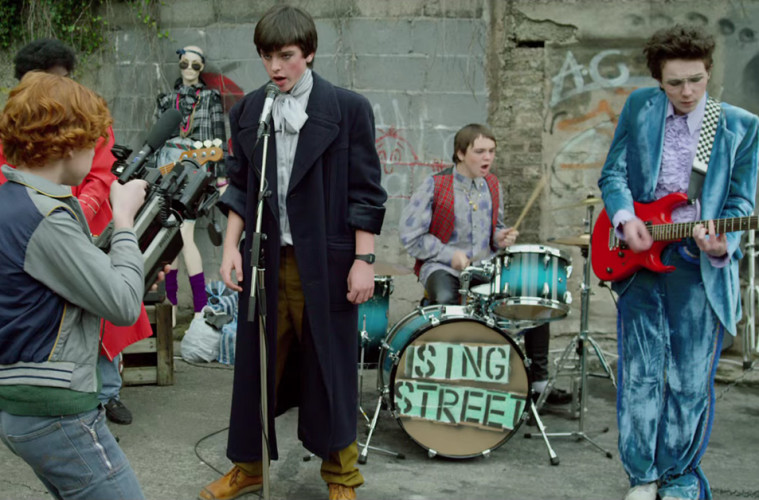
Review: Sing Street

Like Begin Again, his last love song to the restorative powers of music and collaboration, John Carney can play your heartstrings like an orchestra. And like that film’s original title – Can A Song Save Your Life? – Sing Street addresses songwriting as soul food, with a face full of neon eyeliner and a deliciously poignant streak of youth in revolt. And as a young kid trying to forge a path in 1980s Dublin, there’s plenty to rebel against – institutional alcoholism and abuse, isolation from the mainland and mainstream, and the collapse of your elders’ hopes playing out in an endless depressive cycle. The future looks as bleak as the dark and stormy skies portending above the Irish shore, but it just so happens that these are the conditions where inspiration can strike like a lightning bolt. If you don’t like the only song playing on the radio, you’d better chuck it in the bin and dream up a new one.

As the story so often goes, Conor (newcomer Ferdia Walsh-Peelo, the love child of Bud Cort and Harry Styles) starts a band with a ragtag uniform of Catholic schoolboys to impress a girl. He may not know it at first, but that’s not the only reason. More after the jump...

Click to read more ...