Oscar History
Film Bitch History
Welcome

The Film Experience™ was created by Nathaniel R. All material herein is written by our team. (This site is not for profit but for an expression of love for cinema & adjacent artforms.)

Follow TFE on Substackd

Powered by Squarespace
DON'T MISS THIS
What'cha Looking For?
Subscribe
Thursday
Nov062014

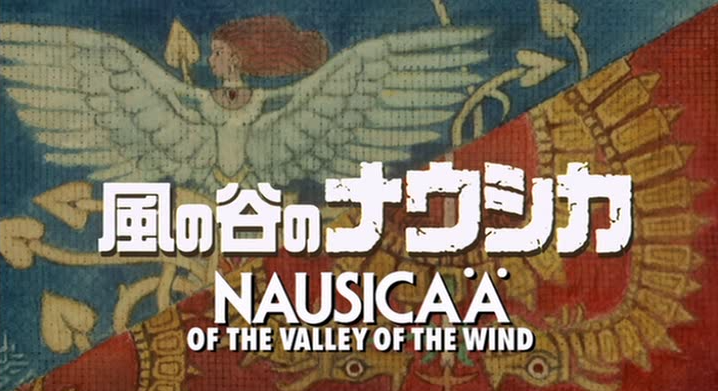
The Honoraries: Hayao Miyazaki's Nausicaä of the Valley of the Wind (1984)

In "The Honoraries" we're looking at the careers of this year's Honorary Oscar recipients including Hayao Miyazaki. Here's Manuel on an animated gem...
Spirited Away, Ponyo, Howl’s Moving Castle and My Neighbor Totoro all wowed me on first viewing. In that sense, I agree with Tim, to choose just one Miyazaki is close to impossible. I know it will date me (more on that in a minute), but while I love what 3D animation can (and has!) done, to me, there’s nothing more exhilarating than traditional, hand-drawn animation. This may be because I come from a household where animation is the family business (little do people know that my mother owns the longest-running animation studio in Colombia) so I pretty much grew up around animators, scanners, and spent many a weekend waiting for a certain scene or episode to finish ‘rendering’ before we could head home, while perusing the “Art of” books that lined the shelves at the office.

So to commemorate Miyazaki’s Honorary Oscar I thought I’d treat myself and look at one of his films I’d never seen before. I ended up choosing Nausicaä of the Valley of the Wind which turned (like yours truly) 30 this year and boy is it a beauty. 

Nausicaä soars on the back of its eponymous protagonist. Catching it in 2014, it’s hard to gage whetherNausicaä was ahead of its time or whether pop culture has been slowly feeling its influence since its premiere. Probably both. I mean, here we have an environmentally-conscious plot about a strong-willed and empathetic teenage girl set in a post-apocalyptic world who refuses to engage in the needless killing and destruction that adults around her seem committed to as a way to survive; hard to deny that that sounds familiar no? But to say that Nausicaä is a precursor to Katniss Everdeen (and her fellow YA kickass dystopian gals) is to sell Miyazaki’s film and protagonist short. This is not only because, as Tim noted last week, Miyazaki is less interested in ‘good guys’ and ‘bad guys’ (there’s no President Snow and The Capitol to hate here), but because his Nausicaä wouldn’t be caught dead in a love triangle, sadly still a staple whenever we’re granted a female-led action adventure franchise. Indeed, Nausicaä may be an even greater feminist film than that dystopian trilogy for the way it presents its protagonist’s strengths as both born out of but not tethered to her own gender.
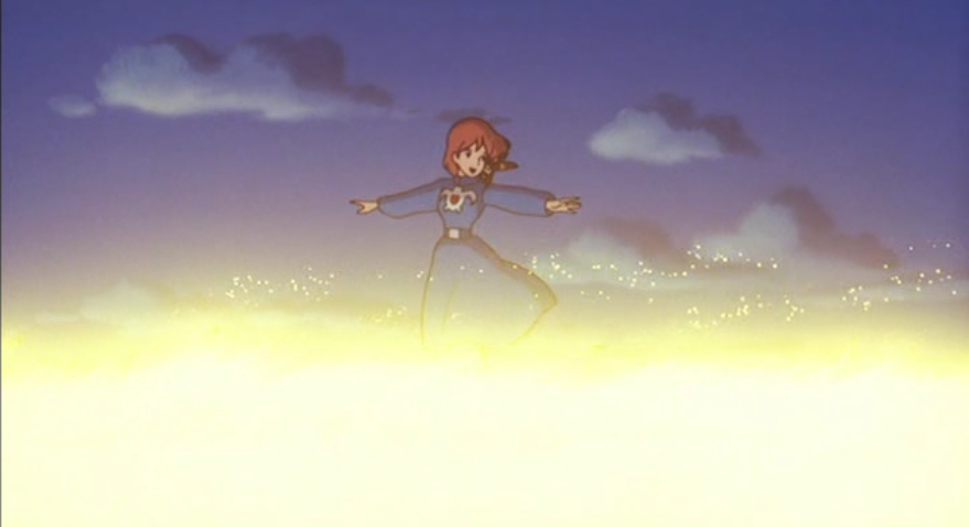
Nausicaä, attuned to the natural world around her (including the seemingly hostile ‘toxic jungle’, home of the dangerously angered Ohm), spends the entire movie presenting empathy as her strongest asset, even when this is constantly demeaned by those around her as mere naïveté. In that, she seems both a throwback as well as a novel protagonist. It may seem outmoded to praise a film for playing into cultural tropes about the connection between women and the earth but Miyazaki is keen to position Nausicaä’s intuition as a source of strength not nearly as incompatible with her physical prowess as we might think. At a critical moment, she’s so blinded by grief and rage (so overwhelmed with feelings) that she lashes out and knocks many a soldier down. A scene that might normally lead to a lecture about “controlling one’s anger” (because it leads to the dark side, remember?) instead quickly taps instead into Nausicaä’s own loyalty and affinity for her people, getting her to privilege pragmatism over her own blinding rage. But it is also that ability to feel and empathize with those most unlike her that ends up saving the day. Like I said, it’s both oddly quaint but also quietly transgressive.

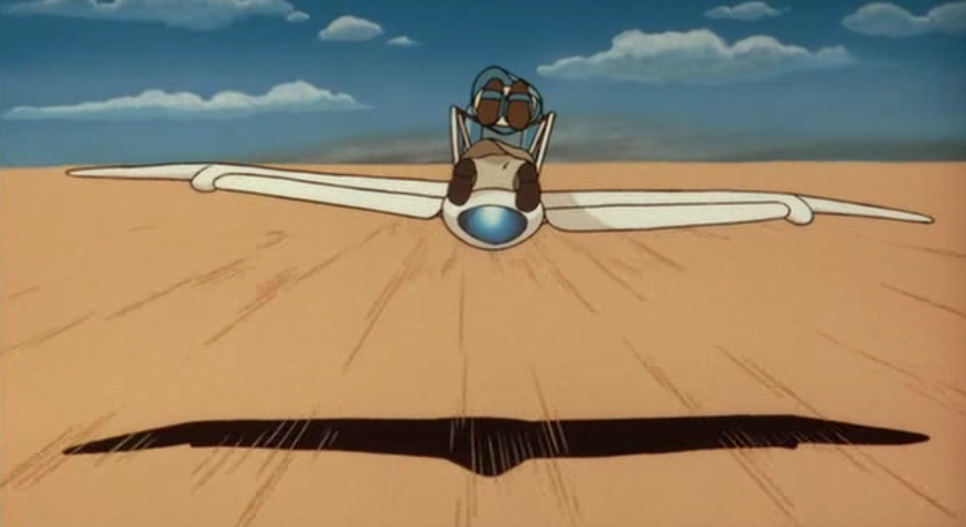
It helps that this type of gender politics becomes a part of Miyazaki’s storytelling fabric rather than its central thread. The film is a classic because it is both a thrill-ride as well as a meditation on mankind’s relationship with nature; it’s an entertaining adventure that doesn’t shy away from Big Themes, it is surprisingly rich in world-building without ever feeling bogged down in exposition; it is kinetic even in quiet moments of reflection; it is beautiful in its simplicity, Miyazaki’s clean lines equally capable of sketching an in-flight action set-piece as well as an almost-forgotten tender childhood memory.

This is all a way of saying that if you haven’t sought Miyazaki’s work, you should do yourself a favor and watch a clear example “they don’t make ‘em like they used to, but also no one ever did ’em like this anyway.” 
Previously in The Honoraries: Maureen O'HaraJean-Claude Carrière, and Harry Belafonte
Thursday
Nov062014

Freakshow: Pink Cupcakes

Nathaniel's in LA for the week so welcome Adam, who previously covered True Blood, for the latest AHS: Freakshow epsiode. Here's the rundown and commentary. How'd you like the episode?  

The Motts. They're the best part of "Freakshow," yes?

Plot: Elsa continues to plot against Bet and Dot since they’re in the position to replace her front-lining status at the Freak Show. Stanley and Maggie conspire to murder the Freaks, choosing money and notoriety over human compassion. Gloria and Dandy each come to terms with his new 'hobby,' she in the way of clean up and him in the embracement of his murderous urges. Desiree realizes she may not be as “freakish” as she once thought, while the Strongmen combats his inner self-loathing for that which he cannot change. 

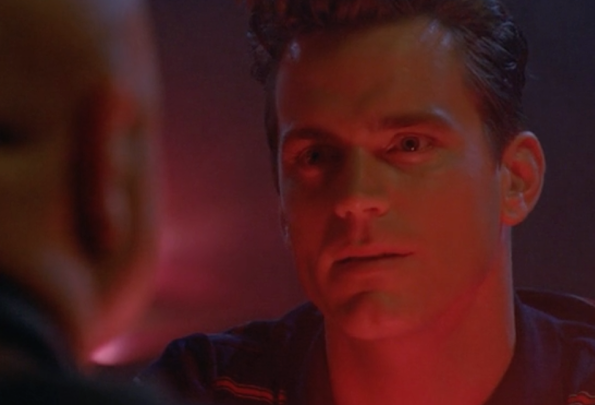
The Strong Man joins the rest of the planet in lusting after Matt BomerGuest Star of Note: Matt Bomer!  ♥ In what begins as a slightly boring intro, more needed for its revelation of the strongman’s love for a man than anything else, becomes exponentially more interesting when Dandy enters the picture. Also, that hair and those eyes. *swoon* (Gabourey Sidibe makes a brief Horror Story return as Patti Labelle’s inquiring daughter, but that scene was more about revealing Gloria’s inner pain from being an absent mother than announcing the presence of a new character.) 

QUOTABLES & SPOILERS after the jump...

Click to read more ...

Thursday
Nov062014

A Year with Kate: On Golden Pond (1981)

Episode 45 of 52: In which Katharine Hepburn makes Oscars history by asserting that old people are interesting.

I’ll be honest: I’ve been really nervous to write about this movie. For the past few weeks, a storm has been brewing in the comments section regarding Kate’s final Oscar win. I’m not one to (intentionally) court controversy, so I’ve been debating all week how to best give a safe space to the righteous fury of the Oscars experts while also celebrating an important moment in Oscars history. Because whether you believe Kate deserved to win or not, this was a record-breaking win at the Academy Awards, and that shouldn’t go unappreciated.

Here’s my plan: we’ll speculate wildly for a bit on why Kate took home her fourth Academy Award (by “took home” I mean “still refused to accept in person”). Then you tell me who you think should have won. What follows is my list of...

POSSIBLE REASONS WHY KATHARINE HEPBURN WON BEST ACTRESS (in order from least likely to most)

Click to read more ...

Wednesday
Nov052014

Threads: "I love her to death"

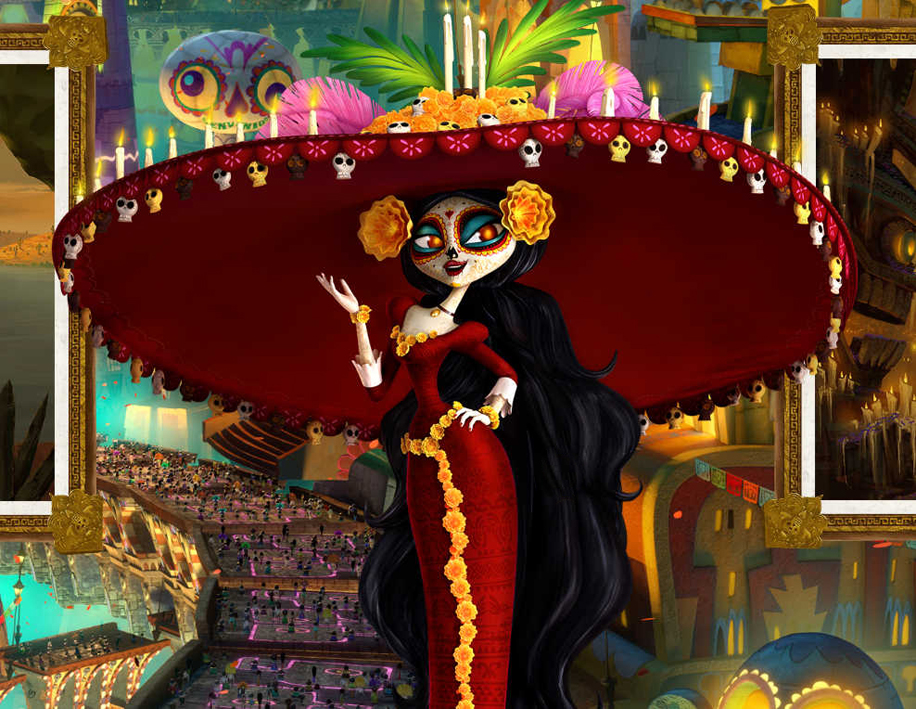
Jose here, each Wednesday in "Threads" we'll be obsessing over a single costume we're fixated on that week. This week, because we're coming down from a Halloween candy sugar rush, we discuss the exuberant elegance of La Muerte in The Book of Life (which Nathaniel had already suggested as a great Halloween costume). 

 
Clad in tight-fitting red fabric from top to bottom, La Muerte’s (voiced by telenovela superstar Kate del Castillo) outfit only truly comes to life through its accessories; particularly that larger than life hat adorned with hanging skulls, flowers and candles, all of which are dazzling to behold from an aesthetic perspective, but are fascinating because of their symbolic meaning. La Muerte, which is Spanish for “death” is a festive representation of the Mexican Day of the Dead, in which family members visit the graves of their deceased ones and bring them offerings which include chocolate skulls, sugar bread and tequila.

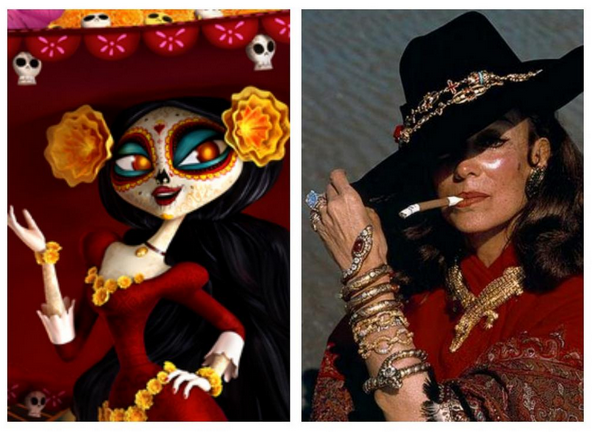
This particular vision of death, not as a Grim Reaper, but a beautiful, even sexy skeleton, became iconic after illustrator José Guadalupe Posada created it as a satirical representation of Mexicans who had adopted foreign traditions and were betraying their culture. The Catrina, as it’s known in Spanish (“catrina” also means “well dressed”) featured in the film combines several cultural elements (notice the Aztec prints on her dress and the altar on her hat) and also pays homage to one of Mexico’s greatest screen legends: María Félix, who was known for her larger than life personality, unique sense of style and her memorable performances.

Félix inspired artists like Diego Rivera, Bridget Tichenor, Christian Dior, Yves Saint Laurent and the jewelers at Cartier, who designed a now legendary snake necklace just for her. She also inspired Francis Cabrel to write the song “Je l'aime à mourir” for her, literally “I love her to death”, talk about coming full circle...

Related: this year's Oscar race for animated feature
Anne Marie interviewed Book of Life exec producer Guillermo del Toro and director Jorge Gutierrez
Previously on "Threads": Snowpiercer 

Wednesday
Nov052014

The Honoraries: Jean-Claude Carrière, Part 2

Our 2014 Honorary Oscar tribute series continues with a two-part look at the long fascinating career of Jean-Claude Carrière. Here's Tim with Part Two.

Yesterday, Amir did a wonderful job of introducing us to the supremely gifted and abnormally prolific Jean-Claude Carrière, focusing on his iconic collaboration with Luis Buñuel. As important as that work was for both men, it tells only a fraction of the tale. With nearly a hundred screenplays to his credit in a career that’s still holding steady, 54 years on, it’s simply not possible to reduce the full scope of Carrière’s contribution to cinema to his work just one collaborator.

And so we now turn to Carrière's writing in the years following Buñuel’s death. Given the transgressive, ultra-modern nature of their films together, it’s perhaps a bit surprising that Carrière’s output from the ‘80s to the present would be dominated by prestigious literary adaptations and costume dramas - what could possibly be less transgressive than that? But just as Belle du jour is nothing like the usual late-‘60s erotic drama, so are Carrière’s late-career period pieces only superficially akin to awards-bating fluff. 1979’s The Tin Drum, which he adapted alongside director Volker Schlöndorff and Franz Seitz, is one of the nerviest films about the psychology of Nazi-era Germany ever filmed. In the scenario he provided for Andrzej Wajda’s 1983 French Revolution film Danton, he built a foundation for an angry, vivid drama about the corruption of politics. These are confrontational films, even upsetting.

As the years progressed, Carrière perhaps mellowed, enough to pick up one final Oscar nomination for 1988’s The Unbearable Lightness of Being, which he shared with that film’s director, Philip Kaufman. Although even here, “mellowing” is a relative term.

(The Unbearable Lightiness of Being, Birth, and Valmont after the jump)

Click to read more ...