Oscar History
Film Bitch History
Welcome

The Film Experience™ was created by Nathaniel R. All material herein is written by our team. (This site is not for profit but for an expression of love for cinema & adjacent artforms.)

Follow TFE on Substackd

Powered by Squarespace
DON'T MISS THIS
What'cha Looking For?
Subscribe

Entries in Reviews (1306)

Saturday
Sep132014

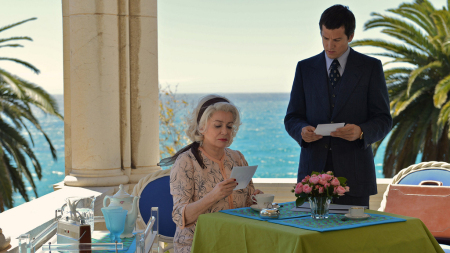
TIFF: A Little Chaos

TIFF 14 doesn't actually wrap until tomorrow night but my adventure in Toronto has come to an end. There are still a few writeups to come but here, for you, is my take on the Closing Night Film as I zip up the suitcase and head to the airport.

How to describe that thing where you thoroughly enjoy watching something that is neither objectively good, nor enjoyably bad? I imagine anyone who has an inordinate fondness for an entire genre or subgenre, quality be damned, will understand. Sci-fi and horror fans will line up nodding, I'm sure. But for me that genre is the costume dramedy.

Those with allergies to "light" costume period pieces should give this trifle from actor/director Alan Rickman a wide wide berth. For me, prone to enjoy both famous thespians playing dress-up and royalty porn as long as it neither are weighed down by the self-seriousness of Oscar-seeking biopics, this obscure fanciful tale flew by. Alan Rickman plays the King of France who wants a brand new something-he's-never-seen-before as new attraction for the gardens of Versailles. He's about to move the entire court there and the unveiling must be magnificent. A fountain it will be then and his royal gardener Andrè Le Norte (Matthias Schoenaerts in walking romance novel cover form with long luscious locks but broad shouldered manliness) hires the widow landscape designer Sabine De Barra (Kate Winslet) to create it because he recognizes that she's actually a visionary immediately though he can't quite admit to it as he weighs her proposal.

Complicating matters is that the King doesn't handle failure well and Le Norte's future hangs in the balance and he wants things quicker than they seem possible. Also: Le Notre and De Barra are, SURPRISE! (just kidding), falling for each other.

There's a bit of proto-feminism wishfulfillment happening and a bit of romantic melodrama but the movie never totally commits to any one thread. Its paper thin, really, with nothing much in the way of thematic interest that's actually explored or depth of characterization. All hangups aside it was just great to see Kate Winslet on the big screen again but she could've done this in her sleep while blinded by silly hats and short of breath from a corse---oh, wait. But better light and unchallenging than embarrassing which is how things go in the movie's most obvious bid at self-seriousness with a "twist" flashback about Madame Barra's tragic past that the movie teases ad nauseum from early on.

The movie suffers from what looks like underfunding since it skimps on anything that might back up the central subject matter which is meant to convey and continually references about how lush, overgrown, and imaginative De Barra's work is. But again, an easy sit, especially if you're costume inclined. Winslet and Schoenearts work fine together though their romance feels more talent-based than physical. Since their work is dramatic they sometimes feel like they're in their own film. It's not unlike those classic Disney fairy tales, really, where the leads are drawn as "beautiful" realistic-ish humans while the side characters are from another species, with oversized heads or comic limbs. Among the ensemble, most of the actors are delightful even if no one is remotely challenged (oh look Stanley Tucci doing his fun gay sidekick schtick again!). Jennifer Ehle (far on the periphery) and Helen McCrory (near the center of the action as Schoenaerts shady wife) both manage to play into the movies preference for types and caricature while also slyly suggesting actual individual character. As a result their scenes feel like whole new films sprouting up like weeds inside the one we got but that's okay since this garden is wilted. C+


Also at TIFF: WildThe Gate, Cub, The Farewell Party, BehaviorThe Theory of Everything, Imitation GameFoxcatcher, Song of the Sea, 1001 Grams, Labyrinth of Lies, Sand DollarsThe Last Five YearsWild Tales, A Pigeon Sat on a Branch Reflecting on ExistenceForce Majeure, Life in a Fishbowl, Out of Nature, The Kingdom of Dreams and MadnessCharlie's Country, and Mommy

Friday
Sep122014

TIFF Quickies: Behavior, Cub, The Gate, and The Farewell Party

Nathaniel's adventures in Toronto, the last leg.

I came out of my last screening a few hours ago and a plane awaits me tomorrow which is a good thing since I'm running on fumes. Four more films need writeups and we'll probably do a podcast. But we'll worry about this tomorrow. Tomorrow is another day. My TIFF screenings ended tonight. And get this: Less than 48 hours after my return to NYC, critics screenings for NYFF begin. I'm not even exaggerating. No rest at all for poor Nathaniel.


LMAO. Tweet of the Year! Okay, on to the movies...

Behavior (Cuba)
A huge hit in Cuba, and their probable Oscar submission if they submit at all (they often skip it), Behavior tackles tough topics like educational buerocracies, dead-end poverty, alcoholism, juvenile delinquency, prejudice against immigrants, you name it. More importantly it asks questions that have interested educators forever: how involved should a teacher be in the lives of her students? do you prepare them for life outside of school or merely provide them shelter from that life for a part of each day? Do you break the rules for one if you feel that child is a special case? Yet for all these heavy topics, provocative questions and the film's frequent classroom scenes, this drama never feels didactic or preachy but organically dramatized around its dimensional characterizations rather than characters as stand-ins for ideas/types (with a couple of exceptions). It's the story of an old passionate teacher Carmela (Alina Rodriguez), past retirement age, who is always at odds with the schoolboard because she's inflexible when it comes to bending rules to meet a student's needs. It's also the story of her class trouble-maker Chala (12 year old Armanda Valdez Friere in a frankly amazing debut), who the schoolboard wants to send to the Cuban equivalent of a juvie home. Chala is the sole breadwinner at home (through illegal means) and his mother drinks away the money rather than paying the bills. Carmela believes the kid has a good heart and continually demands disciplinary leeway at school.

a moving story of teacher and student

While many of the plot developments in Behavior are depressing and predictable, the movie is stubbornly hopeful, knowing the odds are against success but pressing on anyway. Writer director Ernesto Daranas, a fine new voice in Latin American cinema, makes sure this doesn't happen in a corny inspirational way, as in so many inferior teacher/student dramas do, but with roll up your sleeve grit in its narrative and smart visual choices - the camera is often exactly the right distance from the actors, to keep you fully aware of their tough environment and also their dreams. (Cue multiple shots of Chala on rooftops.) Behavior suggests that Carmela has saved a few students from their own lives, knows it, and will save as many more as she can manages before she dies... maybe even Chala. Her stubborn heroism? She knows that the broken system and these broken homes will long outlive her. B+

Cub (Belgium)
I got dragged to this slasher movie by two friends who I hadn't seen in a long time. Spent the film with fingers carefully crossed over my eyes for watching / not watching simultaneously. A group of Cub Scouts are out for a camping weekend and they pick a spot much further into some spooky woods than they were intending, woods they're warned against but you know how people are in movies, they never turn back when warned. The Scouts three barely adult supervisors tell the young boys the tale of Kai a boy who becomes a deadly werewolf at night. It's a legend meant for campfire scares but we see Kai right away, not a werewolf but a boy their age with a creepy one horned mask who watches them from afar. He takes an interest in one of them, a loner named Sam (Maurice Luijten), the film's lead. Kai doesn't attack him but starts the bloodletting elsewhere. It's mildly entertaining but the characters aren't that well delineated and I predicted the finale about 75 minutes in advance. My friends thought the kills were imaginative and I will concur that two of them were, particularly a morbidly funny group kill. But ... GROSS.

"GROSS". That's actually my full sophisticated one-word review, and come to think of it my review for all slasher movies. I have come to understand and admire the broader horror genre after years of reading great critics enthusing about it, but this subgenre I'll never get - even when it comes with subtitles.  C-

The Gate (France/Cambodia)
Like Labyrinth of Lies a few days back, The Gate benefits from a continually engaging true story. The new film from Regis Wargnier, who won the Oscar for the Catherine Deneuve epic Indochine, returns to that rich well of stories, French expatriates in countries they've colonized. The Gate, more appropriately titled Le temps des aveux in French, is based on the memoirs of a man named François Bizot (Raphaël Personnaez) who was arrested by the Khmer Rouge while he was innocently researching Buddhist traditions at monasteries. The communists believed this Frenchmen was a spy for America and the film becomes a battle of wits and test of humanity as Bizot and his captor Much (Phoeung Kompheak) argue and debate about Bizot's purpose in Cambodia and his fate. Like most good prisoner/captive dramas, their relationship is perversely intimate and the heart of the movie. Since its based on Bizot's memoirs, and the film begins near the ending, with Bizot returning to Cambodia we know he survives but things look bleak for a time and even when freed, the chaos isn't over since his wife and child are Cambodian/French and they don't have as much protection. Intense at times and surprisingly well acted -- most of the cast were non-actors aside from, of course, handsome French movie star Personnaez. B


The Farewell Party (Israel)
Israel's Oscars, "the Ophirs," have heartily embraced this dramedy about senior citizens who accidentally and after much prodding become crusaders for mercy killings of their terminally sick friends and spouses. It is far more tasteful than it sounds starting with heartbreaking decisions among longtime friends. But, curiously, the mood gets lighter and lighter in mood and the film funnier and funnier as it progresses. The comic highlight is a wonderfully cheeky display of solidarity when one of the friends is diagnosed with dementia but there are many little laughs along the way and each ensemble member finds a way to shine in a dialogue heavy film. It's a difficult film to describe, part drama about longterm love (both platonic and romantic), part ensemble black comedy, part agitprop about personal choice in matters of the end of life rather than machine-mandated life, and all parts delightful. It's not a done deal yet but it's easy to imagine this as Israel's Oscar submission and if submitted, an actual nominee in the Foreign Language Film category.   B+

Also at TIFF
A Little Chaos
The New Girlfriend
Wild
The Theory of Everything and Imitation Game
Foxcatcher and Song of the Sea
The Last Five Years
Wild Tales and A Pigeon Sat on a Branch Reflecting on Existence
Force MajeureLife in a Fishbowl and Out of Nature
Mommy
The Kingdom of Dreams and Madness
Charlie's Country

Friday
Sep122014

TIFF: Wild, Or How Witherspoon Got Her Groove Back

Nathaniel's adventures in Toronto. Running on fumes... 

Color me surprised that my favorite among the consensus Best Picture hopeful Oscar launches from festival season (the others being Foxcatcher, Imitation Game and Theory of Everything... though I have yet to see Birdman which didn't play here) is Jean-Marc Vallée's Wild, an adaptation of the memoir by Cheryl Strayed. How could a months long solo hike across the Pacific Crest Trail be so cinematic? The answer is in its smart mosaic, visual and aural, as Reese hikes through expansive physical and intimate mental terrain. The present and the past converse and overlap consistently in the sound design like fragments of song sung, hummed or played as if remembered - who is singing? and snippets of dialogue the same evocative way. 

There's not much to say about the plot, the film's most recent kin being Into the Wild though Wild is the stronger film. Reese Witherspoon reminds us why we were all so excited about her in the first place with effortless star magnetism. She doesn't turn on any megawatt charm or do anything strenuous at all with it other than trust that innate cinematic charisma to walk with her on the trail as film-elevating protective gear. That's gear Cheryl needs because those boots aren't made for walking and good god she's got a lot of baggage, both literal (her comically large backpack) and metaphoric, having let herself completely spiral towards a personal abyss with the death of her mother.

More...

Click to read more ...

Wednesday
Sep102014

TIFF: Benedict vs. Redmayne, Round 1

Nathaniel's adventure in Toronto. Days 4 & 5 

Two bonafide contenders for the Best Actor Oscar screened on two consecutive days so I can't help but pair them here for you. We'll surely say more about these movies when they open, because they're both looking like awards heavyweights. But, for now, reviews and some Oscar betting. 

IMITATION GAME
In the opening voiceover, Alan Turing (Benedict Cumberbatch) admonishes someone (us?) to "pay attention. I won't repeat myself" but the story is exciting enough that you're sure to pay attention without the lecture. I mean, it's not every day you get to see a movie about a closeted homosexual genius mathematician secret war hero. Imitation Game has three acts but they play concurrently so we're weaving through Alan's adolescence in boarding school, Alan's top-secret war assignment, and Alan in the 1950s under police investigation. Naturally these three acts are related, not just by having the same protagonist, but by the theme of secrecy. How it informs, shapes, and obscures or destroys the things that matter like character, consequence, and emotional health.

The middle story is the most thrilling as Alan races against the clock to break the Enigma Code during WW II. I think the charge from this section of the film comes from the editing, directing, and its beautifully judged ensemble performance. Turing's obsessive intellectual personality is thrown into vivid relief but also sours when its forced into interaction with others, sliding towards closed off, curt and superior. And Benedict maps all this out with great delicacy...

Click to read more ...

Tuesday
Sep092014

TIFF: Two to see again in "Foxcatcher" & "Song of the Sea"

Nathaniel's adventures at TIFF. Days Whichever.

Here are a two films that I feel I should see again, primarily because they're ambitious works and I wonder if my response would change if I had more familiarity with their visual language. You know how that goes with more complicated art.

FOXCATCHER

Bennett Miller, a remarkably consistent auteurial voice, once again demonstrates great aptitute at exploring masculine intimate true stories and mining them for larger weighty themes, without any of the glazy sentiment that tends to be slathered onto both sports movies and biopics. His best move here is to study the alien body language of wrestlers, like it's a foreign tongue for which close visual track is your only form of subtitles. Channing Tatum and Mark Ruffalo speak this foreign tongue fluently. They play Mark and Dave Schultz, Olympic Gold Medalists in wrestling, "a low sport" (that's Mother DuPont's words as perfectly uttered by Vanessa Redgrave). Into their lives comes a would be patron and "coach" John DuPont, a filthy rich patriotic nutjob who completely takes over and irrevocably and tragically alters their fate.

I was interested the whole time, but unfortunately it never fully engrosses, and moves as if mired in grandiloquent molasses. The line deliveries follow suit with simple sentences feeling as long as paragraphs. The movie improves as it goes, though, ending with a gut punch. I'm not sure why I found it offputting, exactly, despite easily identifiable strengths, but I'm going to chalk it up to its over confidence in its own greatness and the conception and execution of the catalystic figure Steve Carell's John DuPont. It's a very prosthetics and mimicry-based performance of a very difficult role -- to say these words and bring nuance rather than "i'm a dangerous pathetic nutjob!" I can't imagine -- and it's hard to feel the inexorable gravitational pull of any of the great tragedies (which I think this wants to be) when everything is so telegraphed as to its danger and when that gravitational pull towards tragedy is so slow, that any able bodied athlete out to be able to outrun it.

Best in Show: Easily Channing Tatum, who holds his jaw and body so distinctively that you feel, at all times, the monotonous life of this character: the training, the muscle soreness, the lack of any stimulation outside of the physical. He's heartbreatking, really, unable to articulate what meager thoughts are in his easily manipulated mind and body. His body is thick but his skin is thin with easily bruised feelings. Tatum totally understands the character, a manchild who just can't wrestle himself out from under any father figure's shadow.

Honorable Mention: Mark Ruffalo, also excellent throughout, is particularly sensational in one of the movies rare scenes that plays as much for uncomfortable comedy as it does for dramatic arc. He's asked to be a talking head on a documentary and finds his lines thoroughly distasteful. B (but Channing & Mark are total "A"s)

Oscar chances: A threat in all categories but particularly Supporting Actor and maybe Director 

SONG OF THE SEA

This Irish animated film, from the team that brought you The Secret of Kells, is so visually impressive that my eyes were twice their normal size trying to take it all in. I'd need a second pass to focus on the story which might be presented a touch too juvenile, like it's an animated film for very young children when its beauty and imagination are such that it really should be thinking bigger and aim for all ages. It's the tale of a little boy who loses his mother in the birth of his sister, who he then blames for everything for years. Some time later he discovers she's a magical being which means the fairy tales his mother told him in the film's prologue were true. In this world which is our world but filtered through animation that sees everything in glorious watercolor style backdrops, two dimensional lines, bright circles, and dazzling color patterns (my god its beautiful), all the magical beings are slowly being turned to stone. But why and how can he save his sister from the same fate?

Other than the fairies, who I didn't really enjoy, the character designs are compelling, especially for the central family and any animals in the film. The two best characters are the family's giant sheepdog, all bangs and tongue and loyalty and a memorable villain in "The Owl Witch" whose motives and arc are unusually strong and fascinating for this sort of movie. B+

Oscar Chances: it's so unlike any American CG animated film that it will really stand out in the crowd. I'd call it a certain contender for the  Best Animated Feature Oscar - GKids will qualify it this year - but the category sure is getting competitive so who knows.

Also at TIFFA Little ChaosWildThe Gate, Cub, The Farewell Party, BehaviorThe Theory of Everything, Imitation Game1001 Grams, Labyrinth of Lies, Sand DollarsThe Last Five YearsWild Tales, A Pigeon Sat on a Branch Reflecting on ExistenceForce Majeure, Life in a Fishbowl, Out of NatureThe Kingdom of Dreams and MadnessCharlie's Country, and Mommy