Oscar History
Film Bitch History
Welcome

The Film Experience™ was created by Nathaniel R. All material herein is written by our team. (This site is not for profit but for an expression of love for cinema & adjacent artforms.)

Follow TFE on Substackd

Powered by Squarespace
DON'T MISS THIS
What'cha Looking For?
Subscribe

Entries in Leonardo DiCaprio (123)

Friday
Aug122011

This & That: Pop Songs, Oscar Campaigns, Carnage Poster

Bill Pullman's new roleAV Club is success spoiling AMC? More rumors and commentary on the increasingly troubled network of Mad Men and Breaking Bad.
Macleans also reacts to this 'blame Mad Men' meme going around
i09 expresses shock that Bill Pullman is so amazing as a creepy motivational speaker/murderer on Torchwood: Miracle Day. I haven't seen it yet because we don't get Starz but Bill Pullman can do anything. Why are people surprised? Oh, right. Nobody goes to the theater. Pullman's performance on Broadway in The Goat: Or, Who Is Sylvia? is one of the greatest performances I've ever seen, I kid you not. (pun!) The movie roles obviously didn't challenge him enough.

The Hairpin has an interview with Kate Beaton who writes what may be my favorite webcomic "Hark, A Vagrant!"
Cinema Blend I was just talking about Patrick Wilson to a friend last night and bingo: today there's news that he's joined the cast of Ridley Scott's Prometheus. I should talk about actors who don't get enough good parts every night before I sleep so they'll be cast the next morning.
Inside Movies A story that the web will undoubtedly love: Andrew Garfield on the size of Spider-Man's package.

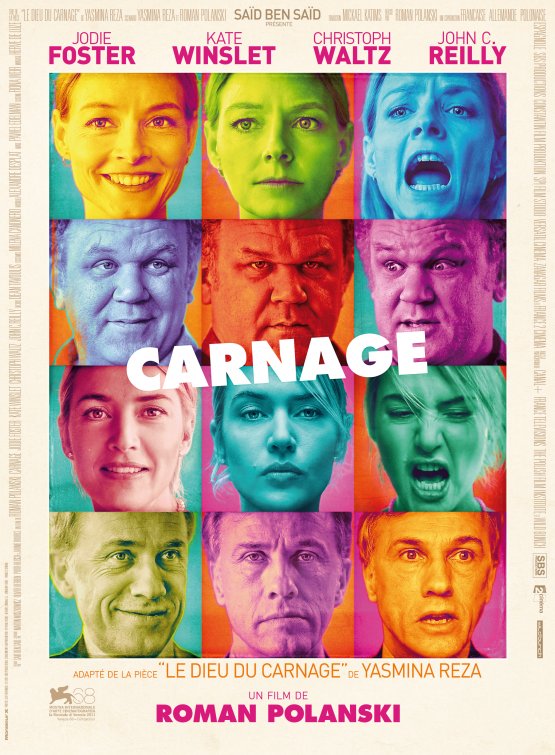
Oooh, lookie. It's the first poster for Roman Polanski's Carnage.

That's a weird loud poster but at least it's interesting. The moody faces are kind of an interesting way to get at the play's rollercoaster tonal shifts and convey that it's an actor's piece.

The Campaigning Begins
Gold Derby is already claiming the Best Actor Oscar for Leonardo DiCaprio in J Edgar. We'll see. Believe it or not he's still kind of young to win an Oscar. They make the men wait, you know. Different rules for men. Although I suppose it helps that he didn't turn out as elfin gorgeous as he looked like he might back in the days of his youth. Oscar likes his women drop dead gorgeous but doesn't like his men too purty. Just ask Paul Newman how long he had to wait. Or Brad Pitt who still hasn't won.
IndieWire Glenn Close to receive the lifetime achievement award at the San Sebastian Film Festival. Festival honors of the career variety are a standard stop on the way to would be Oscar glory. 
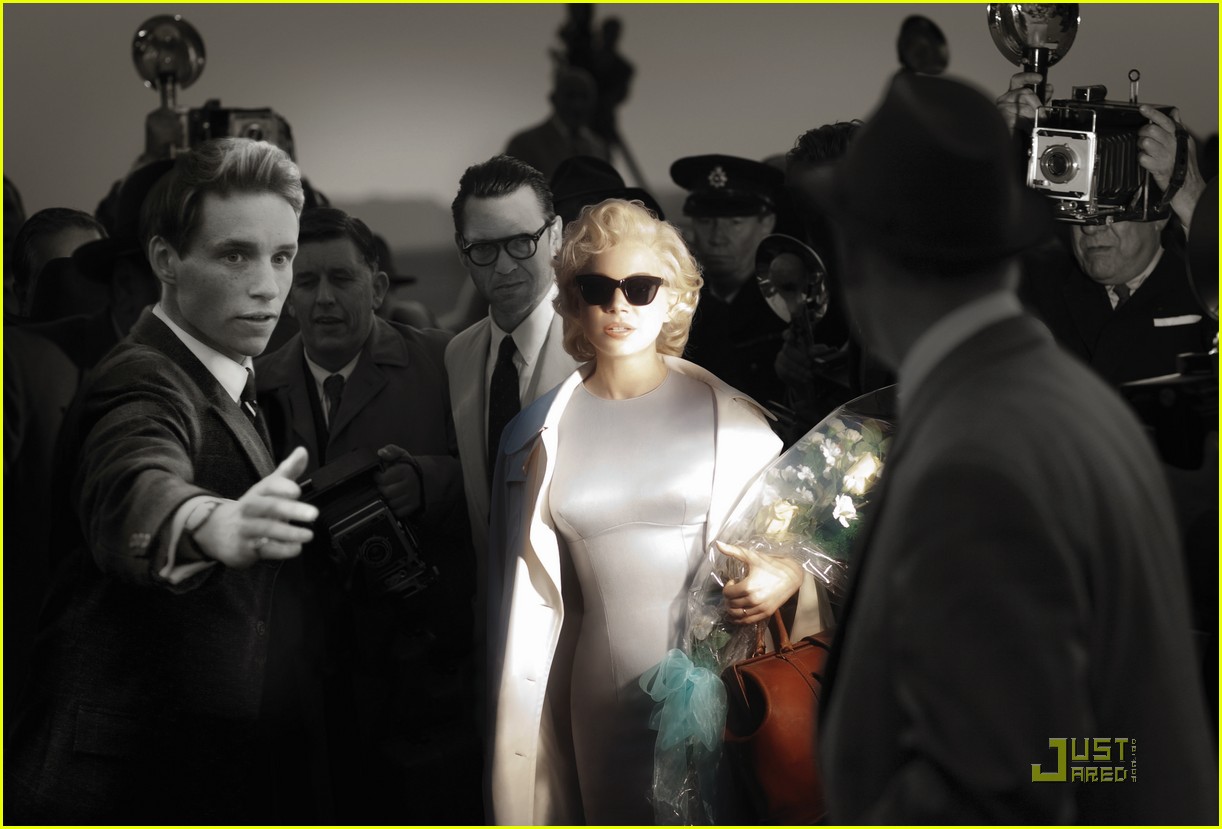
Just Jared just posted this promotional pic of Michelle Williams for My Week With Marilyn but labelled it a "still". If it's really a still in the proper sense than the movie is taking some adventurous chances with its look. 

For Laughs... Movie|Line is listing four reimaginings of princess movies that it never wants to see.

And in other news... True Blood has been renewed for a fifth season. Yay! Get caught up on The Film Experience commentary

Best Song of the 1980s?

Music makes the people come together.... yeah  
Critical Condition's Ultimate Pop Song Tournament has come down to the final four: Madonna's "Like a Prayer" (89), Cyndi Lauper's "Time After Time" (84), Michael Jackson's "Billie Jean" (82) and Journey's "Don't Stop Believin'" (81) This has been such fun for the past few weeks and it also just goes to show you how classic the 1980s are in the cultural canon since songs from other decades were eligible. You already know who I voted for, duh. Go and vote yourselves. May your favorite win... unless it's different than mine.
Boy Culture conjecture about Madonna's upcoming schedule
Examiner DC This is a good piece on the music industry's ability to keep the public interested in the classics, and the film industry's inability to do the same. A provocative mystery, that, right?


Tuesday
Apr052011

April Showers: Shutter Island

waterworks weeknights at 11 as we turn on the cinematic shower.

For a movie I claim to have not liked at all, I really have been going back to Scorsese's Shutter Island (2010) repeatedly while blogging, haven't I? It just keeps coming up somehow. A lot of it is just too stiffly serious when it would have been a better sit had it swerved towards the archly horrific on occassion to offset its portentous Sturm und Drang.

But about those Sturms...

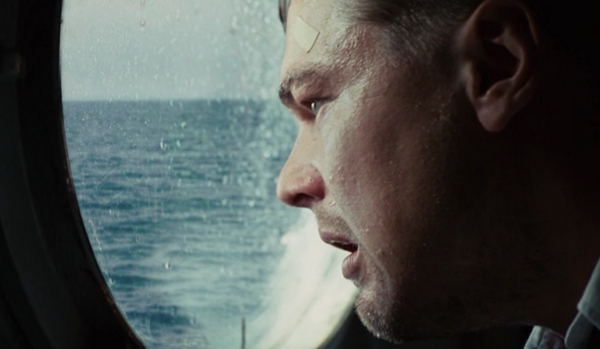
Pull yourself together Teddy. Pull yourself together. It's just water. It's a lot of water.

Teddy Daniels in Shutter Island is barely functional considering all the lakes, oceans and storms haunting him. So it's kind of pitiable that he also has to shower in the movie, too. Both times it's just so completely futile.

Two sorry showers after the jump.

Click to read more ...

Sunday
Apr032011

Oscar Predix: Best Actor and Leonardo DiCaprio

It's that foolish time of year - April Foolish to be precise. I try and suss out what's going to happen nearly a whole year from now without having seen any of the films. I am actually better than most at the year-in-advance thing... it's only later when my skills and prediction ratios put me a bit further back in the Best Prognosticators pack. Must be letting my familiarity with the films cloud the actual buzz! (They do always say that people who don't follow the race closely win Oscar pools just by casually parroting the buzz.)


The big year in advance question that people are already talking about of course is whether Leonardo DiCaprio can finally win for J. Edgar (if the film is released this year as I firmly expect it will be.)

THE PREDICTION CHART

Whether or not Leo is truly overdue is another matter. I was a very early disciple (1993, baby) but I have been losing interest over the years. I may be the only one who thinks that he's actually kind of bad in Inception. That performance just gets clunkier on repeated views, and he's not nearly as successful at making the exposition sound natural and conversational as the other actors are. But then again. That may just be the problem of "The Dead Wives Club," previously discussed. When actors get in role-ruts, it sometimes dulls the range of their imagination.

Still and all, biopics may suit him. (And they definitely suit Oscar.) He was very good in The Aviator (2004) but here's the other odd thing about his "overdue" status. It comes more from the fact that he's his generation's biggest star than from "should've won!" issues. I personally don't think he's ever come close to winning (which is usually when overdue status sets in). In 1993 the race was between Fiennes & Jones, in 2004 there was no race at all with Jamie Foxx sweeping in one of those Helen Mirren/Colin Firth style inevitabilities. 2006 was a "just happy to be nominated" situation and for the wrong film to boot.

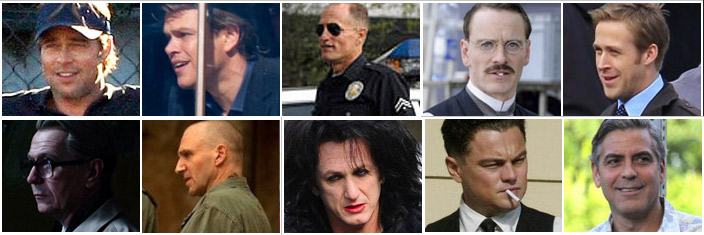
Though he has to be considered a contender for a multiplicity of reasons, the year has barely begun. Other major stars that may have roles tailor-made for their persona or skill set include George Clooney, Brad Pitt, Matt Damon, Mel Gibson, Ryan Gosling and there's always the reliably strong actors like Gary Oldman, Ralph Fiennes, Woody Harrelson or the rising stars like Michael Fassbender who already seems to be staking claim on 2011 and His.

I have lots more to say about the actors but I'll save some of it for the supporting actor post.

What do you make of The Film Experience chart or Leo's "winning" chances?

Thursday
Mar242011

Distant Relatives: The Cabinet of Dr. Caligari and Shutter Island

Robert here, with my series Distant Relatives, where we look at two films, (one classic, one modern) related through a common theme and ask what their similarities and differences can tell us about the evolution of cinema.  This week since both films deal with a twist ending, be warned there are definitely SPOILERS AHEAD


Madness

Audiences don’t much like engaging with a film, its characters, its plot and anticipating its outcome for two hours only to be told that the entire thing was untrue, a dream, the story of a crazy man, an elaborate roleplay. The two films we’re looking at today, though made ninety years apart do that exact thing. Clearly this is a cinematic convention that has stood the test of time.

In the Cabinet of Dr. Caligari, a young man named Francis relates the story of a visiting carnival which brings the evil Dr. Caligari and his somnambulist slave to town. After a series of strange murders and the kidnapping of the young man’s betrothed Jane, Francis leads a posse and discovers that, surprise surprise, Dr. Caligari is the mad director of an asylum, and that his catatonic servant are behind it all. Shutter Island follows two U.S. Marshalls, Teddy Daniels (Leonardo DiCaprio) and his new partner Chuck, sent to a hospital for the criminally insane to investigate a disappearance. As their investigation goes deeper and deeper Teddy begins to suspect a deeper plot involving the hospital’s head psychiatrist, the disappeared Rachel Solondo and Andrew Laeddis, the man who killed his wife.

Unreliable narrators

Now for the twist. If you didn’t see it coming, both of our protagonists are in fact patients in their respective mental facilities. Francis has made up his entire story. Jane and the somnambulist are fellow patients. Dr. Calirgari is in fact the good director of the asylum. Teddy meanwhile isn’t Teddy at all. He is Andrew Laeddis. He killed his own wife. The entire investigation is a ruse attempting to jar him back into reality. It doesn’t quite work.

You’d be forgiven for seeing both twist endings coming for miles. Both films feature stories that become increasingly fantastic and highly expressionist production design that seems to be peace with the reality of the film at first, but eventually we wonder. Yet I’m not sure that the purpose of these films is a cheap trick twist. We logically recognize that films are fake, actors and props on a set. Yet we accept it as a reality that plays beyond the limits of the film. We consider pasts and futures for characters, motivations, inner thoughts. There’s something uncomfortable about movies that tell us explicitly that they’re fake.

The mind’s eye

The significant difference between these two movies may be the process by which they do this. Shutter Island makes little effort to cover up the fact that the “surprise” is coming. This in turn turned off a lot of viewers who anticipated the reveal, and took the falsehood of what they were witnessing as a sign that their emotional involvement was for naught. It’s an understandable reaction. Who wants to put their time and emotional effort into something untrue? The Cabinet of Dr. Caligari strings the audience along with more determination. The reveal that the entire plot is the invention of Francis is more likely to be a surprise and more likely to be received with delight (though this isn’t always the case).

Yet, as the film that spends more time winking at the audience with it’s own artificiality, Shutter Island contains more reality than Dr. Caligari. The events (or at least most of the events) in Shutter Island actually happen. It’s simply the perception of Marshall Teddy that is false, leaving us less clear as to what plot points his mind has manufactured and which are objective reality than Francis’s tale which is entirely concocted and untrue. Both of the protagonists in these stories create realities where they are heroes instead of madmen, and thus both lean toward a question asked frequently in such fantasy films (and DiCaprio’s other movie of 2010): Is a pleasant fantasy better than a troubling reality? Is it really wrong if we don’t know the difference?

So too can it be said of the movies. We allow ourselves to experience reality vicariously through characters we know are false but don’t want to believe are false. Teddy and Francis would rather be great than recognize that they are in fact powerless, ordinary, and flawed. When their films admit that they are in fact all those things, are we vicariously forced to admit that we are too?

Saturday
Feb262011

Mix Tape: "Non, Je Ne Regrette Rien" in Inception

Andreas from Pussy Goes Grrr here, with one more glance at memorable song choices as we anticipate tomorrow's festivities. Although it's only used sparingly, Édith Piaf's "Non, Je Ne Regrette Rien" casts a long shadow over all of Inception. Its texture and meaning clash heavily with the unearned gravitas and reformatted action movie clichés of Christopher Nolan's film, as Piaf's voice introduces a cosmopolitan, plaintive humanity. Less than a minute of the song is used in all of Inception, but it sure sticks with you when you leave the theater.

Within the film, Cobb's team of expert dream-burglars uses "Non, Je Ne Regrette Rien" in order to count down to the "kick"—in short, it's a glorified wake-up call wrapped in swaths of exposition. Whenever the dreamers are about to be woken up, it lets them know how much time is left to fulfill their objectives. So the song serves a neat plot purpose, like a flare gun being fired into the subconcious. (Even if those MP3 players do look a little too unwieldy to drag along on fast-paced mission.)

The song also creates a fun intertextual link to La Vie En Rose, since Marion Cotillard (Piaf herself) stars in both films, even though Nolan claims that he'd picked the song before she was cast. But more important than the song's actual function in the heist, or the Cotillard connection, is how Piaf's unapologetically emotional voice resounds across the epic vistas of Inception's shared dreams. It lends some pathos and strangeness to a film that's precise and diagrammatical, even when it's depicting warped gravity and collapsing buildings.

This is, after all, one of the most common (and valid) complaints about Inception: its dreams aren't even remotely dreamlike. If anything, they're the dreams of a British writer/director who fantasizes about clean gray suits, rainstorms, and shiny hotel plazas. The inclusion of "Non, Je Ne Regrette Rien" is a step in the right direction, however, especially when it plays across multiple dream layers, with Piaf's throaty, melancholy voice echoing down staircases and snowy mountainsides. The juxtaposition of this song with these surroundings is unexpected and, if only briefly, makes these dreams seem mildly surreal.

The song's influence even reaches beyond its short appearances: as Hans Zimmer has admitted, it inspired the ominous, droning brass leitmotif ("BWAAA!") that's most closely identified with Inception's score. So although the film's visual sensibilities may lack any of the sloppiness or irregularity we associate with real-life dreams, at least its soundtrack is informed by Piaf's soulful, decidedly irrational belting. One final irony: that a song whose title translates loosely as "No, I regret nothing" should complement Leonardo DiCaprio's endless mourning for the wife he inadvertently killed. It's a dose of bittersweet humor, buried several layers down in a film that so sorely needs it.