Oscar History
Film Bitch History
Welcome

The Film Experience™ was created by Nathaniel R. All material herein is written by our team. (This site is not for profit but for an expression of love for cinema & adjacent artforms.)

Follow TFE on Substackd

Powered by Squarespace
DON'T MISS THIS
COMMENTS


What'cha Looking For?
Subscribe
Thursday
Sep112014

TIFF Quickies: 1001 Grams, Sand Dollars, Labyrinth of Lies

Nathaniel's adventures in Toronto. Day whichever.

Three more quick takes on Norway's Oscar submission, a LGBT romance of sorts in the Dominican Republic and a surprisingly intense film from Germany that I hadn't heard of before arriving.

Bent Hamer directs Ane Dahl Trop in the Norwegian Oscar submission "1001 Grams"

1001 GRAMS
How much does a soul weigh? I don’t mean to bring up painful memories of 21 Grams, but everything in 1001 Grams must be effortfully measured. Lab technician Marie is just such a meticulous woman, in charge of the official Norwegian kilo, which is to be weighed and calibrated in Paris at an annual seminar to ensure that all countries kilos are the same or else: chaos! Though the oddity of this international standards milieu suggests a comedy, what we get is stonefaced drama... or possibly comedy so dry, I needed a humidifier in the room to get it. Bent Hamer, who directed two previous Norwegian Oscar submisssions O'Horten and Kitchen Stories (neither won nominations), so precisely calibrates this new film that every image feels carefully storyboarded. There's a gorgeous balance of stark blues and bright whites and he often abandons our lonely protagonist in silhouette in dark sparsely furnished apartments. Even Marie’s car, an cute electric thing, fits the color schemes. When Marie and her colleagues take smoke breaks at work the images are so strictly shot that the actors seem like mice stopped for a moment to think (?) in a narrow stretch of  bureaucratic maze. Marie is so controlled that she can’t even express her grief when her father dies, and the actress Ane Dahl Torp, doing fine if limited work by the nature of the role, has to squeeze all Marie's hurt into tiny hollow syllables like “takk” (thank you) when people wonder how she’s doing. It’s a solid movie but unfortunately its strength, that crafted precision, is also its weakness. There’s so much time spent establishing how regimented, monotonous and empty Marie’s life is that the film turns into a dull laborious watch. Things eventually begin to change for Marie when she meets a bird-loving Frenchmen at a business seminar but the actual drama is so backloaded that it's tough to make it to the final stretch. Slightly touching in an unusually low key way, but it’s a complete mystery as to why Norway chose it as their Oscar submission over the daring and hypnotic Blind (Sundance review) which was also in the running. C+

Yanet Mojica and Geraldine Chaplin star in "Sand Dollars"

SAND DOLLARS
Wealthy septuagenarian Frenchwoman Anne (Geraldine Chaplin) is wiling away her twilight years on a private beach of the Dominican Republic. There’s little to tether her to France, her only child being estranged, and she’s fallen in love with a young local girl named Noeli (Yanet Mojica) though she knows almost nothing about her. Money is often exchanged though Noeli is neither, strictly speaking, a prostitute nor a kept girl. This intimate and relatively stable relationship (two years and counting) begins to crack when Anne wants to take Noeli back to Paris with her permanently. Sand Dollars hits its encomic colonialism, class disparity, and exploitation notes relatively indelicately  -- there's no mistaking the themes -- but the odd connections between its characters are, in contrast, delicately observed. Noeli's true feelings are hard to read, but she is both an attentive lover and shameless about requests for money. Little details begin to accumulate like the way Anne's mascara clumps always look like she's crying even when she's happy, how Noeli dances both for self pleasure and with awareness of the practical value of her body, the way that even when Noeli's boyfriend  looks away he's weighing the presence of "the old lady". The film gets under your skin especially with the complications of actual affection where only a business transaction would be easier for everyone. A minor film but sensitively delivered and blissfully short (80 minutes) in keeping with its slim story. B/B-

LABYRINTH OF LIES
For the first reel or two of this postwar German drama, I wondered why they’d cast such a handsome but blank lead actor (Alexander Fehling) as the protagonist Johann Radmann. Radmann is an ambitious young lawyer who, somewhat on a whim, takes an interest in unpunished war crimes and former Nazis teaching school children that a local activist reporter has clued him in to. But the initial empty suit impression is a false one. At a party early in the film the reporter tells his bohemian friends that they have to encourage Radmann until his flicker of humanity turns to a raging fire. It’s meant as a ‘loosen up’ joke, and very smartly delivered as an offhand remark rather than foreshadowing. But this is exactly what happens in this impressive debut feature from Giulio Ricciarelli. Fehling's performances, very well modulated, grows more and more intense as the new case shifts from curiousity to a detective-like fascination and then full blown righteous vendetta with Fehling's blown out eyes and angrier voice dramatizing that he hasn't slept in weeks, and that his daydreams are all nightmares. The story is fascinating, detailing the widespread ignorance about The Holocaust in Germany just one generation after the war. Auschwitz, for example, the chief subject of the investigation, is a place most young Germans the lawyers talks to have never heard of. Labyrinth of Lies is glossily made (perhaps too glossy?), well acted, and moving with a constant throughline of the need for survivors to tell their stories and for people to understand their own country's history and face their own demons.

Germany was the first country to ever try its own soldiers for war crimes and if there is a significant mark against the film it's that this is, frankly, an impossible story to squeeze into a 122 minutes motion picture. It's implications are so vast and though the movie has many fine scenes and is appropriately sober about the psychic turmoil of survivors and the need to understand your nation's own character and face your own personal demons, it also wants to be a detective story and a romance. Labyrinth is sometimes so swift that some of the developlments and results feel convenient rather than desperately produced or are brushed off so quickly that they matter less in retrospect. I rarely ask for movies to be longer but this one could have used Zodiac's willingness to chase loose ends and run on for at least another half hour or so. B+ 

Alexander Fehling loses himself in horrific documentation of World War II

Also at TIFF
A Little Chaos
The New Girlfriend
Wild
The Gate, Cub, The Farewell Party and Behavior
The Theory of Everything and Imitation Game
Foxcatcher and Song of the Sea
The Last Five Years
Wild Tales and A Pigeon Sat on a Branch Reflecting on Existence
Force Majeure, Life in a Fishbowl and Out of Nature
Mommy
The Kingdom of Dreams and Madness
Charlie's Country

Wednesday
Sep102014

TIFF: Benedict vs. Redmayne, Round 1

Nathaniel's adventure in Toronto. Days 4 & 5 

Two bonafide contenders for the Best Actor Oscar screened on two consecutive days so I can't help but pair them here for you. We'll surely say more about these movies when they open, because they're both looking like awards heavyweights. But, for now, reviews and some Oscar betting. 

IMITATION GAME
In the opening voiceover, Alan Turing (Benedict Cumberbatch) admonishes someone (us?) to "pay attention. I won't repeat myself" but the story is exciting enough that you're sure to pay attention without the lecture. I mean, it's not every day you get to see a movie about a closeted homosexual genius mathematician secret war hero. Imitation Game has three acts but they play concurrently so we're weaving through Alan's adolescence in boarding school, Alan's top-secret war assignment, and Alan in the 1950s under police investigation. Naturally these three acts are related, not just by having the same protagonist, but by the theme of secrecy. How it informs, shapes, and obscures or destroys the things that matter like character, consequence, and emotional health.

The middle story is the most thrilling as Alan races against the clock to break the Enigma Code during WW II. I think the charge from this section of the film comes from the editing, directing, and its beautifully judged ensemble performance. Turing's obsessive intellectual personality is thrown into vivid relief but also sours when its forced into interaction with others, sliding towards closed off, curt and superior. And Benedict maps all this out with great delicacy...

Click to read more ...

Wednesday
Sep102014

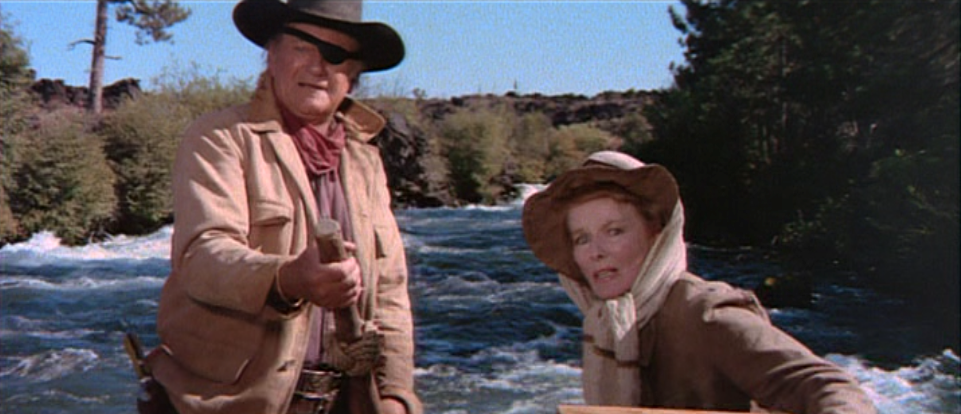
A Year with Kate: The Madwoman of Chaillot (1969)

Episode 37 of 52:  In which Katharine Hepburn plays another aristocrat in an odd little movie that makes no sense.

1969 was a really weird year for Kate. At age 62, she’d achieved commercial and critical success unlike any she’d experienced before. The Lion in Winter and Guess Who’s Coming To Dinner had not only earned Katharine Hepburn back-to-back Oscars, but also made her one of the top grossing stars of 1968. But as the 60s blossomed into the 70s, Kate took two very strange steps: an allegory, and a musical. Limitations be damned, she was Kate the Great, and she hadn’t had a flop in 15 years. That was about to change.

The Madwoman of Chaillot works as a curio, but not as a film. Based on a postwar French allegory, “updated” to include topical issues such as student riots and atomic power, the resulting movie is one Be In short of a bad 60s cliche. The cast is a veritable Who’s Who of Old Hollywood, New Hollywood, and Cinecitta: Katharine Hepburn is joined by Yul Brynner, Richard Chamberlain, Dame Edith Evans, Donald Pleasence, John Gavin, Danny Kaye, and Fellini muse Giulietta Masina, as well as two of Kate’s former leading men: Charles Boyer and Paul Henreid. This is great news for anyone playing Six Degrees of Kevin Bacon, but unfortunately does not improve the quality of the film.

"That's the way we became the Chaillot Bunch!"


Click to read more ...

Wednesday
Sep102014

Robert Wise Centenary: Audrey Rose (1977)

We've been celebrating 100 years of director Robert Wise all week by looking at some of his lesser known efforts. Previously: Tim on "Curse of the Cat People", Nathaniel on "Somebody Up There...", David on "I Want To Live!", and Manuel on "Star!" -- now here's Jason wrapping it up with "Audrey Rose"

It says a lot about the breadth of Robert Wise's filmography that the team of writers that tackled his Centennial this week here at The Film Experience have had such a gigantic stage to play upon. I mean here I am an avowed musical-agnostic taking on the director of two of the biggest movie musicals of all time, and even with the tossing aside The Sound of Music and West Side Story (although strangely I did write that movie up at TFE back in the day) I had multiple films which I could've tackled with glee. His early pair with producer Val Lewton, Curse of the Cat People (which Tim beautifully wrote up) and The Body Snatcher, are amongst the finest horror films of the 1940s; The Day the Earth Stood Still is one of the most memorable expressions of the 50s sci-fi landscape; and well 1963's The Haunting is probably in my top five horror movies of ever -- to watch sad Nell lose herself amongst the shadows of Hill House is to feel your own edges fading away, bit by bit.

But my confidence in Wise convinced me that tackling an unknown was the way to go - had I really never seen 1977's Audrey Rose? I really hadn't. [more...]

Click to read more ...

Wednesday
Sep102014

New Posters (Now With Less Floating Heads)

Manuel here to whet everyone's appetites with some recently released posters.

Fall movie season can sometimes feel much more thrilling for the way it builds anticipation than for what it actually delivers. Every year we can count on plenty of films to entertain, amaze, and awe us, but I'd wager that that number is usually lower than the number of films you were looking forward to. This is partly a math game and partly an acknowledgement of how PR and marketing savvy distributors (both big and small) have become. 

Take, for example these new posters for, respectively, Jason Reitman's Men, Women & Children (as divisive after its premiere in Toronto as the film's trailer proved here), Justin Simien's Sundance sensation Dear White People, and Jon Stewart's first feature film Rosewater. I have to admit I love these posters not only because they aren't full of floating heads or beautifully lit silhouettes, but because they manage to signal the film's sensibility. Arguably, this is what we expect from movie posters, but it's not often we get artistic posters like these that embrace the expressiveness of the medium without resorting to distractingly obvious photoshop.

Men, Women and Children clearly works overtime to let you know that it is a Reitman joint what with the imagery evoking that opening credit sequence from Juno and placing Jennifer Garner front and center; yet it also (if a bit bluntly with that tagline) lets you know what the film's core problematic is, something the poster needs to do when the title itself, unless you know the source material, gives you little to no information. How many people do you think are reading The Film Experience on their phones in this poster? 

But if Reitman's poster goes for both quirky and serious, Dear White People openly goes for laughs in a way that is keenly attuned to the racial politics of the film, with Tyler James Williams' character's equally exasperated yet sardonically knowing look letting you know precisely where the film's humor lies. (You can actually read more about the poster's design over at Vulture; turns out a fan of the film went ahead and created this design only to find it becoming the film's official poster when he sent to Simien who loved it!).

The stark color scheme, the off-center image of Gael (covering up his entrancing eyes! the horror!), the prominence of that ever ubiquitous "Based on a True Story" tagline -- or is it more a disclaimer? a promise?; the poster is clearly wanting to associate "Jon Stewart" with something other than the comedic satire he's known for, going instead for a bleak poster that nevertheless bleeds into a hopeful light in the right hand corner. I particularly love the single bullet hole above the S.

What recent posters have nabbed your attention? Has any of them already secured a spot on your movie poster wall? If you could design a poster for one of your all-time favorite films, which one would it be?