Oscar History
Film Bitch History
Welcome

The Film Experience™ was created by Nathaniel R. All material herein is written by our team. (This site is not for profit but for an expression of love for cinema & adjacent artforms.)

Follow TFE on Substackd

Powered by Squarespace
COMMENTS


What'cha Looking For?
Subscribe

Entries in Judy Garland (120)

Thursday
Aug042011

Judy Fest: "For Me and My Gal"

Bless the Walter Reade theater and The Film Society of Lincoln Center. This summer has been so trying in so many ways, but the Judy Garland retrospective is bliss. It helps that the Walter Reade is such a great place to see older films what with great air conditioning, comfortable seats and a big screen. The same can't (unfortunately) be said for the other prime NYC HQ for cinephiles (Film Forum). Anyway, people often think of Judy as an icon of tragic catharsis: heartbreak voice, trembling gesture, short life... but then you see the movies and she's just got charm for miles, a full range from light touch to direct hit, and she's funny and dazzling.  Watching her proves far more joyous than tearful though sometimes the two come together.

I caught two consecutive features earlier this week from the brief moment between her ascendance (Dorothy Gale + all those Mickey Rooney pictures) and adult superstardom (Meet Me In St. Louis).  Both pictures were made around her 20th year, as she left teen stardom behind. 

For Me and My Gal (1942)
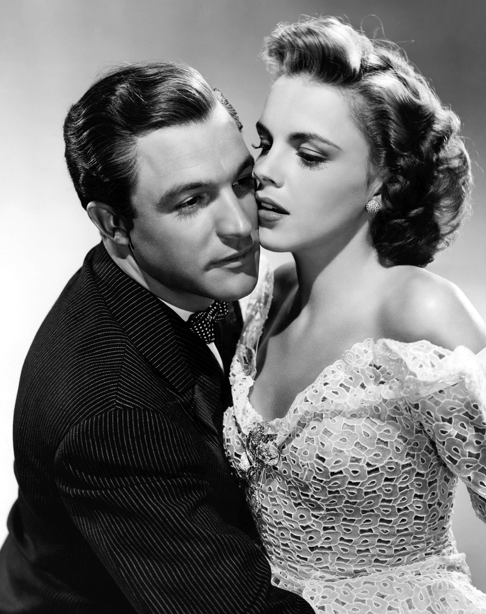
This was the first of Judy Garland's three pairings with Gene Kelly (and his film debut!) and the first picture where she alone was billed above the title, indicating Hollywood's new confidence in her bankability. It's a period piece with Gene & Judy playing low rent vaudeville act "Palmer & Hayden". They're attempting to up their game and become headliners at the Palace (New York) just as Judy's brother and all able bodied young men are being shipped off to World War I. Palmer (Kelly) doesn't want to go when the draft hits him and this relentless career drive looks like cowardice and lack of patriotism to everyone including Hayden (Garland).
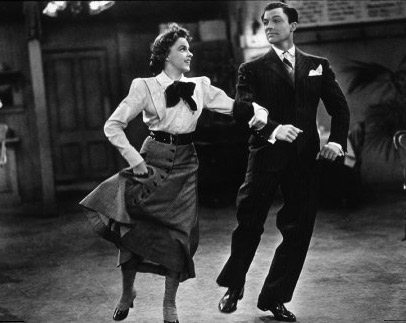
Two of the movie musical's greatest bond over song and dance. It's a little bit like that famous scene in ONCE (2007) actually, a kindred spirit discovered at the piano.

The film peaks quite early with the title song, a thrilling example of what modern musicals are always forgetting: songs are supposed to move the story along! "For Me and My Gal" was an old standard at the time -- this is essentially a jukebox musical like Singin' in the Rain -- but it's used as a plot device, the performance of which, falsely casual over coffee, is a sneaky ploy by loveable cad Palmer (Kelly) to win innocent Hayden (Kelly) away from her current act.

As anyone who's ever seen Kelly & Garland perform together knows, they're a match. The ploy will work. That swoony soft tenor of Kelly's, the aural equivalent of a randy comfortable blanket for vocal partners to take to their beds, just nuzzles right up to her more powerful alto, and let's it do the heavier breathing while he moves. And oh how he moves. John Fricke, noted Garland historian, was on hand to introduce the film and he shared that Kelly credited Judy with teaching him how to act for the camera. He didn't yet know how subtly you can play for the camera as opposed to the stage (Before this film he'd become a Broadway sensation in "Pal Joey" and Garland lobbied to hand him this debut.). You can see Kelly's learning curve in this film but as a song and dance man, he just can't be beat. 

I amend. The film peaks a little later than that, when Judy sings "After You're Gone" which would become a concert staple for her (see below). 

You can chalk up the song's staying power to the weird combo of its fickle tempo changes and Garland's unfaltering emotional control of its content. The film version of this number (I couldn't find a good video), takes place in a improvisational hurry because Kelly has been seeing another woman (Márta Eggerth -- more on her in the next post) and is late to their performance. Garland is essentially selling the song AND three separate character and plot points within its ebbs and crescendos: Hayden's ascendance into a confident entertainer who is able to leave her personal drama offstage, a young girl's immediate and unruly love for a man who is clearly trouble, and a maturing woman's worry about their future as partners. The song is prophecy, future tense, but Garland manages to sell her character's past, immediate present and future depending on the note.

Amazing.

The film's second half -- once we arrive at draft dodging and war bond selling patriotism and even an actual grenade throwing war sequence, is weirdly ungainly and choppy. But the film is definitely worth seeing as a milestone in three of the greatest careers within cinema's musical genre: Garland's, Kelly's, and director Busby Berkeley who considered For Me and My Gal his best film. (People aren't always the best judges of their own work but that's still something.

For Me and My Gal (first half: B+; second half: B-)

As exit music, why not Gene Kelly dueting with wee Liza on the title track years and years after her mama's movie hit it big?

Isn't that sweet?

Next up... the other film from this time period, with some interesting similarities Presenting Lily Mars (1943)

Sunday
Jul312011

Hallelujah! A Judy Garland Retrospective

The Lincoln Center and the Paley Center here in NYC have joined forces to celebrate the all-singing all-dancing legend that is Judy Garland! 

Shout 'Hallelujah', c'mon get happy!"

Once upon a time she was dubbed "The World's Greatest Entertainer." Few celebrities have ever earned their PR self-mythologizing titles the way Judy G did. There's just no beating her for musical pleasure and cathartic heartbreak. And as if her sensational singing and dancing weren't enough, she was a fine actress, too!

I missed the first week of the celebration being in Michigan but I'll see what I can catch for the remainder of the summer program which ends August 9th. If you're not in New York City, you can always follow along at home as best you can with an impromptu DVD festival.


Still to come in the festival are...

Young Judy:
Everybody Sing (1938), For Me and My Gal (1942), Presenting Lily Mars (1943).... and of course a handful with Mickey Rooney: Babes in Arms (1939), Andy Hardy Meets Debutante (1940), Strike Up the Band (1940), Babes on Broadway (1941), Life Begins For Andy Hardy (1941) and Girl Crazy (1943)

Peak Judy: 
Meet Me in St. Louis
(1944) *one of my personal all time favorite films*, The Clock (1945) which was her first non-musical dramatic role, The Harvey Girls (1946), Easter Parade (1948), In the Good Old Summertime (1949), Summer Stock (1950), and the legendary A Star is Born (1954) in which Judy gives one of the greatest performances of all time. It should have won her the Oscar with ease. 

Late Period Judy:
Judgment at Nuremberg (1961) *Judy's final Oscar nomination*, A Child is Waiting (1963) with Burt Lancaster, and the must-see (for its thinly veiled Judy autiobiopic'isms) I Could Go On Singing (1963). Meanwhile, over at The Paley Center there's a longer celebration of her television years which runs through August 18th [more info here].

Watch a Judy Garland film this week! Which would you choose?


Saturday
Apr232011

50th Anniversary: "Judy Judy Judy"

10|25|50|75|100 -anniversary specials

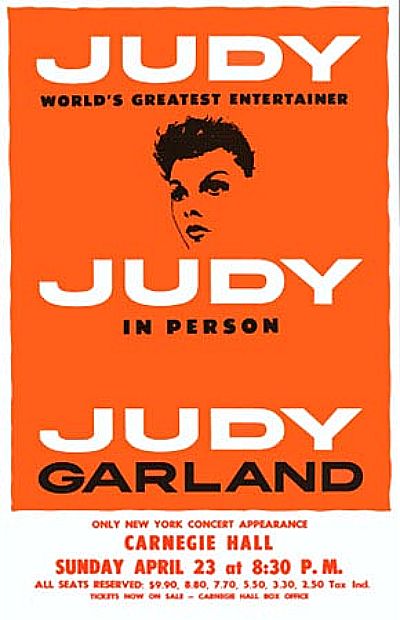
In the annals of showbiz history few one night events are as seismic as "Judy Judy Judy" the night Judy Garland hit Carnegie Hall, 50 years ago at this very moment, for her comeback performance. She was called many things during her legendary career: Hurricane Judy, The World's Greatest Entertainer, Ms. Showbiz and a lot of those titles coincide or funnel right into or through this big night. There's not really any concert footage of this event though it was famously recorded live to fulfill her record contract and eventually became her most important album.

I can't for the life of me remember how that Garland miniseries with Judy Davis covered the event but they must have done so given that it was one of those 'from cradle to grave' bios. Garland died just 8 years after this concert at the age of 47. Do you think the proposed Anne Hathaway as Judy Garland film will stretch this far into Judy's career? Or maybe it will never get made?

Hathaway is 28 years old at the moment, just ten years younger than Judy was on this big night...

Lots more after the jump including four melodic videos because I couldn't help myself. I do get carried away with the mythic actresses, don't I?

Click to read more ...

Sunday
Mar132011

Meet Me in St. Louis (1944)

To honor the passing of the great songwriter Hugh Martin Friday at 96 years of age, a repost of a review of one of my 100 favorite movies, a member of my personal canon. (If you joined us after 2008 you can pretend it's a new essay!) Imagine giving the world such perfectly crafted enduring gifts as "Have Yourself a Merry Little Christmas" and "The Trolley Song". R.I.P. Mr. Martin.

Meet Me in St. Louis "The Blossoming of Judy Garland"


Meet Me in St. Louis (1944)
Directed by Vincente Minnelli; Written by Irving Brecher and Fred F Finklehoffe from the novel "5135 Kensington" by Sally Benson; Starring Judy Garland, Mary Astor, Leon Ames, Margaret O'Brien, Lucille Bremer, Harry Davenport, June Lockhart, Tom Drake and Marjorie Main; Production & Distributor Metro-Goldwyn-Mayer (MGM); Released 11/28/1944

It's Summer 1903 in Missouri and the Smith family are buzzing about the World's Fair coming to their town the following spring. Teenage daughters Rose (Lucille Bremer) and Esther (Judy Garland) are dreaming about proposals from handsome men, the eldest son Lonnie (Henry H Daniels Jr) is off to college and the father Lon (Leon Ames), a junior partner at a law firm, is about to tell the family that they're all relocating to New York Ci -- oh, but let's stop there. For any plot summary of Meet Me in St. Louis does the movie a great disservice. This classic musical isn't plot driven at all so much as a series of three seasonal vignettes of family life: Summer, Autumn and Winter with the following Spring in 1904 serving as a coda. Almost all of what might be called "plot" in Meet Me In St. Louis is imagined. That is to say, that the story drivers are all in the future. One day the family will move to New York. One day Rose, Lonnie, and Esther will be married. One day St. Louis will catch the attention of the nation. In essence the movie is a lovingly rendered still life of a family (and town) on the brink of great changes rather than an animated portrait of the changes themselves.

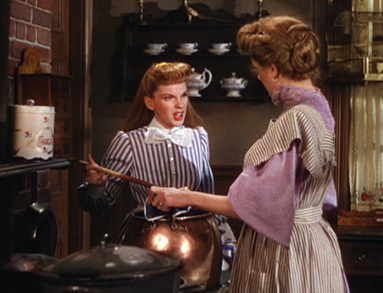
St. Louis begins smartly in the kitchen, the heart of any home. Mrs. Anna Smith (Mary Astor) and her maid and cook Katie (Marjorie Main) are preparing ketchup. Katie thinks it's too sweet, Anna thinks her husband will like it that way. Various members of the cast scoot through the kitchen sharing their opinions, too. They can't seem to agree on the flavor: too sweet? too sour? too spicy? too watery? Vincente Minnelli the real gourmet cook in the director's chair doesn't have the same problem. He gets everything right.

If the director was nervous about handling his first big budget color feature with a bonafide superstar in the lead role, you'd never know it from the results. Minnelli had only directed two black and white pictures (Cabin in the Sky, see previous article, and I Dood It both in 1943) prior to this big break but Meet Me In St Louis moves with such easy confidence, gently in and out of song and book scenes, you'd think he had nothing at all to prove.

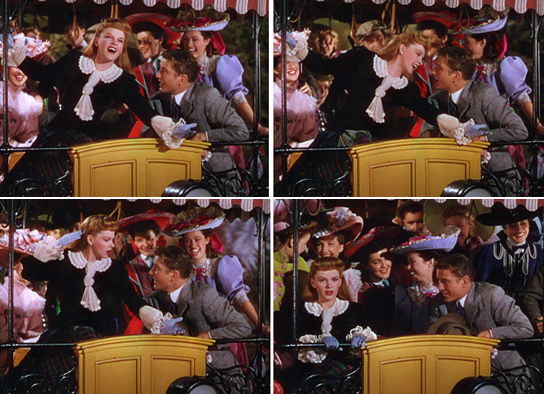
Take the terrific economy and pacing --the movie is at once both leisurely and jam packed with comic, musical and dramatic beats -- of the final two scenes that conclude the first and longest act in the movie (Summer 1903). First there's a lengthy party sequence at the Smith home wherein Esther comically tries to seduce "The Boy Next Door" John Pruett (Tom Drake). She's endearingly amateur at seduction though Judy Garland is of course anything but amateurish when it comes to ingratiating herself to the viewer. John accompanies her through her house as she turns off the lights. It's ostensibly her duty but she's makes a huge drawn out production of it -- she's only doing it to set the mood for their first kiss. The amusement of the scene is that Esther doesn't realize she's succeeding and misreads John's nerves and equally adolescent flirting. When he finally hightails it out of her house without the kiss she's been longing for she flips the lights back on, at once. It's a great deflating punchline. The follow up scene, the classic Trolley sequence, repeats the punchline.

Buzz, buzz, buzz went the buzzer
Plop, plop, plop went the wheels
Stop, stop, stop went my heartstrings

As he started to leave, I took hold of his sleeve with my hand
And as if it were planned... he stayed on with me
And it was grand just to stand with his hand holding mine
To the end of the line.
Esther is obviously singing/dreaming about John but hasn't noticed his arrival beside her for the last chorus. On her last joyous note she turns to finds the object of her affections staring her in the face. It totally throws her. Oops! Once again she's more comfortable in the dream than in the reality. It's the perfect performance note to hit for this girl who is not quite yet a woman.


Speaking of which...

Judy Garland was 22 years old when St. Louis hit theaters. She was already a screen sensation with multiple Mickey Rooney hits and The Wizard of Oz behind her. According to reports she was hesitant to take this role, another teenage character, since she had wanted to move into more grown up roles. Esther Smith turned out to be just what she was after all along. The answer was right in front of her. (There's no place like home and all that).

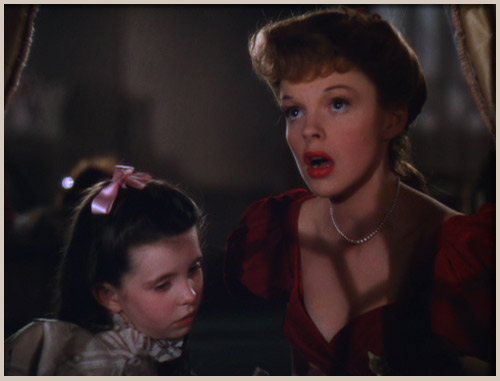
Esther Smith proved the perfect bridge role for one of the greatest stars of all time, taking Garland from teenager to woman both onscreen and off. By the third act (Winter 1903) Esther and John are in the thrall of requited love and faced with rather adult choices about their futures. By the time Esther is singing "Have Yourself a Merry Little Christmas" to her young sister Tootie (Margaret O'Brien), Judy Garland is a grown woman in full bloom and the camera treats her accordingly. By the time the film was released, Garland and Minnelli were in love and living together. It all came together gloriously. Arguably Meet Me in St. Louis (1944) is the emblematic peak of Garland's film career between her 'star is born' role in The Wizard of Oz (1939) to, well, A Star is Born (1954) itself.

But all this talk of Judy's blossoming (she was never lovelier onscreen), changing seasons, loving families and screen romances also does a disservice to the spicy flavors within this musical. While it is a sweet nostalgic slice of Americana, it never descends into mere treacly pablum. The Fall 1903 segment adds enough sour to the soup, focusing on the sometimes gruesome antics and morbid imaginations of Esther's young sisters Agnes (Joan Carroll) and particularly Tootie played by child star Margaret O'Brien who received a juvenile Academy Award for her performance --just like her co-star had in The Wizard of Oz. And the delicate balance of flavors continues all through The Winter 1903 segment when Rose and Esther behave badly at a local dance. One particular bit has Esther putting on her first corset. Rather than play up the beauty of her figure, Minnelli and Garland opt to spike the scene with laughs and physical comedy.


I feel elegant but I can't breathe.

Furthermore, the sweetness of Esther and John's romance is tempered with their very un movie-like (if barely acknowledged) realization that they're moving too quickly. The movie never settles for just one flavor. In short, it's delicious. Or, to quote Esther herself, "heavenly... simply heavenly".


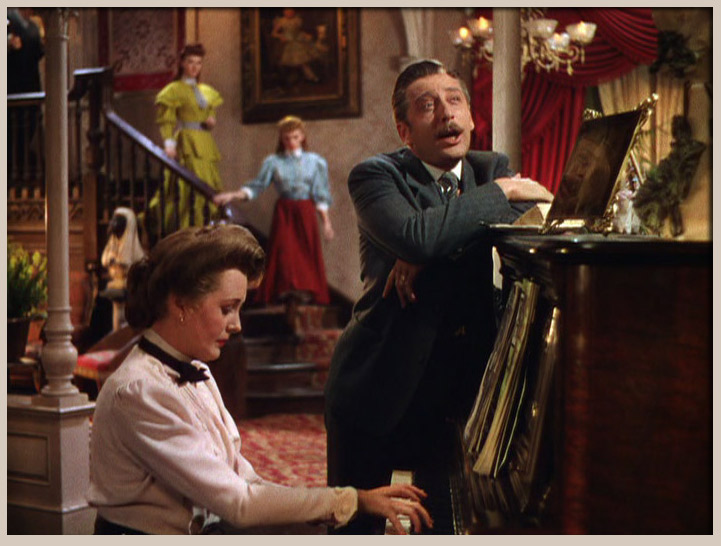
For all of the undoubtedly careful mix of moods and delicate character arcs that Minnelli stirs into his career-making hit, the most impressive thing might well be how effortless his achievement plays. With the semi resurgence of the film musical in the Aughts, much has been written about modern audiences hesistation to suspend their disbelief when characters burst into song. Modern musicals still feel a bit tentative, like they're scared to do at all what musicals are best at doing. Today's filmmakers would do well to study Meet Me In St. Louis which fills its central family's life with music: they hum, they sing phrases of songs even when no production number is on the way, they play piano; Music feels as natural here as it's ever felt in a movie. The space between musical performance and acting of the non-singing variety is blissfully blurred. In the Trolley Song sequence already discussed Judy spends the first verse of the song fretting. She's not singing at all, letting the crowd handle the number as she makes her way through the crowded car. By the time she's spotted her would be man running toward the car (He hadn't forgotten her invitation after all!) the sudden lift in her spirits is expressed quite naturally by her joining in... Everyone else is singing, why shouldn't she? There's another wonderful moment late in the film which I think best expresses Minnelli's graceful direction through performance, plot and song. Mr and Mrs Smith have had a row over the family's impending move to New York and their children have already exited the scene in anger. The mother and father begin to make peace at the piano. And as the father's voice lifts, the sisters are all gently coaxed back into frame, with unspoken forgiveness on their minds. It's a beautiful grace note in an altogether heavenly movie. A


Wednesday
Mar022011

James & Anne & Mickey & Judy

Editor's note: This is my final Oscar column for Tribeca Film to wrap up awards season. Thanks for your patience. I'd intended to do a lot more right here but I'm in day 3 of flu and about to pass out again. If you're not done talking Oscar night, let me know by commenting. But here it is.

Early on Oscar night, the legendary actor Kirk Douglas took to the stage to present Best Supporting Actress. (Oscar producers wisely throw one of the big awards near the beginning each year lest the least committed viewers click away.) "Spartacus" himself, still an entertainer at 94, didn't make you wait for the envelope reveal for a show—he was hamming it up from his cane-walking entrance to his purposefully distracted, drawn-out announcement of the winner. Before he even got to the nominees, he stopped to joke with the youngest hosts Oscar has ever had, 32-year-old James Franco and 28-year-old Anne Hathaway. To the giggling, girlish Hathaway, he said, "Where were you when I was making movies?"

The irony, if you stop to think about, is that she was around back then. Not “Anne Hathaway,” exactly, mind you, but earlier incarnations of her...

Read the rest at Tribeca Film

Now that the 83rd Oscar dust has settled, how are you feeling about them?

Page 1 ... 20 21 22 23 24