Oscar History
Film Bitch History
Welcome

The Film Experience™ was created by Nathaniel R. All material herein is written by our team. (This site is not for profit but for an expression of love for cinema & adjacent artforms.)

Follow TFE on Substackd

Powered by Squarespace
DON'T MISS THIS

Oscar Volleys - one week until the big night!  


COMMENTS
What'cha Looking For?
Subscribe

Entries in Cinematography (394)

Friday
Oct122012

RIP Harris Savides

Truly sad to hear about the passing of one of the great cinematographers, Harris Savides. Given his visual craft and my lack of a free moment at this very moment, a video tribute seems more appropriate than any words I could hastily write so I'm sharing this beautiful visual essay from Press Play.

Press Play VIDEO ESSAY: In Memory of Harris Savides (1957-2012) from Nelson Carvajal on Vimeo.


I knew they'd use the Birth score. How could they not? We've lost a great.

RIP Harris Savides and thank you most especially for your work on Birth, Milk, and Zodiac and your gorgeous record-breaking* work on haunting music videos like these...

*little known factoid: Harris Savides has won more "best cinematography" awards at the MTV Music Video Awards than any other DP. He won three for those two videos and R.E.M.'s "Everybody Hurts"

Friday
Sep282012

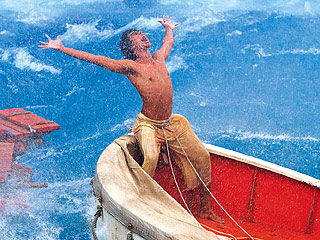
Life of Pi and other movies inside my head. It's a zoo in there.

My head is all ascramble. Last thing I know I was boozing it up with Joaquin* Suddenly I'm waking up adrift in the ocean** with only my beloved dog***, who I'd just brought back from the dead ****, and a fierce Bengal tiger for company. All of this while trying to chase and kill an older version of myself from the future ***** ! 

Which movies are jostling around inside your head right now vying for attention? Which one is winning?

* The Master ** Life of Pi *** Bwakaw **** Frankenweenie ****** Looper 
(Thoughts coming on all of those pictures -- a streak of happy moviegoing -- though not in that order as soon as I can collect myself.)

P.S. I'm aware that I'm burying the headline which is that I've just seen Life of Pi. Judging on the joygasms on twitter, it looks like a critical crowdpleaser and a bonafide Oscar contender. I was less ecstatic but boy does it look good. Cinematography nomination #2 for Claudio Miranda (The Curious Case of Benjamin Button) coming right up. Yes, I'll update the Oscar charts this weekend. A lot of adjustments are due from shifting release dates and buzz.

Friday
Aug242012

Two Tolands

Matt here. Earlier, I wrote about Gregg Toland as Teresa Wright’s accomplice in manufacturing the luminance of William Wyler’s 1946 film, Best Years of Our Lives. If anyone is unfamiliar with Toland’s name, you’ve certainly seen his work. He’s the cinematographer responsible for Citizen Kane, The Best Years of Our Lives, Wuthering Heights, and The Grapes of Wrath. He could be considered as much of an auteur as many of the great directors, leaving a fairly recognizable stamp on anything bearing his name. Orson Welles cemented his legacy when he decided to share his title card with Toland at the end of Kane.

Anyway, Toland came to mind earlier and it made me think about how, among his innumerable virtues, his most important skill was his ability to adapt. It’s fascinating to see how his trademarks (deep focus, risky lighting, etc.) shifted to suit whatever director he worked with.

Deep focus existed before Toland, but he taught the world to see it as an extension of the cinematic language. As the best filmmakers do, he used the camera to define the emotional implications of the script. In Citizen Kane, Toland’s methods suggested the deep tragedy of the film and helped the audience to understand Charles Foster Kane merely by looking at him. You could probably watch Kane on mute and still comprehend the characterization.

At his best, Toland told the story with his camera. Deep focus is used to isolate characters in Kane – detailing their proportion to the world around them. Characters occupy different parts of the screen depending their emotional status. But in Best Years of Our Lives, deep focus is used to bring characters together.

By the time The Best Years of Our Lives rolled around, Toland was secure in his technique. His impeccable style and clarity adjusted to combine brilliantly with William Wyler's organizational fixation. When Al returns home and so timidly walks into his own home (after ringing the doorbell, no less), he embraces his wife about 20 feet away from the camera, down a long hallway. They are nicely in focus and so are their children, standing 5 feet away.

By comparing Toland's use of deep focus in Best Years of Our Lives with something like Kane, we begin to notice how his gift wasn't only in choosing lenses – it was in his wisdom of when and how to use them. With Wyler, Toland used the device to synchronize with his organizational instinct and his obsession with neatness. Welles, on the other hand, encouraged deep focus to occupy a component of Kane's megalomania, to follow him down the barrel of the gun. Same method. Two wildly different results.

Monday
Aug202012

To Our San Francisco Readers

I lost my ship."

See it Tuesday night (tomorrow) and report back!

♥ the Castro Theatre.

Thursday
Aug022012

Best Shot: "How to Marry a Millionaire"

Hit Me With Your Best Shot, our series in which all participating movielovers argue for what is a particular movie's best shot, just keeps on surprising me. I've learned so much about the movies by doing it: what I personally respond to, how often a single image is dependent on the editing around it or the scenes preceding it for its punch, and that the most brilliant images tend to either define an entire movie OR illuminate a very particular piece of its identity. Best of all, I've learned things I couldn't have learned without an extra set of eyeballs... yours. Last week, for example, I came to appreciate The Royal Tenenbaums, in whole new ways via the posts on other blogs. Which is why I'm super anxious to read this week's entries. Because this week's movie, the romantic comedy How To Marry a Millionaire (1953) which was a favorite of mine as a teenager, left me very uninspired. I hadn't remembered how unambitious the visuals were, lazily trusting that Cinemascope would provide us with terrific images.

Which is, come to think of it, what many filmmakers did in the early days of Cinemascope. I've joked before that rectangles > squares but shapes are neutral. It's up to the filmmaker to know what to use a movie's shape for, be that square or rectangular or circle (should the movies ever get round)
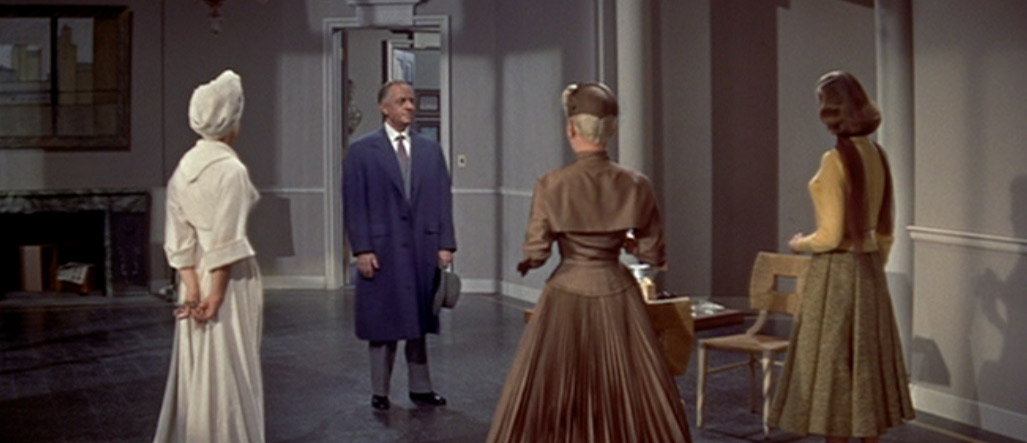
So my choice for best shot makes good use of the Cinemascope. The Cinemascope allows this image above to be expansive while the blocking reveals a tight trap. The moment  comes early in the movie when the three golddiggers (Marilyn Monroe as "Pola", Betty Grable as "Loco", and Lauren Bacall as "Shatze"-- delicious character names!) think they've snared their first 'bear', a millionaire by the name of J.D. (William Powell, extremely well cast). The girls aren't greedy *cough* and have already agreed that even just one millionaire will do.

You only need one!

For a brief flash with all their backs are turned to the camera, it's easy to imagine a much creepier movie wherein the ladies pounce in for the kill. They're essentially predators, after all, sexy spiders slinking around their phony web (Manhattan condo with terrace) for billionaire flies.

While How to Marry is good popcorn fun, especially for Monroe's adorkable blind as a bat insecurities and Bacall's elegant snobbery as she looks down her nose at everyone and everything (including herself!), it's not much more than that. It feels padded even at only an hour and a half (is it the weirdly sleepy editing?) and the visuals are the least interesting thing about it. This is the only film we've covered where I had absolutely zero indecision about which shot to use. I'm a sucker for a continuous shot and if How to Marry's collection of them didn't feel so much like a filmed stage play (I actually wanted more cutting; that's so weird for me) they'd be a lot more exciting. But this one is a keeper. The middle 'backs to the camera' bit when the ladies pander to and coo at the squirming millionaire is perfect. The cherry on top is that the shot (and scene) ends with a delicious triple diva walk to the camera, all three stars really giving it to the camera... in character no less!
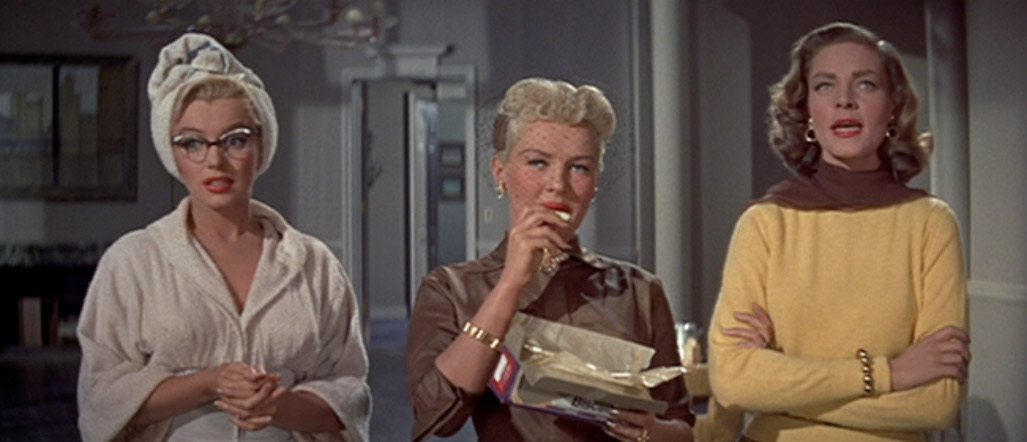
I think this is it kids, a great big room filled with nothing but rich millionaires. And us."

How To Discover Great Blogs (2012)
[Hint: click on them] 
Against the Hype Monroe, Gable and Bacall existing in the same universe?
Amiresque gets dreamy with Betty Grable 
Antagony & Ecstacy a passing of the sex goddess torch
Armchair Audience Bacall sure can move across a screen. But does she choose the right man?
Dial P For Popcorn moments that stick with you
Encore's World in most intrigued by the revealing shots of the threesome.
Film Actually Best Shot = Best Comic Timing
Movies Kick Ass 'there's no business like men business'

Final Three Episodes of Season Three:
Buster Keaton's Sherlock Jr (August 8th), Singin' in the Rain (August 15th), and Dog Day Afternoon (August 22nd). JOIN US. WHAT WILL YOU CHOOSE AS BEST SHOT?