Oscar History
Film Bitch History
Welcome

The Film Experience™ was created by Nathaniel R. All material herein is written by our team. (This site is not for profit but for an expression of love for cinema & adjacent artforms.)

Follow TFE on Substackd

Powered by Squarespace
What'cha Looking For?
Subscribe

Entries in Old Hollywood (180)

Wednesday
Apr022014

A Year With Kate: Bringing Up Baby (1938)

Episode 14 of 52 from Anne Marie's series screening Katharine Hepburn's films in chronological order.
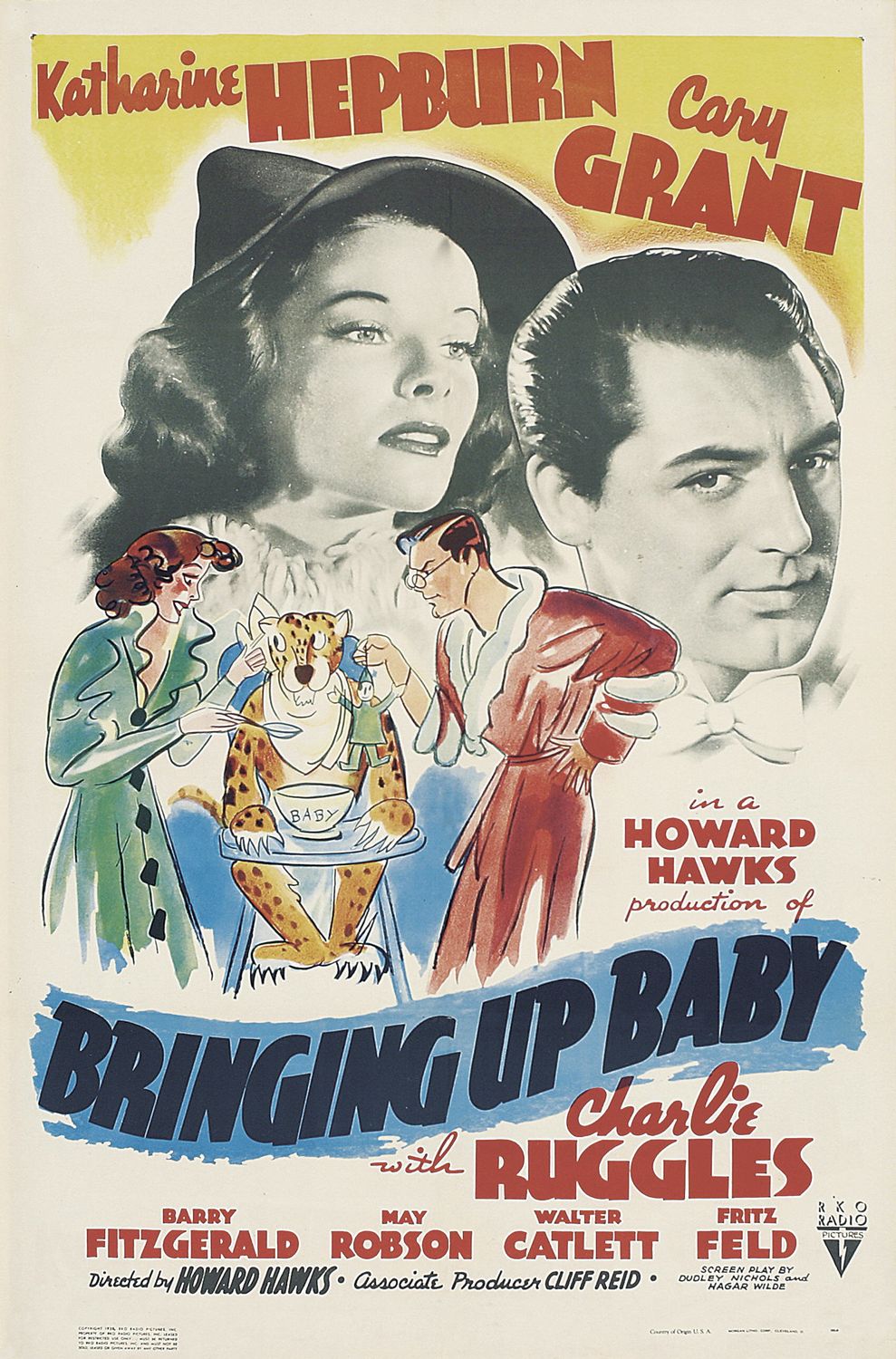
In which there is a leopard on your roof and it’s my leopard and I have to get it down and to get it down I have to sing!

Bringing Up Baby is a movie I’m honestly a little afraid to discuss. This golden Howard Hawks comedy about a befuddled professor (Cary Grant), a ditzy socialite (Kate) and a leopard (Baby), rightly occupies many “best of” lists. But while we all know the legend behind the film--troubled production, loses money, critically panned, “box office poison,” etc--the reality is a little less dramatic. Well, except the critically panned part:

“In Bringing Up Baby Miss Hepburn has a role which calls for her to be breathless, senseless, and terribly, terribly fatiguing. She succeeds, and we can be callous enough to hint it is not entirely a matter of performance.”

In March of 1938, New York Times film critic Frank S. Nugent devoted not one but two columns to eviscerating Bringing Up Baby. Though he was only one voice - Bringing Up Baby received mixed reviews both negative and positive - his vitriol cast a pall over the film’s reputation. It hurts my sense of justice that Nugent was allowed to say such terrible things about Hepburn and Bringing Up Baby, yet Kate never responded. I refuse to let that stand.

What follows are quotes from Nugent’s March 4th and 13th reviews (best read in the voice of Addison de Witt) with rebuttals taken from the film. After 76 years, Kate should get the last word.

Click to read more ...

Wednesday
Mar262014

A Year With Kate: Stage Door (1937)

Episode 13 of 52 wherein Anne Marie screens all of Katharine Hepburn's films in chronological order.

In which we've finally made it to the good stuff, so let's celebrate with Katharine Hepburn vs Ginger Rogers in a battle of the stars.

Hallelujah! Katharine Hepburn has arrived! From the ashes of Quality Street she rises, patrician and perfect. After 12 weeks of inconsistent performances, to suddenly be confronted with Kate in all her Mid-Atlantic, New England-born, iron spined, pants-wearing glory is a downright religious experience. And lo, Katharine Hepburn did star in a Kaufman and Ferber adaptation, and it was good.

Stage Door is the limelight dramedy of a gaggle of Broadway hopefuls living at the fictional Footlights Club in New York. The original play was an ensemble piece, but director Gregory La Cava and writer Morrie Ryskind remade the the movie in the image of its stars. Ginger Rogers, then between musical blockbusters, stars as Jean Maitland, a cynical chorine who falls for a slimy producer (Adolph Menjou). Kate is Terry Randall, a rich New England girl who decides to make it in showbiz. Rounding out the cast are Eve Arden, Gail Patrick, Lucille Ball, baby-faced Ann Miller, and Andrea Leeds, whose bland Olivia de Havilland knock off somehow landed her an Oscar nomination, and therefore a mention here.

Catfights and calla lilies after the jump

Click to read more ...

Thursday
Mar202014

50 Years in the Pink

Tim here, extending our unexpected and unplanned tribute to 50-year-old Peter Sellers movies by one day, following Diana’s lovely tribute to The World of Henry Orient. For today marks the 50th anniversary of the U.S. release of The Pink Panther, the arch-‘60s caper film that begat Sellers’ iconic Inspector Jacques Clouseau, the pratfall-prone Frenchman who remains the actor’s most famous character this side of a certain wheelchair-bound ex-Nazi (and Dr. Strangelove ALSO opened in 1964, which was just an all-around great year for Sellers).

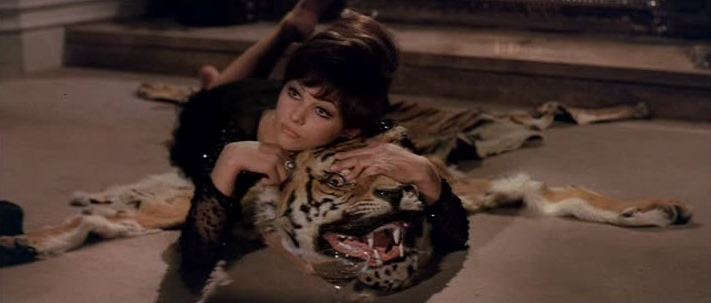
The film itself is a fascinating relic, a by-turns hilarious and lumpy encapsulation of what European high society looked like as filtered through the comic sensibilities of Blake Edwards of Tulsa, OK. Scenes of breathless physical comedy rub elbows with elegant caper film machinery and deadening longeurs as Claudia Cardinale rolls around on a tiger skin while suffering from a wobbly case of dubbing. [more...]

Click to read more ...

Wednesday
Mar192014

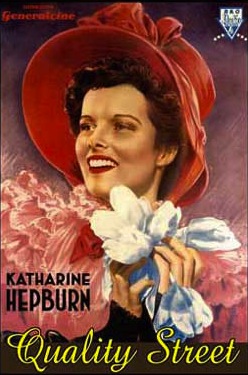
A Year With Kate: Quality Street (1937)

Episode 12 of 52 wherein Anne Marie screens all of Katharine Hepburn's films in chronological order

In which Katharine Hepburn is an old maid at 30 and sometimes I hate Old Hollywood.

It's strangely fitting that the last movie before Kate's string of classics turns out to be the worst film of her RKO career. Yes, I'm including Spitfire. Spitfire was laughably bad. Quality Street is downright insulting. But while groaning through the longest 82 minutes of my life, I did a little research, and I managed to solve the mystery behind the last 11 weeks of (mostly) bad movies. Better yet, I solved it with science. But first a little exposition.

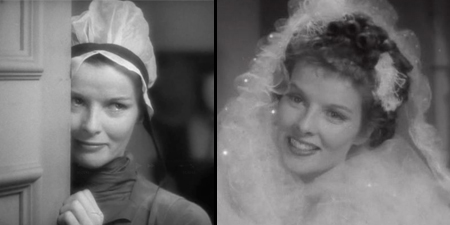
I've been informed that I occasionally skip over major movie details/actor information/whatnot. Here's a quick summary: Based on a J.M. Barrie play, Quality Street is the story of a spinster teacher who, at 30 years old, finds herself too worn and ugly for her recently-returned beau (Franchot Tone, remember him?). Determined to win his heart, the spinster disguises herself as her prettier, (fictional) younger niece. This only works because by Hollywood Logic, Hepburn's bonnets have the same beauty-dampening power as Rachael Leigh Cook's glasses in She's All That.

Click to read more ...

Monday
Mar172014

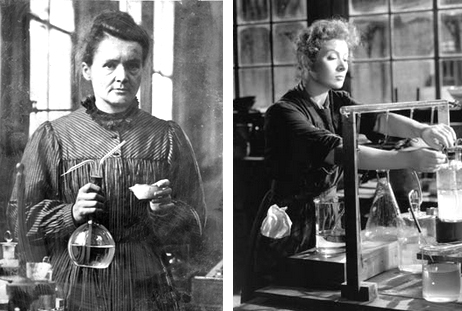
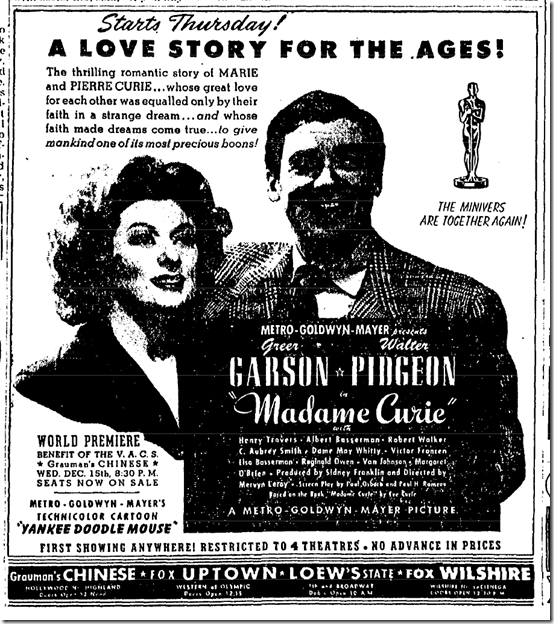
Women's History Month: Greer Garson as Marie Curie

Our celebration of Women's History Month continues with abstew's look at English Rose Greer Garson in a nearly-forgotten classic about one of the most important women in science. 

Marie Curie

Born: She was born Maria Sklodowska on November 7, 1867 in Warsaw, Poland. She was the youngest of five children and her father was a professor in the fields Marie would later study, mathematics and physics. 

Death: After years of being exposed to the radioactivity from her experiments (no Silkwood showers for Curie) and the X-ray carts she created and worked in during WWI, her life's work would ultimately bring about her own end. Curie died on July 4, 1934 of aplastic anemia, a disease that damages the bone marrow and blood stem cells caused by exposure to chemicals and radiation. In 1995, her remains were moved to the Panthéon in Paris. She is the only woman to be buried in the prestigious monument because of her own achievements.

Greer Garson's Madame Curie (1943) is after the jump

Click to read more ...