Nathaniel's adventures at TIFF. Day 2
Day 2 was just magical from start to finish with 3 great movies and 1 solid one. Two of the films you've already read about here in Sweden's stellar Oscar submission Force Majeure and Norway's Out of Nature about one man hiking around in the wilderness on a long weekend. I like to think of the latter as Norway's counterpart to Reese Witherspoon in Wild - which I'll be seeing soon - though I doubt Reese takes her clothes off for a wank and runs around starkers. Day 2 was something of a vignette day since I will remember it primarily as the day I saw Mike Leigh twice and hid from the rain with him (long story - save it for the podcast!), the day I scarfed down melted cheese sandwiches with Nick & Joe in an highly unglamorous take-out setting, and a day of not one but 2 great movies composed of vignettes.
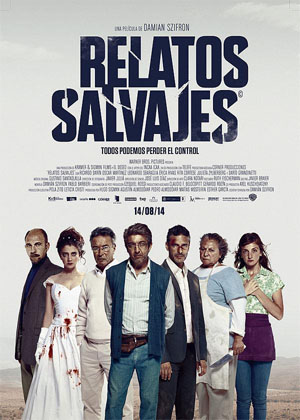 WILD TALES. an amazing Argentinian delightVignette films, like their cousin the omnibus, are tough beasts to pull off because you're essentially asking the audience to reinvest in the movie every 20 minutes or so, as if they've stumbled into a short film festival. They're also bound to feel uneven with some segments much richer than others. But here's two films that pull it off with real aplomb...
Argentina's Wild Tales is directed by Damián Szifrón but produced by TFE's favorite Pedro Almodóvar who I imagine is just thrilled with the results. It seems like a movie he would love what with its colorful characters, amusingly melodramatic and twisty stories, and at least three vivid female characters though it's not as actressy as his movies. Let's just say everyone in this six story movie is ...on the Edge of a Nervous Breakdown, and not just the women. Wild Tales was a big hit at Cannes earlier this year and it might possibly be Argentina's Oscar submission. It's easy to see why since the title is accurate. You feel like anything could happen primarily because not so very many minutes into the terrific opening vignette, it does. It starts just like any movie might with a beautiful woman being chatted up by a handsome older stranger as their flight takes off. But then they realize they have an acquaintance in common. Another passenger overhears them, interrupts and...
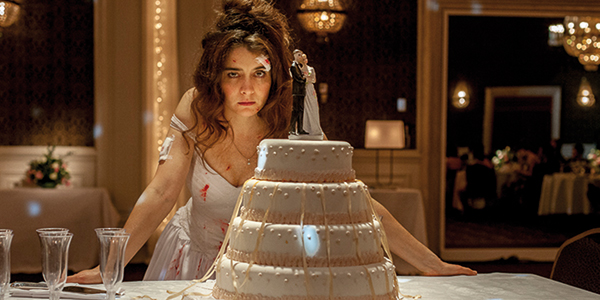
No, I shan't tell you more because this movie is best seen cold as the surprises are half the fun. Let's just say this free-fall into insanity sets the tone for the whole film which plays like a highwire act of dark comedy, violent thrills, and romances gone awry. Of the six segments, of which only one is just "good" (that'd be the one starring Argentinian cinema's Mr Ubiquitous Ricardo Darin), I had two favorites. The third vignette takes place on a long stretch of dusty highway where two men piss each other off while driving. Neither of them can let any affront go. It's a stretch of cinema that should make the majority of the world's action directors ashamed of themselves for not bothering to pack in as many thrills and cleverly choreographed beats into 2 hours that Szifron manages in 20 minutes. The final sequence centering on a wedding reception that goes sour and descends into utter chaos is also pretty damn great, and funny too. Don't read anything more about it and if gets released, jump in. A-
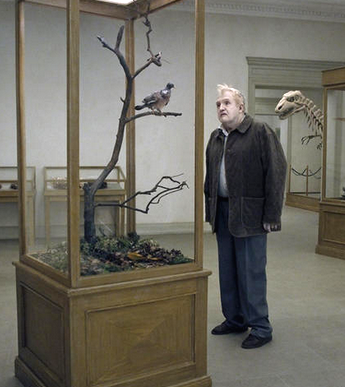 VENICE GOLDEN LION WINNER!
Sweden's A Pigeon Sat on a Branch Reflecting On Existence comes from one of Mike Leigh's favorite directors Roy Andersson. Hence the first Mike Leigh sighting of the day since he came to the show with Mr Turner's primary non-Timothy Spall Oscar contender Marion Bailey. The room was jam-packed with press many of whom were laughing out loud and very frequently which is not all that common in critics screenings, I have to tell you.
A Pigeon... which does indeed include pigeons sitting on branches (albeit mostly offscreen), bills itself as the final part of a trilogy of what it means to be human. And it starts with three short scenes called "Three Encounters With Death" which are beyond hilarious. I will never forget the ancient little lady hanging tightly on to her purse because she wants to take it with her when she goes. Every scene in the film is its own little continuous shot vignette in which the camera does not move but the things within the frame do, albeit sometimes very slowly. The two most frequently recurring characters are gag salesmen who keep announcing that they're there to help people have fun but are the glummest downers you ever did see, perpetually frowning, failing, frumpy and shuffling as if they're zombies across Andersson's often brilliant mise-en-scène . Not that anyone in the frame looks "alive" per se, since Andersson's figures are nearly all chalky white with a touch of ginger in their hair. The salesmen turned out to be my least favorite running gag in the movie and definitely wore out their welcome a bit though they're super funny at first. My favorite recurring bit was the generic repetitive dialogue heard whenever anyone onscreen answers a telephone. As if all the disconnected oddness weren't perplexing enough, there are three amazing period piece scenes involving warring soldiers, a musical number in a diner, and a slave ship (a very disturbing sequence).
Andersson strikes me a singular director, but there is one comparison point I feel comfortable sharing. I kept thinking of Jacques Tati, because the longer you stare at the sometimes crowded sometimes spare shots, the funnier they become and the bigger their comic payoffs whenever anything changes within the frame you've been visually searching for more things to discover or giggle about. I'm still scratching my head over this film but I'm already kicking myself for having missed Andersson's previous films. Several people have told me that I would love them. They were right and I am a fool for taking so long to get to them. A-
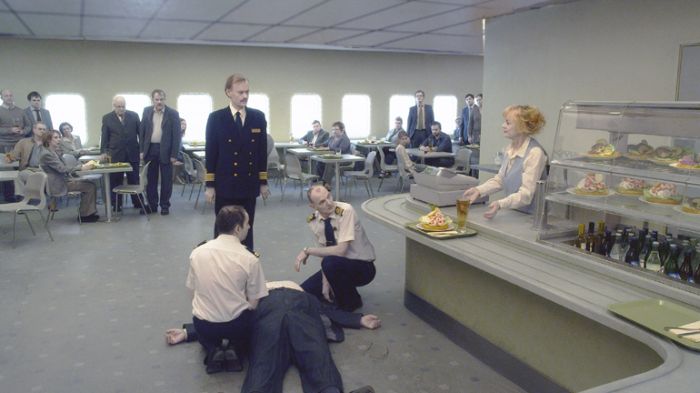 one of many screamingly funny but morbid scenes in "A Pigeon..."
Can you tell that I'm having a great great festival this year?



 Monday, September 8, 2014 at 11:00AM