Oscar History
Film Bitch History
Welcome

The Film Experience™ was created by Nathaniel R. All material herein is written by our team. (This site is not for profit but for an expression of love for cinema & adjacent artforms.)

Follow TFE on Substackd

Powered by Squarespace
What'cha Looking For?
Subscribe

Entries in gender politics (231)

Thursday
Nov122015

Foreign Quickies: Mustang, El Club, Ixcanul

Three quick takes on foreign film competitors from the long list of eligible titles, all screened at AFI.

Mustang (France) Opens November 20th in select cities. Cohen Media Group.
Given that 2015's loudest topic may well be the need for fresh cinematic female voices, the French/Turkish production Mustang deserves $100 million blockbuster status instead of art house ghettoization with a $300,000 gross which is what they're infinitely more likely to get. Director Deniz Gamze Ergüven and screenwriter Alice Winocour, two very talented women, team up to tell the riveting story of five spirited sisters living with their hands-off grandma who keep colliding with the confines, literal and metaphoric, of the patriarchy. An innocent 'schools out for the summer' beach romp prompts the end of their adolescent abandon as their horrified conservative uncle steps in to shape them up, train them to be subservient wives, and marry them off to respectable families. Though the premise is reminiscent of Sofia Coppola's elegiac and dreamy Virgin Suicides, the execution is not. Ergüven and Winocour are more physically grounded and rambunctous in their presentation and there is no distancing conceit of viewing the sisters through the eyes of boys. Mustang has successfully rowdy comedic moments, an earthy non-exploitive sensuality, often clever visual framing, and even a hard-won scrappy optimism to balance out its tough reality checks. In short: it's excellent. Let's hope the Foreign Film Oscar Committee agrees. A- 
(See also: Amir's TIFF Review)

 

Ixcanul (Guatemala) -Kino Lorber will distribute in the US. Dates TBA
At the well attended premiere of this memorable Guatemalan Oscar submission (their first!), the director brought out, not one of the actresses, but an older woman dressed in South American finery who was some kind of public official/icon (the applause was so loud I missed her title/name). The takeaway of the intro was that Guatemala has a tiny but newly excited film industry and they're extremely proud of this little movie. As well they should be. Ixcanul (or Volcano) looks at a poverty-stricken Kaqchikel family, living next to an active volcano and working on a coffee plantation. The volcano, in addition to being a beautiful and alien visual backdrop for a movie is also a monolithic wall, blocking their view of the rest of the world; Mexico and the United States, to the North, are more myth than reality. The family hopes to marry their sexually curious daughter off to their comparatively rich boss and thereby lift all their futures. Needless to say, things don't go as planned. While the actions of nearly all the characters are often enraging, Ixcanul is never mean spirited, condemning the exploitation of their ignorance rather than the ignorance itself. (One heartbreaking emergy trip to a nearby city shows the family utterly at the mercy of an untrustworthy translator since they don't even speak Spanish in the mountains.) Bustamante's well crafted film is authentically steeped in a nearly alien culture but its humanity is entirely familiar. B

 

El Club (Chile) - Music Box Films will distribute in the US. Dates TBA
My first encounter with the acclaimed director Pablo Larrain was the violent Tony Manero, a film about a Chilean sociopath obsessed with winning a Saturday Night Fever lookalike contest. It was altogether unsavory and though the director's command was evident I couldn't wait for it to end. The second was the wondrous No, starring Gael García Bernal as an unlikely hero who helps rid his country of their dictator through an unlikely ad campaign. Though not without its necessarily dark moments -- all the Larrain films I've seen take place during the Pinochet era in Chile -- it was an exuberant, moving, and technically amazing film which I was happy to champion; it went on to be nominated for Best Foreign Film at the Oscars. The third encounter is, sadly, more reminiscent of the first in its absolute mandate to rub your face, artfully, in brutal shit.

The film begins deceptively as a mellow observational drama about a strange retirement community in a yellow house by the sea. Shortly, though, the curtain of ambiguity is lifted by an uninvited drunk stranger who stands outside the house spewing a hostel tirade of obscenities. The house, you immediately realize, is a shelter/prison for criminal priests that the Catholic Church is hiding away and the man shouting was one of their victims, repeatedly raped as a young boy. The depressing reveal deepens when you realizes that there are houses like this all over the world. 

Fans of disturbing cinema might admire Larraîn's chutzpah but everyone else should steer clear. Though the film has strong performances, particularly Antonia Zegers as a despicable nun and Marcelo Alonso as a remarkably stone-faced priest sent to assess the inhabitants of the house, it's a tough sit through spiritual rationalization, disturbing psychologies, and actual brutality [SPOILER WARNING] Animals are viciously killed in the film -- albeit just barely off camera -- and I never would have seen it if I had known. [/SPOILER]. Even the resolution, which could be read as spiritually uplifting is ambiguous; it played for me more like a sick pitch-black joke about "penance" and "redemption". (I will be wary of seeing another Larraîn film despite my love for No.) No Rating.

Wednesday
Nov042015

Topic Du Jour: Female Directors

If you haven't read Vulture's list of 100 female directors Hollywood could be hiring you should. It's a great 'shut your mouth' argument for those suits that hilariously say 'well, we would hire female directors if there were any!' Bless Kyle Buchanan for spearheading this -- though I hope he had interns helping.  Naturally there will be passionate responses. Diversity arguments will always promote some degree of snark -- see Anthony Mackie's recent comments about the Black Panther movie's search for a director -- and nitpicking, including here.

But we nitpick with love.

David Poland argues that "strategy," not shaming, is what's required and that statistics and math won't help. He neglects to detail the strategy though. As for myself I (mostly) love the list and think it's important that a wake up call like this is out there -- what did happen to Laverne herself, Penny Marshall, who directed so many huge hits in the 80s and 90s? It's smart to make the list far reaching and extensive but some of the people are not reasonable for an argument either because their careers have been over for so long or because...wait for it... they aren't good directors. (Obviously there are many bad directors with penises who get lots of work. But we'd like them to find other jobs, too!)  

Click to read more ...

Monday
Nov022015

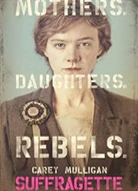
"Suffragette" Shoulders into the Oscar Fray

Is “Suffragette” faltering under the weight of overly high expectations?  With its impressive pedigree and unimpeachable subject matter, Sarah Gavron’s historical drama about the militant wing of the British suffragist movement seemed poised to be a strong Oscar contender for this fall.  Now, as we move towards the holidays, its status is looking uncertain: reviews have been mixed, and it’s drawn criticism for everything from its limited narrative focus to the limited screen time of Meryl Streep, who receives top of the line billing for a role that’s essentially no more than a cameo.  

If there’s a common trend to the criticism, it’s that the critics seem mostly preoccupied with what the movie doesn't do rather than what it does.  “Suffragette” is less a historical chronicle of the suffragettes than a snapshot view through the eyes of one (fictional) working class woman who’s accidentally and at first reluctantly drafted into their ranks.  It’s a study of what circumstances would drive such a woman to join a movement that would seem to hold no immediate benefit or attraction for someone in her position.  [more...]

Click to read more ...

Thursday
Oct082015

Oscar's Foreign Race Pt 2: Female Directors & Debut Filmmakers

Pt 1 - All 81 Movie Trailers
Pt 2 Everything You Wanted to Know About the Foreign Language Film Category...  *But Were Afraid to Ask

Mustang has a female director and female cast. Will this be a good year for women in Oscar's Foreign Film race?

The next time you see someone tweeting about the lack of female directors that get work in Hollywood, please point them to Oscar's Foreign Language Film category. This category reminds us, year after year, that Hollywood is not the entirety of Cinema. We'd do well to commit that to memory. And progressive thinking moviegoers would do well to seek out the alternate voices that already exist that they say they want... even if that requires reading subtitles.

You see, each year countries around the world are asked to submit one film to represent their entire country at the Oscars (it need no longer be in an indigenous language to that country, just not in English). Each year at least a handful of countries submit films directed by women. This year it's much more than that. Now, that might not be a direct correlative to "it's better for female directors in ____ than in the USA" but it's not nothing!

Consider the act in reverse. Can you imagine Hollywood, if they were forced to submit one film that represented them for a whole calendar year, choosing a female-directed film to speak for them? Given their lack of interest in films about women let alone films directed by them, this seems unthinkable. The sole exception is probably Kathryn Bigelow's military drama The Hurt Locker (2009). 

Where are the Women? Right Here!
This year the Oscar race for Best Foreign Language Film has 81 contenders. A total of 13 of those films are directed or co-directed by women. [More...]

Click to read more ...

Sunday
Oct042015

Stage Door: Nicole Kidman in Photograph 51

Stage Door is taking a little trip across the Atlantic, since David is lucky enough to live in London, where TFE deity Nicole Kidman is currently treading the boards in Photograph 51.

Every article announcing Nicole Kidman’s return to the London stage made reference to the infamous review labeling her “pure theatrical Viagra” when she first played in the West End in 1998’s The Blue Room. Seventeen years on, the subject of Photograph 51 could hardly seem more antithetical: Rosalind Franklin’s passion in life is her work, the groundbreaking research into the structure of DNA, her part in which has been forgotten by mainstream history, partially due to her premature death from ovarian cancer before her male peers were awarded the Nobel Prize for their work.

Click to read more ...