Oscar History
Film Bitch History
Welcome

The Film Experience™ was created by Nathaniel R. All material herein is written by our team. (This site is not for profit but for an expression of love for cinema & adjacent artforms.)

Follow TFE on Substackd

Powered by Squarespace
DON'T MISS THIS
COMMENTS


What'cha Looking For?
Subscribe
Thursday
Apr052018

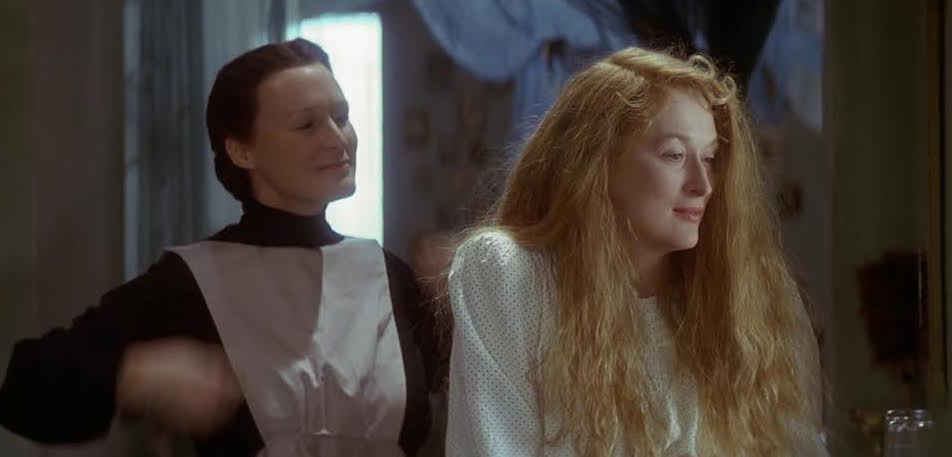
Months of Meryl: Ironweed (1987)

John and Matthew are watching every single live-action film starring Meryl Streep. 

 #14 — Helen Archer, a dying homeless alcoholic.

JOHN: Behold, the most devastating sequel to Heartburn imaginable. Directed by Hector Babenco and adapted by William Kennedy from his own Pulitzer-winning novel, Ironweed follows Francis (Jack Nicholson) and Helen (Streep), two homeless drifters biding their time and eking out their lives in Depression-era Albany. At nearly two and a half hours long, Ironweed is a bleak, wrenching study of poverty with nary a promise of redemption in sight. We’re talking about a movie whose most uplifting and musical scene is chased with a crushing dose of hopeless reality, a movie in which dogs assail a woman’s frozen corpse outside a church, digging graves is considered a good day’s work, and ramshackle vagrants pray they drink enough liquor to die in their sleep. It’s a tough sell and an even tougher sit, but Ironweed features one of Streep’s most spellbinding transformations.

Helen Archer does not make her entrance for a good twenty minutes. First we watch Nicholson’s Francis dig graves, slug whiskey, and fecklessly address the headstone of his deceased infant son, who he dropped and killed in a drunken daze. In the basement of a church serving free hot meals for the homeless, Helen slips through the door, a regular who, after some time away, returns to more of the same, reuniting with her moribund companion Francis. Streep’s Helen is shrewd enough to get herself warm and fed, but something about Helen suggests that she isn’t entirely there; it’s almost as if she is suspended halfway between life and death, past and present.

Helen, who we will come to learn is a former singer and concert pianist, constantly recollects the glory of her dashed dreams with utmost clarity, as again Streep is able to conjure a memory so expressively that one believes it to be as true as fact...

Click to read more ...

Thursday
Apr052018

So many questions about the next Best Actor race

by Nathaniel R

Nicole Kidman and Lucas Hedges in "Boy Erased"

Resarch is coming along for the April Foolish Oscar predictions and since y'all were so helpful in extending the early Best Actress possibilities list, let's do the same for Best Actor, shall we? An early alphabetical list of leading men is after the jump...

Click to read more ...

Wednesday
Apr042018

The Men in the High Castles

Jason Adams reviews Chappaquidick, new in theaters this Friday

"I am a collage of unaccounted for brushstrokes - I am all random." Those are among the last words spoken by Stockard Channing's character in Six Degrees of Separation as she flees another ritzy party, her sense of self in tatters. Who are we, just an assemblage of stories we tell ourselves, and others? Is there something in between the molecules, if you drill down deep enough, or does infinite digging render everything dug? When we get up and look at ourselves in the mirror in the morning, are our eyes showing us Fake News? The post-modern self is an existential crisis in overdrive, but at a certain point don't you have to just stop drilling and take stock of what you actually see? Where does the scrutinizing of facts end and the perversion of them begin? Who writes our histories?

On July 18th, 1969 in Chappaquiddick, Massachusetts, Ted Kennedy drove off a bridge and a 29-year-old woman named Mary Jo Kopechne died. What happened in the hours following that accident has been the subject of numerous books, not to mention many a feverish speculative daydream of right-leaning politicians and pundits. But it hasn't gotten the movie treatment until now with John Curran's Chappaquiddick, starring Jason Clarke as Kennedy and Kate Mara as Kopechne, out in theaters this Friday. Curran seeks to write that history...

Click to read more ...

Wednesday
Apr042018

Come to "Show Business: The Road to Broadway" this Sunday!

by Nathaniel R

Hello all. A week or so ago I moderated a screening of Mean Girls (2004) for Show-Score's new Stage and Screen series with two members of the new stage musical's team (The Broadway version of Tina Fey's classic officially opens this Sunday).

I'm doing another Q&A so come! This Sunday at 1:00 PM I'll be speaking with director/producer Dori Berinstein about her documentary Show Business: The Road to Broadway (2007) which follows four musicals during the seminal 2003/2004 Broadway season: the blockbuster Wicked, the little scrappy show that could (and did) Avenue Q, Tony Kushner and Jeanine Tesori's brilliant Caroline or Change, and the troubled Boy George musical Taboo.  I saw all the big shows that year (a rare occurrence) and loved all four of the musicals this doc follows so that season remains special to my heart.

The movie has awesome rehearsal and backstage footage and all sorts of brilliant taking heads like Tony Kushner, Carol Channing, Alan Cumming and many more.

Idina and Kristin rehearsing Wicked in 2003.

WhenSunday, April 8 at 1:00 PM
Where: Peter Norton Symphony Space's Leonard Nimoy Thalia (2537 Broadway at 95th).

If you'd like to attend as my guest, please e-mail me and I'll arrange it. Would love to have some TFE readers there! Come support my stage fright AND see a fun movie that isn't streaming anywhere.


Wednesday
Apr042018

Soundtracking: "2001: A Space Odyssey"

Stanley Kubrick's space saga is 50 this week! Here's Chris on its iconic music...

bwaamm bwaaammm bwaamMMM...
BAH BAHHHH
!!...

It’s as memorable a music cue as any in film history. Out of darkness, Stanley Kubrick opens his abract space opus 2001: A Space Odyssey to the stirrings of Richard Strauss’s Also sprach Zarathustra (the “Sunrise” movement specifically) with the sonic weight of impending creation. Or is it destruction?

Strauss’s composition carries throughout the final, creating an a link that ties its ambitious, fractured narrative together. By repeating the track, Kubrick shows how innovation, exploration, and even violence come from the same lifeforce, like a spiritual Big Bang. The music is a key to understand how the film explores human instincts against the nature of the universe: can they be both at odds while also being the same? The sheer force of the sound, the kind of music you feel deeper than your bones, is its own impenetrable force. For a movie that creates iconography out of a literal monolith, its biggest monolith might be its omnipresent orchestral sound.

Click to read more ...