Oscar History
Film Bitch History
Welcome

The Film Experience™ was created by Nathaniel R. All material herein is written by our team. (This site is not for profit but for an expression of love for cinema & adjacent artforms.)

Follow TFE on Substackd

Powered by Squarespace
What'cha Looking For?
Subscribe

Entries in Cinematography (395)

Thursday
Jul112013

Best Shot: Dead Ringers, Conjoined in Shadow

Hit Me With Your Best Shot happens each Wednesday night and usually spills on over into Thursday morning. Next week (July 17th) we're all looking at the practically perfect "Mary Poppins." This week: David Cronenberg's masterpiece...

Dead Ringers (1988)

For the uninitiated Dead Ringers (1988) is the 'Saga' of 'The Fabulous Mantle Brothers,' twin gynecologists Beverly (Jeremy Irons) and Elliott (Jeremy Irons again) and the 'destructive force' Claire (Genevieve Bujold) that separates them. I've put the air quotes in the synopsis since that's how Elliott, the more theatrical and dominant twin, and the elder by a few minutes, describes the movies from its insides. I don't want to spoil the movie if you haven't yet seen it but if you haven't (*cough* 25 years later) get on that! If you ask me Jeremy Irons deserved the Oscar he wasn't nominated for for this career topping performance(s). 

My earliest favorite movie was The Parent Trap (1961) which I watched on television countless times as a child. Though I realize it's hardly a unique fascination, twins have always done it for me. There's so much to explore and even more to never understand about the possible psychologies of two distinct people who are, genetically, the same person. Though I've seen David Cronenberg's Dead Ringers about four times now I confess that I usually have trouble differentiating Beverly and Elliott. But not this time. Visually, the clarity of their separateness, even though they're loathe to experience it as such, was riveting. Even the old trick of dividing the same actor on two sides of a clearly divided frame doesn't even feel like a sad necessity but the point.

Cronenberg's direction is so assured that you can pick a corker of a shot in virtually every scene as the Best Shot participants have done. Any number of shots will reveal top notch production design (also robbed of Oscar attention) by turning half the spaces into something out of a medical illustration, with intricate lines, weirdly sterile immobility and sleek curves and flat color. But this time through the shot that resonated most was simpler. And I don't even feel like it's cheating that I've chosen twin shots, one of Elliott and one of Beverly, which I've displayed in reverse chronological order. 

These shots are close in proximity in the narrative and each features one of the Mantle Twins reacting to Claire talking to him about the other Mantle Twin. Elliott (up top) is angry that Claire has entered the picture and attempts to intimidate her and seduce her but she won't be cowed. Nevertheless he's too cool and too controlled to lose his composure. The shadow only augments his sinister handsomeness, like a flattering accomplice in seduction and plotting. But Beverly, more emotional and more fluid, who so yearns for separation that he hides Elliot from Claire until this very scene, is also terrified by it. In this simple but brilliant shot he has been found out. Claire has uttered Elliott's name. This shadow neither conceals nor flatters; it merely wipes out his identity. Who is he without Elliott anyway?

For 12 other takes on this movie, please check out the rich array of articles provided by this week's Best Shot club in the visual index. 

Wednesday
Jul032013

Visual Index ~ American Graffiti's Best Shot(s)

Where were you on 7/2? Hopefully watching American Graffiti (1973) to better appreciate today's edition of "Hit Me With Your Best Shot", our collective series in which we invite anyone who loves movies  'round the web to select their favorite image from a pre-selected movie. [Next Wednesday we'll be discussing the brilliant and disturbing Dead Ringers (1988) so do not miss that.] This week we return to simpler times...

1962 by way of 1973, in point of fact, courtesy of George Lucas's first Best Picture nominee, the very fine nostalgia fest American Graffiti which we thought an appropriate choice for the 4th of July Holiday. more...

Click to read more ...

Friday
May312013

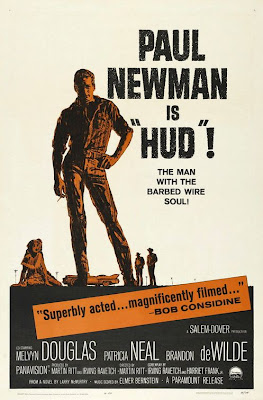
Visual Index ~ Hud's Best Shot(s)

I know it's my own fault since I failed to post on Fantasia last week but I was a bit sad that we had a lower than usual turnout for Hud for this week's "Best Shot" selection (the last of our weekly viewing assignments until the series returns in July for the second half of Season 4). If only so we could all enthuse together about one of the all time great taglines...

the man with the barbed wire soul

...and how it's not false advertising.  

I wish this fine western drama from Martin Ritt had a reputation as humongous as, oh, the one enjoyed by Who's Afraid of Virginia Woolf? which I reference primarily because it's also a electric quartet-powered black and white masterpiece from the 1960s and just as worthy of obsessing over.

The following shots, chosen by our wee club this week [more...]

Click to read more ...

Thursday
May302013

Cold Eyes and Weary Bodies in "Hud"

For this week's Hit Me With Your Best Shot we're celebrating Hud on it's 50th anniversary

Though I readily concede that its my own prejudices as a Yank and a cityboy that get in the way, I rarely associate nuanced feeling with the western genre or artful dialogue with a Texas twang. So Hud (1963) plays like a miracle to me, a major one. This adaptation of Larry McMurty's novel (he would later write screenplays including Brokeback Mountain, which plays like a distant cousin to this 1960s masterpiece) never feels anything less than authentic in its Southwestern reality and yet its pure poetry. Consider this callous but perfectly sculpted line of dialogue from Hud (Paul Newman in arguably his finest hour) to his nephew Lon (Brandon deWilde) who is worrying about Homer's (Melvyn Douglas), the paterfamilia's, waning health. 

Happens to everybody - horses, dogs, men; nobody gets out of life alive

But I'm not really here to talk about the rough beauty of the dialogue in Hud -- though it's never far from my mind -- but the language of the eyes and the body delivering it. And, I rush to add, the award-winning cinematography and composition which package the unimproveable ensemble up so potently. Look at the shadows and the way Newman, bathed in light, become a handsome devil (essentially the truth of his character) his famous blue eyes less like inviting pools of water than icy death. 

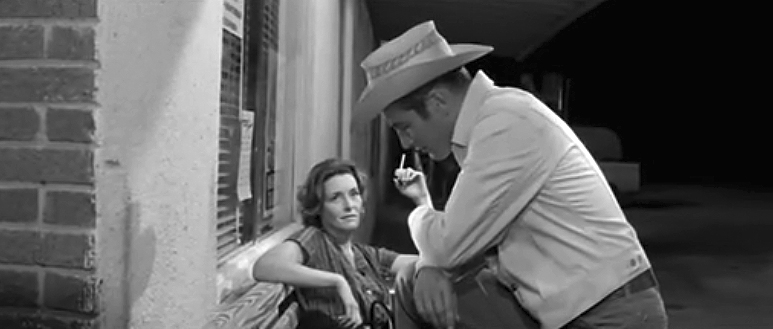
But we'll return to close ups shortly. Much of Hud is shot in medium and long shot and everywhere you look, limbs are dangling and swaying and whole bodies are sneaking brief moments of rest, perched on porches, settling into chairs, or suggestively refusing to leave their beds. Melvyn Douglas and Patricia Neal, as the family's housekeeper Alma, both won deserved Oscars for their inspired work, and they beautifully capture not just the details of their characters but the physicality of people who've worked their bodies every day of their lives whether cattle rustling or scrubbing dishes. The younger characters Lon and Hud, are less exhausted, though there's still a kind of future arthritic effort to their jerky performative posing. 

runner up for best shot. Hud is a big deal

Lonnie: I'll go with you Hud.
Hud: What big deal you got lined up, sport -  a snowcone or something?"

Take one of the best scenes in Hud on the porch of the family house while the characters eat peach ice cream and enter and exit the frame without the camera following them (though Hud is quite cinematic, this particular scene is blocked like a play). Lon and his granddad have a fascinatingly evasive exchange about Hud's dead brother (Lon's dad) and why Homer dislikes his only living son "He knows. You don't need to." Douglas delivers each line with evasive though never rude gruffness, his cards held tight to his chest. When Hud enters the scene and announces a run into town, Lon shifts his attention to the uncle he idolizes but doesn't understand. There's this exquisitely telling funny shot of him mirroring Hud's pose -- while Hud mocks him but invites him to tag along anyway. How brilliant that it takes a second to even figure whose shadow is thrown onto the wall.

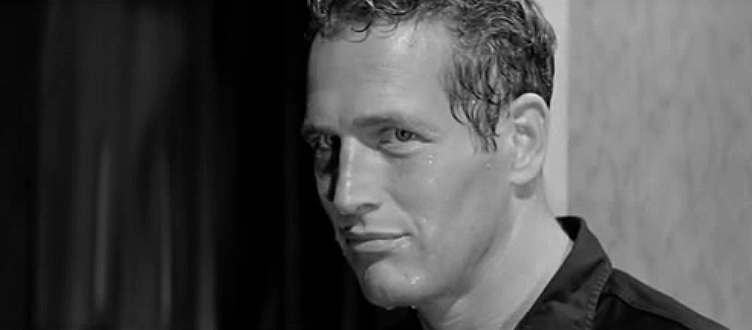
The withholding father and his ungrateful child finally  have it out in the film's centerpiece, a truly seismic emotional clash (the first hour being foreshadowing tremor and the second cruel aftershock) which Hud believes is entirely about his dead brother - the son Homer adored - which Homer denies. The righteous father tears into Hud as a man without principle, without empathy for his fellow man, without care for the world around him. Hud listens with silent hostility (he knows it's true) in one of the most gloriously lit and perfectly acted close-ups in all of cinema - my choice for best shot - as water from the well drips down his angry face. That's the closest he'll ever get to human tears in the film though Hud may have once shed them for the mutual loss that ripped them apart 15 years earlier. His cool eyes shift with a cruel smile as the room falls silent until he finds an unexpected nonsequitor to hurt both of them, and shoves the dagger in.

his mamma loved him but she died

My mamma loved me but she died."

This scene never fails to tear me up inside and deeply impress me for myriad reasons but precisely for the writing, the lighting, blocking and precise direction by Martin Ritt (Norma Rae, Cross Creek, Sounder) and the peak moment of Newman's indelible cold, cruel star turn.

Frank Langella the actor recently dissed Paul Newman's acting reputation in his memoir "Dropped Names: Famous Men & Women as I Knew Them" saying that while he was a great movie star he was not a great actor. His reasoning was that Newman lacked the one thing that Langella figures all great actors have - danger.  I can only surmise that Langella never saw Hud. For Paul Newman was both a great movie star and a great actor and Hud is the proof of it. Even if his career had ended there he'd still be legendary. There's enough danger in his hostile beauty in Hud to scar everyone in his orbit. 

Hud: I don't usually get rough on my women. Generally don't have to. 
Alma: You're rough on everyone. 

Other "Best Shot" Must-Reads on Hud For its 50th Anniversary


Monday
May202013

Early Bird Oscar Predix Nearly Finished !

Working as fast as I can through the first wave of Oscar charts. I realize 'fast as I can' this year is snail-paced but you have to agree that this year has been a slow-starter anyway. Not that things haven't started now. Cannes is in full swing and in addition to the awards speculation for the Palme D'Or, Cannes prompts film sales, too, and thus distributor shuffling. Stephen Frears Philomena (currently in post) was picked up by the Weinstein Company and given that they had a full slate already -- especially for Best Actress since they're also representing Streep & Kidman in August and Grace -- it must have been more than Judi Dench that prompted the high priced sale. I've added it to the previously completed charts because it's just one of those projects that felt right to me when I first heard about it. Isn't it about time for Stephen Frears to get his mojo back? I've added that new contender to the prediction charts.

But for now, let's talk about the visual and aural categories. What follows is not my predictions but just a few thoughts to kick off a conversation. You can see predictions on the charts here (for visuals) and here (for sound) 


Cinematography
It may finally be Emmanuel Lubezki's year. The truly great cinematographer has always been overshadowed by non-discriminatory love for competing films in his nominated years -- in fact he's one of the very rare frequent below the title nominees that does not require any degree of Best Picture heat to be in the conversation. In fact only 20% of his nominations come from Best Picture nominated films. So you know they really love his work and it's not just coattails from the movies. This year he has the now-important advantage (sigh) of working with a ton of visual effects with his frequent collaborator Alfonso Cuarón's Gravity. For reasons that are still unclear to me Oscar voters now view Cinematography as an extension of the Visual Effects category; in the last four years the winners of both categories have been the exact same film. This is a terrible trend since cinematography is an art that's been producing myriad breathtaking works long before anybody had ever heard of CGI. Still... if this is what it takes to finally get Lubezki the Oscar... [more]

Click to read more ...