Oscar History
Film Bitch History
Welcome

The Film Experience™ was created by Nathaniel R. All material herein is written by our team. (This site is not for profit but for an expression of love for cinema & adjacent artforms.)

Follow TFE on Substackd

Powered by Squarespace
What'cha Looking For?
Subscribe

Entries in NYFF (264)

Friday
Sep302011

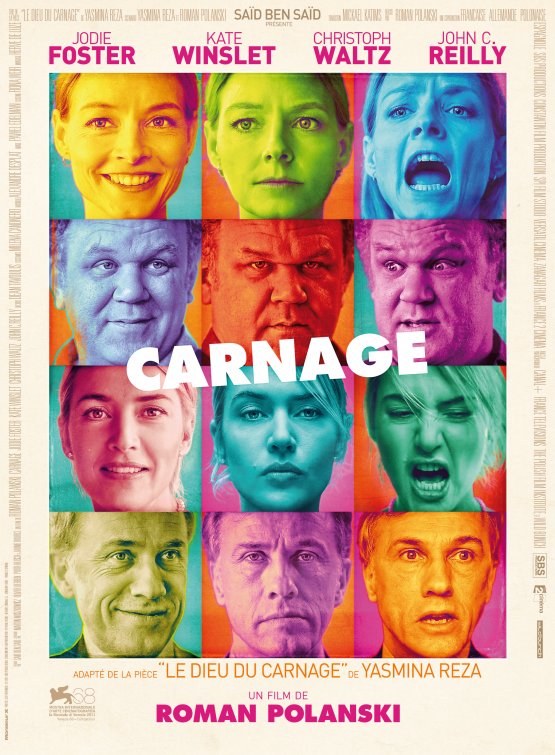
NYFF: "Carnage" 

Though critics screenings have been well under way for some time, tonight is the official opening night of the New York Film Festival. The kick off film is Roman Polanski's Carnage, about which we should undoubtedly say a few words. And then scream them, as we lose our composure.

Moviegoers who have seen Yasmina Reza's hit play "God of Carnage" in any of its many stage productions, had just cause to fear a film version; it's very much a work of the stage. What if they cast the two young boys whose stick-wielding playground tussle prompts all the (psychological) carnage between their parents, who meet to discuss the fight? What if the movie leaves the apartment where the entire play takes place? What if the actors can't handle the tricky satirical tone that has to be rooted in internal drama but stylized enough to extract external laughs?

The first two fears involve the dread "open it up" problem that hover like dark storm clouds over so many stage-to-screen adaptations. If you don't "open it up" you run the risk of your movie feeling weirdly hemmed in and even cheap. If you do "open it up" you run the risk of arbitrary and awkward resizing that feels more like nervous approval-seeking then an attempt to serve the material. With Roman Polanski, an expert at claustrophic storytelling, guiding the tight-quarters squabbling perhaps we shouldn't have worried.

The trouble-making sons of Penelope and Michael Longstreet (Jodie Foster and John C Reilly) and Nancy and Allen Cowan (Kate Winslet and Christoph Waltz) do appear in the film but in a wonderfully smart and ambiguously played framing device. This change from the play stays magically true to the spirit of the source material but is also entirely new and right for the change in medium (which is EXACTLY what adaptations should strive for). So the first thing Roman Polanski does right is that even though we do technically leave the confines of a realistically sized New York apartment (i.e. small) both visually and physically (the apartment building's hallway), we never once feel as though we've escaped the crowded private hell of two married couples. For a smartly succinct 80 minutes (it happens in real time) you are trapped with the parental quartet and their justifiable concern: what to do about a violent encounter between their children. The comedy and drama of the play-turned-movie are the ways in which said real and justifiable but basic-sized problem morphs, twists, pivots, wiggles, shrinks and expands -- it just can't hold its shape -- until it's a series of problems both microcosmically petty (home cooking, name calling, cel phones) and gargantuan unsolvable (Genocide! Corporate Greed! Marriage!).   
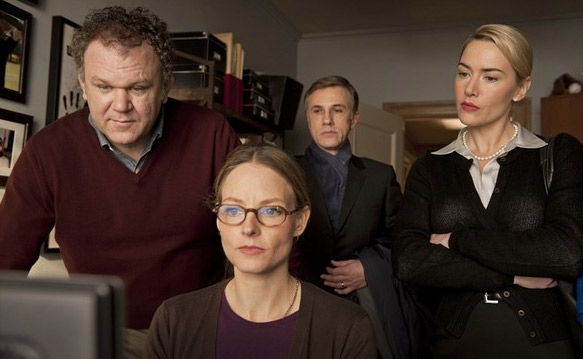
For the most part the actors all do solid work. Christoph Waltz, in the film's best and most nimble performance, ably suggests that Alan is a bit of a sadist and the only one who is actually enjoying all the squabbling and suffering (until he isn't). John C Reilly has the biggest about face, appearing to be the most accomodating character (and the dullest actor) until alcohol and aggravating phone calls from his mother loosen him up. Kate Winslet and Jodie Foster, two of the screen's most formidable actresses are both good. Kate is best with Nancy's comedic outbursts  (her weak stomach and quick inebriation, just as in the play, provides some of the most memorable moments) but one wishes for more character detail in the inbetween when she isn't the focus of the scene. Foster has the most difficult role. Penelope is an extremely uptight and self-righteous Africa-obsessed mother and she's the one character that's simultaneously the worst at keeping it together and the one most concerned with keeping it together. Though Foster has fine moments her comedy is the wobbliest; one ends up pitying Penelope more than laughing with or at her which is a strange place to end up inside of a viciously dark comedy. Still, there's a certain go-for-broke original bravura in Foster's vein-popping despair (hers is the performance least like the original play's), that one has to admire it even while one mentally recasts. 

As Carnage winds down... Stop. Winds down? Yes, though Polanski often comes up with clever angles by which to watch the four characters interact, the film does run into some trouble with momentum which the play didn't have. The hallway scenes offer new and funny ways of thinking about the fact that the couples can't seem to end their evening even while their hatred for each other grows, but they strain credulity as well. If you're that close to leaving... There are strange lulls just as things are reaching fever pitch, and the ending itself is one of those and weirdly sedate.

Despite Polanski's very smart and controlled approach to the material, one almost wishes he'd taken a page from Jodie's book and just gone jugular. He employs so many different techniques to keep you visually stimulated: depth of focus, variety of shot lengths, staging, camera stability (things get a bit shakier in time with the copious alcohol) that one almost wants to scream at him to commit to one of them, embrace it feverishly and "DO IT UP REAL BIG LIKE!!!" Take your cues from Winslet's ugly vomiting, Foster's whiny-screaming or Christoph Waltz's man-pouting and let your hair down a little. Lose your composure. Risk bloodying yourself up but good.

Carnage (2011) is maybe the best film version one could hope for given the absolute stageyness of the source material but it's good enough that it leaves you wanting one that you didn't dare hope for. B/B-*

Previously on NYFF
Miss Bala wins the "must-see crown" from judge Michael.
Tahrir drops Michael right down in the titular Square.
A Dangerous Method excites Kurt... not in that way, perv!
The Loneliest Planet brushes against Nathaniel's skin.
Melancholia shows Michael the end of von Trier's world. 

* Carnage is unique enough that the grade probably doesn't suggest how "see worthy!" it actually is. It's also the kind of property one might conceivably feel differently about on a second pass. For those of you wondering Carnage's best bet Oscar-wise is an Adapted Screenplay nomination. Since no consensus seems to have formed about "best in show" acting traction will be hard to come by for a shared movie.

Friday
Sep302011

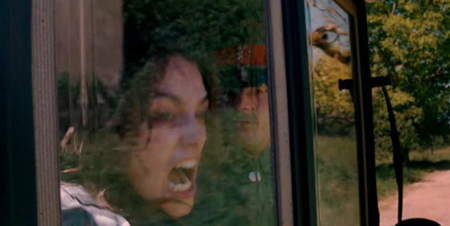
NYFF: "Miss Bala" Blood, Guns, and Tiaras 

Serious Film's Michael C pleased to report he's viewed his first, but hopefully not last, knockout, must-see movie of the New York Film Festival.

According to director Gerardo Naranjo, some critics have accused his drug war thriller Miss Bala of glamorizing the life of cartel gang members. I didn’t get a chance to ask a question at the Q & A, but if I had it might have been, “What planet are these critics on, and how do they get movies way out there?” Miss Bala is the answer for every person wearing a Scarface t-shirt. It glamorizes the business of drugs about as much as Requiem for a Dream glamorizes the use of them. 

Miss Bala is a thriller that manages to generate incredible suspense despite upending genre conventions at every turn. It is the tale of Laura, an aspiring beauty queen, who through incredibly bad luck finds herself sucked into the Hell that is Mexico’s drug wars. Naranjo sticks to the point of view of his naïve, overwhelmed protagonist throughout. It’s a reversal of the Hitchcock method of suspense through letting the audience know as much as possible since at any moment Laura has little idea what the motives of her captors are and what role she is plays in their schemes. Unlike 99% of thrillers the audience isn't trying along with Laura to outwit her tormentors, but rather to scrape enough information together to survive.

Utilizing riveting, hold-your-breath long takes that recall fellow countryman Alfonso Cuaron, Naranjo work behind the camera is a breakthrough to make film lovers sit up and take notice. Bala deserves comparison with 4 Months, 3 Weeks, 2 Days for its depiction of societal ills through straightforward gut punch realism without political sermonizing or a trace of movie-movie bullshit. It’s a harrowing experience, but also a compulsively watchable one. 

Naranjo is aided by Stephanie Sigman, who delivers a performance of beautiful vulnerability and well-modulated desperation as Laura. Often the director does well to simply rest the camera on her face and watch as her expressive doe eyes absorb the seemingly endless string of horrors.

Miss Bala is Mexico’s submission for the foreign language Oscar... which is gutsy on their part since I've seen movies about the Vietnam War that depict a safer, more stable country. Oscar's foreign language branch, like its doc branch, is prone to wild, inexplicable omissions, so I won’t make any predictions, but I will say this: I would be shocked if five better, more powerful films are in contention this year.

Wednesday
Sep282011

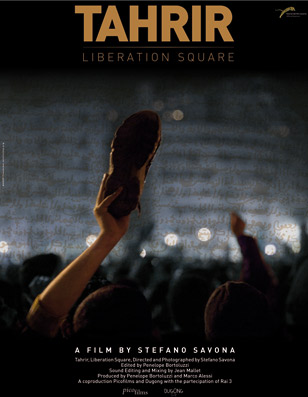
NYFF: "Tahrir" You Are There

Michael C reporting from the New York Film Festival. 

In years to come there will no doubt be countless documentaries made attempting to make sense of the world changing events in the Middle East in the first half of 2011. Yet for all the context and analysis they bring to bear on the complexities of the Arab Spring I doubt any will have the immediacy of Stefano Savona’s Tahrir.

When the people of Egypy took to the streets, filling Tahrir Square, Savona grabbed his camera and marched out with them. When assembling his film he afforded himself no additional perspective. No talking heads. No title cards. No voiceover narration. If the protesters don’t have the information neither does the audience.

Without those crutches to lean on Savona goes in the opposite direction, building a picture of those days through collage - the musical repetition of chanting, the urgent, unsure spread of information, the confrontations with government enforcers. One such battle devolves horrifyingly into endless hours of rock throwing as protesters fashion makeshift helmets out of cardboard, scarves or whatever they can tie to their heads. The Egyptians we meet are a great antidote to the mainstream media’s usual representation of a sea of indistinguishable screaming foreigners. They debate the next course of action, speculate about events outside their control, and worry if it will all be worth it if in the end one tyrant is traded for another. 

Those unfamiliar with the events in Egypt last February will be more than a bit lost, even a news junkie like myself longed for a little added perspective, but with Tahrir that is beside the point. When historians set about to reconstruct what it was like to be in that square at that time, Savona's film will be essential viewing. 

✩

Previously... A Dangerous Method, The Loneliest Planet, Melancholia

Tuesday
Sep272011

NYFF: 'A Dangerous Method' with Keira Unleashed

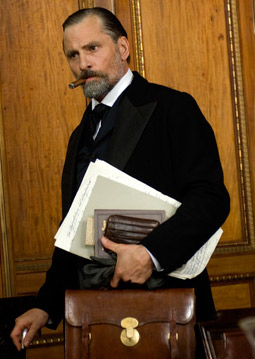
Kurt here. I'll admit I'm not as well-versed in the work of David Cronenberg as a 27-year-old cinephile should be, but I know enough to confidently conclude that A Dangerous Method, while every bit worth seeing, won't go down as a definitive entry in the Canadian maestro's oeuvre. A bubbling marriage of the sexual and the cerebral, the material surely speaks to Cronenberg's penchant for exploring the curious links between mind and body, but the resulting film doesn't haunt, nor does it even consistently provoke, short of whatever reactions are elicited from the recurring spanking of Keira Knightley's bum. A prestige piece through and through, A Dangerous Method is the intersection of a handful of prior collaborators, teaming Cronenberg with muse Viggo Mortensen, Dangerous Liaisons and Atonement screenwriter Christopher Hampton (who here adapts his own 2002 play, The Talking Cure), and Atonement leading lady Keira Knightley. It seems an almost experimental assemblage of talent, with Cronenberg's newfound Oscar-friendliness put into the mix with some very Oscary playmates. It could be grander, it could be harder, it could be better.

But damn, is it watchable, especially in regard to Knightley's performance as Sabina Spielrein, the unhinged, yet shrewd, Russian fetishist who ultimately comes between psych titans Sigmund Freud (Mortensen) and Carl Jung (Michael Fassbender). A violently screaming Sabina is the first thing you see after some ink-on-paper credits, and it's immediately arresting, if only because you've never seen Knightley so...loud. This is easily Knightley's most impassioned and most transformative performance, one that's sure to have Oscar calling in whatever category she lands in (note to voters: it's a leading role). For a long while, I was having a hard time deciding if her turn was too shrill or dead-on, but I'm leaning toward the latter, despite the lingering sense that she's operating on a wild plane independent of the film. Ably tackling a convincing accent, and looking even more gorgeously gaunt than usual, Knightley plays the sexually-scarred Sabina like a slinky Linda Blair, her deep, dark and gyrating confessions to Jung trickling out as if part of a deep-seated, slow-motion seizure that's long been brewing in her groin. It's uncomfortably compelling, and it gains interest as the film proceeds, as Sabina proves to be much more than her demons.

Mortensen also slips deep into his character, in a performance that's also likely to have at least some amount of gold thrown at it. Behind dark contacts and a good bit of facial hair, he steps into uncommon character-actor territory, to which his handsomely-aging face lends itself well (he's also best with the movie's easy, unassuming humor, which finds a mature, yet playful, way to fool with so much clinical sex talk). Faces, I'd say, are Cronenberg's greatest collective asset here, and one he exploits like a pro. I'm avoiding a great deal of plot, because I don't feel that gripping storytelling is the movie's strong suit. But the not-quite-million-dollar mugs of Knightley, Mortensen and Fassbender, all of whom have enough uncannily symmetrical beauty to ensnare you, but enough slightly-offbeat features to keep things interesting, are what hold you from moment-to-moment and stick with you when you leave. Fassbender, bless him, is clean-cut and awkwardly dashing, yet he shares Knightley's cadaverous look, his well-formed bones exceptionally pronounced. And Mortensen gets a lot of mileage out of those wrinkles, swapping out smolder for aloof wisdom.

Of the milieu on display, I found it most interesting to consider a group of characters evaluating their behaviors while Freudian explanations were still being established. Can we imagine a world without them now? Where motivations and actions aren't looked upon with some degree of id assessment? Such thoughts make A Dangerous Method feel important, at the very least in relation to the whole of 2011's output. What burrowed into my head, though, were those faces and that feral performance from Knightley. Getting in the spirit, I kept wondering what she drew from to get into character, what conscious and unconscious Knightley demons brought Sabina to life. Whatever the answer, it worked, as Knightley's method, pardon the pun, is a dangerous one indeed.

Previously on NYFF
The Loneliest Planet brushes against Nathaniel's skin.
Melancholia shows Michael the end of von Trier's world. 

Monday
Sep262011

NYFF: "The Loneliest Planet" With Gael García Bernal

The first of the senses that writer/director Julia Loktev hits us with over the opening black screen is sound. We heara  rhythmic pounding/creaking/breathing that's hard to place (sex scene? construction work?). When the fade-up happens, you'd never guess what image is waiting for you. It's something both utterly mundane and alien and strange. This is only the first of the surprises that await you as you journey across the Georgian wilderness with Nica (Hani Furstenberg) and Alex (Gael García Bernal) in The Loneliest Planet. 

Hani Furstenberg could eat Gael García Bernal right up in "The Loneliest Planet"

Nica and Alex are madly in love both with each other and their mutual wanderlust. They're seeking an authentic travel experience beyond touristy paths before they marry. English is their common tongue (though neither of their native languages) and the film makes the very smart decision of subtitling nothing, as they attempt to communicate with the locales and teach each other a bit of their native tongues. They sign up with a local guide Dato (Bidzina Gujabidze), the only other major character in the film, and they're off.

The Loneliest Planet ostensibly belongs to the arthouse school of contemplative "slow" films but there's actually quite a lot happening, as we observe Nica and Alex making love, absorbing nature alone or together and alternately building bonds with their guide and ignoring him. The space between each character is more geographically interesting than the landscape surrounding them. (Whether there's enough happening to justify its 113 minute running time is a separate question.)

The movies construction is such that you're climbing its mountain of details to the peak at Act One's curtain where "The Incident" takes place. And then you're climbing back down again in Act Two, with so much new to process in stunned silence.  "The Incident" (which is all I'll call it and what the director herself calls it) is a frightening and confusing moment that's also utterly believable and gorgeously acted. It's rendered all the more potent by the lack of constant cutting that mars so many pictures in the editing stage. The Incident is the movie's guaranteed conversation centerpiece which I fear most reviews with their lazy insistence on plot-plot-plot will give away. Loktev's mode throughout is observational and her refusal to offer up any commentary or (non visual) point-of-view on the matter will surely be counted as a detriment for some and a plus for others. Put another way she's masterfully collecting details but whether or not she has something to say about her treasured collection remains an open question to be answered by future films.

All movies engage your eyes and your ears by their very nature, but seize your visual and aural imagination only with skill. Loktev gently forces a third and dominant sense into the equation. Right from the very first startling image Loktev shows an extraordinary gift for the tactile. How many movies can you feel on your skin? Cold water, the brush of fingertips, a stone in one's shoe, hair violently tossing about in the wind and so many more sensations are beautifully captured. Most tellingly in The Loneliest Planet you can absolutely feel the warmth of a lover's touch and the unavoidable sudden chill whenever bodies separate.  B+ 


Previously @ NYFF
Melancholia - Michael gazes upon the end of the world with von Trier