Oscar History
Film Bitch History
Welcome

The Film Experience™ was created by Nathaniel R. All material herein is written by our team. (This site is not for profit but for an expression of love for cinema & adjacent artforms.)

Follow TFE on Substackd

Powered by Squarespace
COMMENTS
What'cha Looking For?
Subscribe

Entries in sci-fi fantasy horror (158)

Thursday
Apr072011

April Showers: The Fifth Element

waterworks each weeknight at 11 as we turn on the cinematic shower.

True Story: The house my family lived in from the time I was nine years old until high school graduation had an unusual bathroom. I didn't think it was so terribly unusual because I lived with it but whenever friends would come to visit for the first time they would always demand to see the bathroom. They'd heard, you see. The storied feature in question was a sunken shower. You had to step down into it, as if it were an in-ground swimming pool and it was larger than your traditional shower or bathtub. But there were no rounded smooth edges, just tiles. So it wasn't, unfortunately, a comfortable bathtub unless you find sharp flat corners restive for reclining against, in which case… are you an invertebrate?

 I suddenly flashed to my parent's old house while watching The Fifth Element recently.  In the scene in question, law enforcement of one sort or another (it's hard to keep track in Luc Besson's frenzy-filled futurism) has entered Bruce Willis's building and good ol' Bruce realizes he needs to hide his strange guest, supreme being Leeloo (Milla Jovovich).

Where else? The shower, that most private of places... except maybe in the movies.

read the rest after the jump. (safe for work.)

Click to read more ...

Tuesday
Apr052011

Box Office: The Source of that Insidious Hopping

Fact #1: I love Easter, bunnies, Easter bunnies, chocolate bunnies, coloring eggs.
Fact #2: Seeing Hop would ruin the upcoming holiday entirely for me because nothing makes me gag harder than animated CGI characters doing hip anachronistic things like oh, I don't know dreaming of playing in a rock n roll band. Just typing this out gave me salmonella. Mainstream moviegoers felt otherwise throwing their hardearned cash at the British wabbit. It had the best opening weekend since Rango. Where were these crowds when The Rock was doing Tooth Fairy?

01. HOP $37.5 new
02. SOURCE CODE $14.8 new
03. INSIDIOUS $13.2 new
04. DIARY OF A WIMPY KID: RODRICK RULES $10.0 (cumulative: $38.1)
05. LIMITLESS $9.3 (cumulative: $55.5)

Poor Patrick. Things never end well for him at the movies.

Hop's success frightens me and the only possible joy that can come from it is that maybe someone will give James Marsden another plum comic gig like the one in Enchanted.  I would however totally want to see this week's chart topper if it were about Jake Gyllenhaal and the Easter Bunny ibeing thrust back in time repeatedly until they saved Patrick Wilson from demonic possessions in The Source of That Insidious Hopping. Don't you wish you could sometimes watch three movies at once?

Per Screen Average Which movies were you most likely to find crowds at? I've eliminated all the specialty IMAX stuff and everything that's only at one theater because "come on" and here's what'cha got.

01. HOP $10,000ish
02. IN A BETTER WORLD $8,000ish (The Danish Oscar winner is finally on a few screens. Weird to wait an entire month post Oscar win to debut.)
03. WIN WIN $7,000ish (cumulative $1.9 million. Big jump in screen count this past weekend. I almost went today but my friend shifted plans.)
04. JANE EYRE $6,700ish  (cumulative $3.4 million. Still going strong. Yay)
05. INSIDIOUS $5,500ish (and this type of movie is always better with a crowd)

What did you see over the weekend? I was entertaining so I didn't get out. Although we did watch the SXSW winner Weekend which was fairly strong as indies go. It definitely knew what it wanted to be and didn't get distracted at being that and that's always a huge plus.

Wednesday
Mar302011

Hit Me With Your Best Shot: "PSYCHO"

In this weekly series "Hit Me With Your Best Shot", we look at a pre-determined movie and select what we think is the best (or at least our favorite) shot. 


 Let's stare this down right away.

The best shot in Alfred Hitchcock's immortal Psycho (1960) comes from arguably the most famous single scene in cinema's 100+ year history. It's that devastating slow clockwise turn (mirroring blood swirling down the drain) paired with a slow zoom out. Marion Crane is dead or thereabouts. Dying in the shower allows her final posthumous tears.

In what is arguably Hitchcock's most brilliant decision in a film filled with them, this moment turns the movie's fabled voyeurism (and explicit understanding of cinema's very nature) back at the audience. We've been staring at Marion Crane, foolish bird-like Marion, for 49 minutes watching her squirm in her "private trap". We couldn't (didn't want to?) save her. Now it's her turn to stare back.

How much death does the cinema need?
[read full post and participating blogs]

Click to read more ...

Thursday
Mar242011

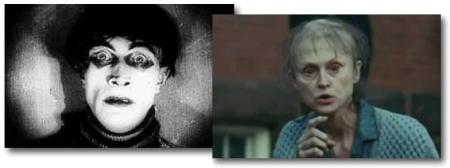
Distant Relatives: The Cabinet of Dr. Caligari and Shutter Island

Robert here, with my series Distant Relatives, where we look at two films, (one classic, one modern) related through a common theme and ask what their similarities and differences can tell us about the evolution of cinema.  This week since both films deal with a twist ending, be warned there are definitely SPOILERS AHEAD


Madness

Audiences don’t much like engaging with a film, its characters, its plot and anticipating its outcome for two hours only to be told that the entire thing was untrue, a dream, the story of a crazy man, an elaborate roleplay. The two films we’re looking at today, though made ninety years apart do that exact thing. Clearly this is a cinematic convention that has stood the test of time.

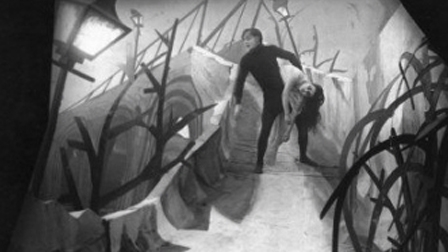
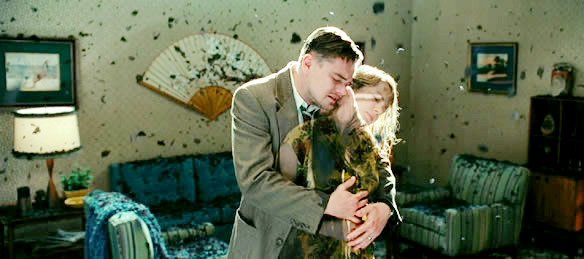
In the Cabinet of Dr. Caligari, a young man named Francis relates the story of a visiting carnival which brings the evil Dr. Caligari and his somnambulist slave to town. After a series of strange murders and the kidnapping of the young man’s betrothed Jane, Francis leads a posse and discovers that, surprise surprise, Dr. Caligari is the mad director of an asylum, and that his catatonic servant are behind it all. Shutter Island follows two U.S. Marshalls, Teddy Daniels (Leonardo DiCaprio) and his new partner Chuck, sent to a hospital for the criminally insane to investigate a disappearance. As their investigation goes deeper and deeper Teddy begins to suspect a deeper plot involving the hospital’s head psychiatrist, the disappeared Rachel Solondo and Andrew Laeddis, the man who killed his wife.

Unreliable narrators

Now for the twist. If you didn’t see it coming, both of our protagonists are in fact patients in their respective mental facilities. Francis has made up his entire story. Jane and the somnambulist are fellow patients. Dr. Calirgari is in fact the good director of the asylum. Teddy meanwhile isn’t Teddy at all. He is Andrew Laeddis. He killed his own wife. The entire investigation is a ruse attempting to jar him back into reality. It doesn’t quite work.

You’d be forgiven for seeing both twist endings coming for miles. Both films feature stories that become increasingly fantastic and highly expressionist production design that seems to be peace with the reality of the film at first, but eventually we wonder. Yet I’m not sure that the purpose of these films is a cheap trick twist. We logically recognize that films are fake, actors and props on a set. Yet we accept it as a reality that plays beyond the limits of the film. We consider pasts and futures for characters, motivations, inner thoughts. There’s something uncomfortable about movies that tell us explicitly that they’re fake.

The mind’s eye

The significant difference between these two movies may be the process by which they do this. Shutter Island makes little effort to cover up the fact that the “surprise” is coming. This in turn turned off a lot of viewers who anticipated the reveal, and took the falsehood of what they were witnessing as a sign that their emotional involvement was for naught. It’s an understandable reaction. Who wants to put their time and emotional effort into something untrue? The Cabinet of Dr. Caligari strings the audience along with more determination. The reveal that the entire plot is the invention of Francis is more likely to be a surprise and more likely to be received with delight (though this isn’t always the case).

Yet, as the film that spends more time winking at the audience with it’s own artificiality, Shutter Island contains more reality than Dr. Caligari. The events (or at least most of the events) in Shutter Island actually happen. It’s simply the perception of Marshall Teddy that is false, leaving us less clear as to what plot points his mind has manufactured and which are objective reality than Francis’s tale which is entirely concocted and untrue. Both of the protagonists in these stories create realities where they are heroes instead of madmen, and thus both lean toward a question asked frequently in such fantasy films (and DiCaprio’s other movie of 2010): Is a pleasant fantasy better than a troubling reality? Is it really wrong if we don’t know the difference?

So too can it be said of the movies. We allow ourselves to experience reality vicariously through characters we know are false but don’t want to believe are false. Teddy and Francis would rather be great than recognize that they are in fact powerless, ordinary, and flawed. When their films admit that they are in fact all those things, are we vicariously forced to admit that we are too?

Tuesday
Mar222011

Akira Redux

You've heard that they're making a live action American version of Katsuhiro Otomo's Akira (1988), right? That's the sci-fi cartoon that really opened the Anime floodgates here in the States. I have a faint memory of seeing the movie in the theater when it arrived in the States -- I think 1990? -- and that memory involves two things: my jaw was mostly open throughout from the epic violent craziness, and my best friend at the time who I went to every movie with (hi Kevan!) turned to me during the climactic battle when Tetsuo transforms hideously into this blob like creature and said something silly like "quivering mounds of blubbery goo" in a dramatic but silly voice. We started giggling and a rather, um, large patron in front of us turned around to give us hateful looks. Embarrassing! But we were just reacting to the visuals on screen, I promise.

For those of you who are unfamiliar, the film is about a gang member biker Kaneda and his efforts to stop his powerful psychic friend Tetsuo from destroying Neo-Tokyo, an artificial city of sorts built after the destruction of the real Tokyo by another psychic boy named Akira who is still alive but imprisoned. (It takes place in 2019.) The new version will be directed by Albert Hughes (The Book of Eli) and the adaptation was done by Steve Kloves (The Fabulous Baker Boys, the Harry Potter franchise).

Though it was to be expected that the American remake would Americanize the story (it'll now take place in a futuristic New York City. Will they call it "New New York"?), some of us were stupid enough to hope that they'd realize that America does not equal caucasian. When your movie is based on a famous Japanese movie, it's not like you couldn't win lots of street cred and fan favor by casting Japanese Americans in the lead roles. Hell, even just Asian Americans of any type would win you non-racist points, as you'd still be acknowledging that people of color should maybe lead properties that are non-white in origin. Oh sure, you can say "there are no bankable Asian American actors" but how will there ever be if they're never given opportunities? And here's a thing Hollywood often forgets in their risk averse decisions: remakes of famous movies as well as virtually all genre titles, are sold primarily on their brand awareness and on their genre. This may be an unpopular theory but even something like Inception. Consider: What sold more opening weekend tickets? The folding city in the trailer or Leonardo DiCaprio's name in the trailer. The latter cost them 8 figures. This is why I've never understood why Batman in his multiple incarnations always requires an expensive leading man; BATMAN IS THE STAR, not the actor. Movie producers used to understand this. Christopher Reeves was not famous when he signed on for Superman and it sure didn't hurt that film's box office. District 9's box office wasn't hurt by using an (excellent) unknown in the lead role. With certain genres (mostly the "geek" genres: superhero, sci-fi, horror) the genre and the concept is the star.

My points is this. New York City is not lacking for diversity. I am white and I am most definitely a minority in my neighborhood. So why do movies set in NYC always seem lily white? And surprise: Actors come in all nationalities and skin colors, not just American/British/Australian and white.

illustration by taka0801

The actors being discussed for the lead roles of Kaneda and Tetsuo, who'll obviously have to be renamed Ken and Todd, are the following: Robert Pattinson, Andrew Garfield, James McAvoy, Garrett Hedlund, Michael Fassbender, Chris Pine, Justin Timberlake and Joaquin Phoenix. That's a lot of different acting styles and accomplishments and types and even ages. So basically, once again, we see that casting has nothing to do with what's required for roles or what tone a film is aiming for, it's just "whoever is on the studio's lips" each time. Sad. Casting is an artform, too. I really wish we'd see some acknowledgement that it is.

If The Film Experience were a massive site with millions of readers I'd demand a casting call right here. I'd be asking for all unknown or 20to30something Asian actors with excellent English skills, physical action film aptitude, and movie star good looks to send in their headshots and reels and I'd be packaging it all up with the top 20 and sending it Warner Bros way. Freelance casting director for hire!

Daniel Henney, Won Bin, Chang Chen, Masahiro Motoki, Takeshi Kaneshiro, Dennis Oh, Matsuyami Kenichi and Hiroshi Tamaki

Seriously, I don't understand why I can spend (literally only) 15 minutes brainstorming and come up with a couple of handfuls of Asian actors that might be cool to think about / test / consider for these roles (even allowing for the studio's random age ranges and no discernable "type") if they spoke English well -- surely some of them do, especially the American ones! ;)  -- but Hollywood studios with all of their casting resources and their budgets and their months of pre-production work don't ever even consider meeting with any of them? Do they even look at headshots? Do they even know that male actors of Asian descent exist? I'm beginning to wonder.

I suppose the most we can hope for at this point is that they deign to let Ken's (née Kaneda) love-interest Kei keep her Asian-ness. Every once in awhile the studios will let an Asian actress play a girlfriend. But Asian men? Forget about it. Shame.

Need More Akira? We'll be celebrating again in April in our "Hit Me With Your Best Shot" series. It's collaborative so join in.

Are you a new reader? Welcome. Please consider subscribing or bookmarking - some more pieces on animated films and Asian cinema coming up. We've been in the mood.

Another article addressing this problem -- though not Akira related:
Asia Pacific Arts "Hot Asian Actors Hollywood Doesn't Yet Realize It Needs"